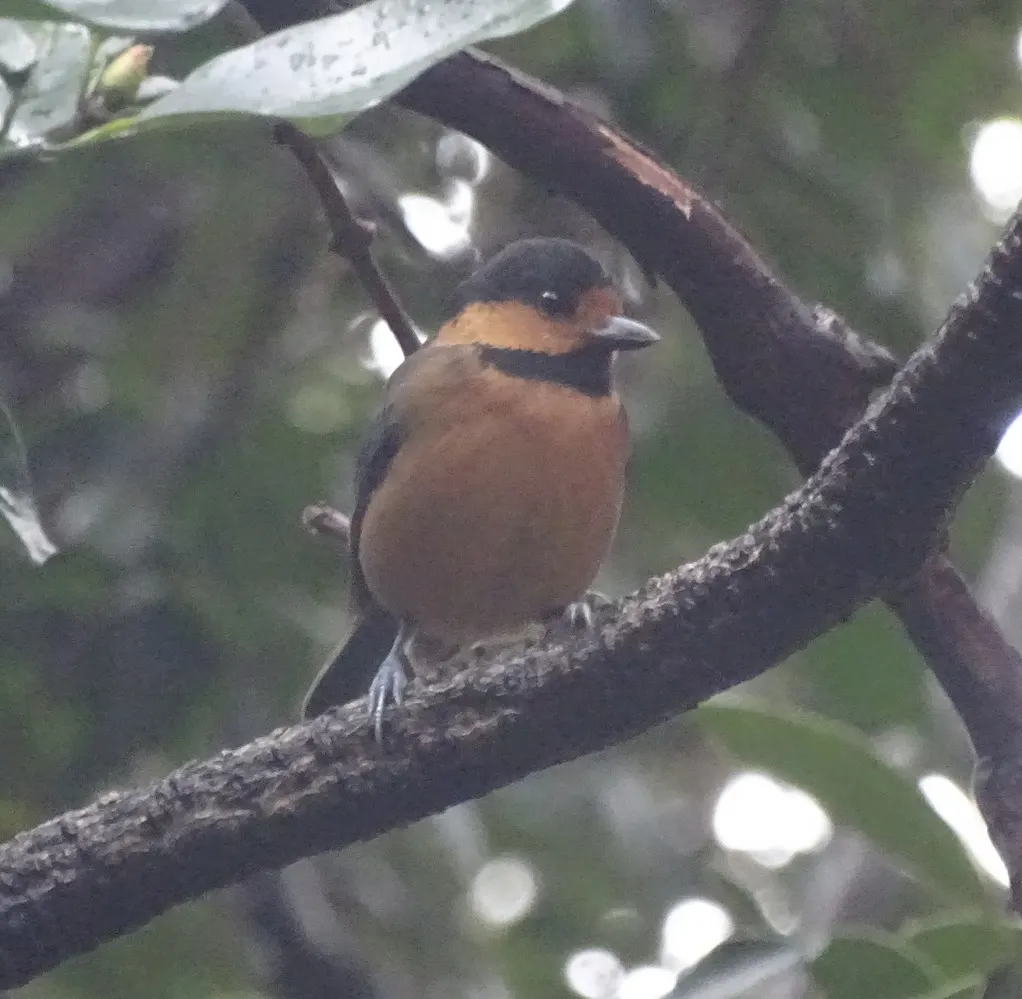
Endangered
Owston's Tit
Sittiparus owstoni
Owston's tit (Sittiparus owstoni), also called the Izu tit, is a small songbird found only on a few forested islands south of Tokyo. The IUCN Red List rated it Endangered in 2017, estimating 2,900 to 3,600 mature birds. A later BirdLife review proposed that the population may be larger and stable.
How to recognise it
It's a member of the tit family (Paridae), larger than the varied tit and without that bird's buff patches on the forehead and sides of the neck. For a long time it was treated as a subspecies of the varied tit, and it was reportedly raised to full species after a 2014 phylogenetic study. That year's genetic work on Izu Islands birds found the large southern birds to be genetically close to mainland-type varied tits, and concluded they colonised the islands more recently than the birds of the central islands.
The bird was described in 1893 by Isao Ijima from two females collected on Miyakejima for Alan Owston, whose name it carries. It is reportedly the first bird described by a Japanese zoologist.
Where it lives
Owston's tit is endemic to the southern Izu Islands, off Japan. It occurs on Miyakejima, Mikurajima and Hachijojima. A small group of tits on neighbouring Shikine, which colonised that island in 2007 and clusters genetically with the Miyakejima birds, is treated as belonging to the species in recent BirdLife work.
The IUCN lists temperate forest and rural gardens as suitable habitat, and describes the bird as resident rather than migratory. Fieldwork in 2002 and 2003 found about 65 square km of suitable forest across the three main islands.
Pins are Wikidata “endemic to” fields. Orange dots, when present, are GBIF occurrence tiles — survey bias included.
How many are left
Counts differ by source and year. Breeding-season surveys in 2002 and 2003 estimated 4,420 to 5,290 birds, split roughly as 1,953 to 2,285 on Miyakejima, 1,077 to 1,453 on Mikurajima and 1,394 to 1,548 on Hachijojima. The 2017 Red List assessment gave a smaller figure of 2,900 to 3,600 mature individuals and a decreasing trend.
A BirdLife consultation document disagrees with that decline. It cites annual counts at sites on Miyakejima between 2014 and 2022 that stayed stable, and satellite data showing under 1% forest loss over ten years. It proposes moving the species to Least Concern, using an estimate of 4,700 to 6,000 mature individuals, with comments invited until 25 January 2026. That is a proposal, not a decision. The Red List still shows Endangered (2017), and the trend on Mikurajima and Hachijojima is unknown.
Why it is in trouble
The species is small in number and lives in just four island populations, so a single event can matter. The 2017 assessment lists volcanic activity as a future threat, along with tourism and recreation areas, roads, agro-industrial plantations, small-scale unintentional harvest, and two named species: domestic cats and large-billed crows. Each is scored as low impact.
Weasels are an introduced animal on Miyakejima. A 2025 survey in PLOS One by Kubo and colleagues found their droppings more abundant there than on Izu-Oshima, where they are native, and estimated about 20 weasels per square km in one area. That study did not look at birds, so any effect on the tit is unknown.
What is being done
The Red List records that sites important to the bird have been identified across its whole range and that it occurs in at least one protected area. Actions listed are control of problem species, site protection and site management. At the time of the 2017 assessment there was no recovery plan and no systematic monitoring scheme, although the Miyake-jima Nature Centre has run annual counts at five sites there since 2014.
Sources
Written for this catalog in our own words from the sources below, checked against them on 12 November 2026. Population figures are estimates and carry the year they were made. Status and assessment year: IUCN. 2026. The IUCN Red List of Threatened Species. Version 2026-1. iucnredlist.org.




