Endangered
Otton frog
Babina subaspera
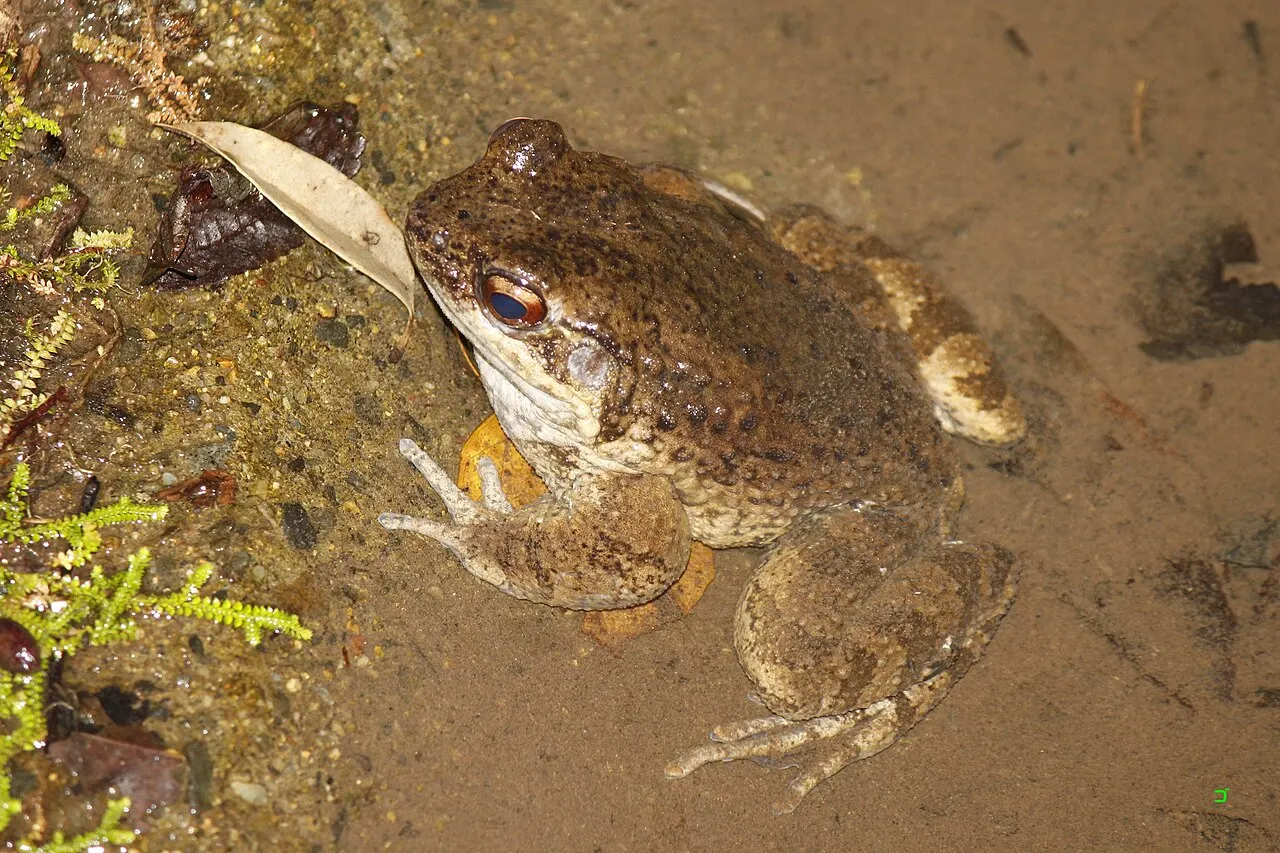
The Otton frog (Babina subaspera) is a big, warty frog found only on two islands in Japan's Amami group, Amami Ōshima and Kakeromajima. The IUCN assessed it as Endangered in 2021. Males carry a hidden bony spine on each thumb, and Japanese law protects the species.
How to recognise it
This is a large frog. Males average about 12.4 centimetres and females about 11.9 centimetres, with a broad head. The skin is covered in wart-like bumps tipped with white granules. The back is yellowish brown with irregular dark blotches.
The inner thumb is a pseudothumb, from which a sharp bony spine can be pushed out. It is thought to help the frog defend itself, and in males it is used in fights and probably to grip the female during mating. Males have longer spines than females, and the frog has been nicknamed the wolverine frog. Only one other species, Holst's frog (Babina holsti), shares the trait.
Where it lives
It is endemic to Amami Ōshima and Kakeromajima in the Ryukyu Islands. The IUCN counts two locations and estimates its extent of occurrence at about 1,248 square kilometres, with a severely fragmented population. A Key Biodiversity Areas listing for the Amami islands says the site holds its entire known population.
It lives mostly in evergreen broadleaf forest, both old growth and secondary, and near freshwater pools and marshes. It sometimes turns up on farmland or in parks.
Pins are Wikidata “endemic to” fields. Orange dots, when present, are GBIF occurrence tiles — survey bias included.
How it lives
Breeding runs from April to October, peaking in July and early August. A female digs a shallow pit at the water's edge, sometimes at an artificial puddle, and lays roughly 800 to 1,300 eggs. Tadpoles grow large, reaching 8 to 9 centimetres in total length.
Adults eat insects, centipedes, freshwater crabs, slugs and earthworms, and occasionally other frogs. They mature at about three years. Japanese sources give an average lifespan of about four years and a maximum of seven.
Why it is in trouble
The 2021 assessment lists roads, an invasive predator and small-scale accidental harvest among the pressures, along with a continuing loss of habitat. Soil washing off cleared forest and new forest roads is also named as a threat, and the introduced mongoose preys on the frogs.
A 2012 study by Iwai and Shoda-Kagaya in Conservation Genetics found that two populations had little gene flow with the others. Its results support the idea that a gap in the frog's range, created by mongoose predation around an urban area, kept populations apart. The IUCN gives the population trend as stable, but notes that the area of habitat is still shrinking.
What is being done
Kagoshima Prefecture named the frog a natural monument in 2005. In 2016 it was listed as a nationally designated endangered species, which restricts capturing it, transferring it and collecting its eggs. Amami City and Setouchi Town also protect it as a rare species. The IUCN lists site management, site protection and control of invasive species among the actions that apply.
Sources
Written for this catalog in our own words from the sources below, checked against them on 12 November 2026. Population figures are estimates and carry the year they were made. Status and assessment year: IUCN. 2026. The IUCN Red List of Threatened Species. Version 2026-1. iucnredlist.org.




