Critically Endangered
Black-naped Pheasant-pigeon
Otidiphaps insularis
The black-naped pheasant-pigeon (Otidiphaps insularis) is a large ground-dwelling pigeon found only on Fergusson Island, off eastern Papua New Guinea. The IUCN Red List assessed it as Critically Endangered in 2021, with a decreasing trend. No scientist had recorded it since 1896 until a camera trap photographed it in 2022.
How to recognise it
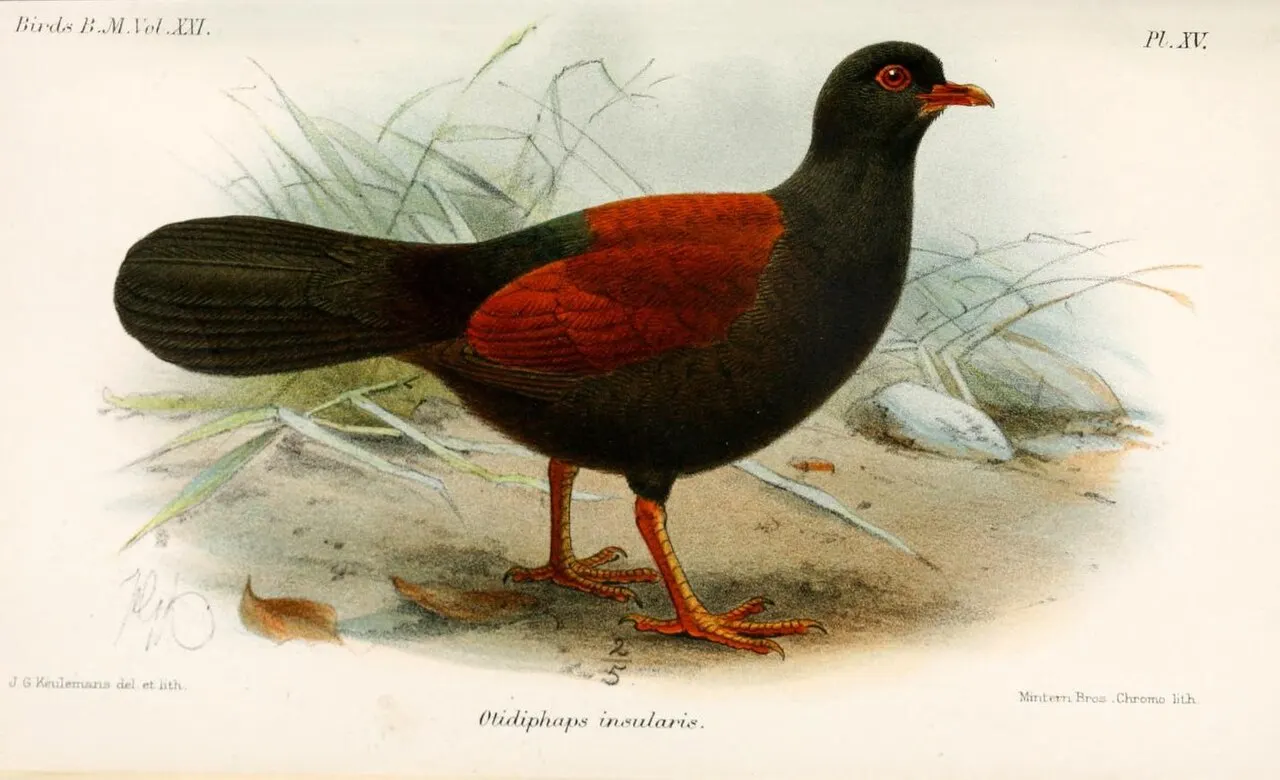
This is a pigeon built more like a small pheasant. It is about 46 cm long and walks the forest floor with a full, flattened-sided black tail that it pumps up and down. The head, underparts, rump and lower back are purplish-black, while the short, rounded wings and the mantle are chestnut.
Its relatives in the pheasant-pigeon group live elsewhere and show a glossy-green, grey-white or white hindneck, and none of them lives on Fergusson Island. The call is loud and carries a long way, a rising and falling hoot that trails off at the end. Pheasant-pigeons feed on seeds and fallen fruit, and the group is secretive and avoids people.
Where it lives
It is known only from Fergusson Island in the D'Entrecasteaux Archipelago. Older treatments counted it as a subspecies of the pheasant pigeon (Otidiphaps nobilis), but the IUCN now treats it as a species in its own right, which is how it is assessed here.
The habitat is steep, dense, mountainous forest. The IUCN assessment lists moist lowland and montane forest, with a modelled elevation range from sea level to about 2,050 m, and an estimated area of occupancy of roughly 1,600 square km. After the 2022 expedition, the team suggested the rugged forest where the bird was photographed, on the western side of Mount Kilkerran, may be its last stronghold on the island.
Pins are Wikidata “endemic to” fields. Orange dots, when present, are GBIF occurrence tiles — survey bias included.
A very long absence
The bird was described in the early 1880s from specimens, and the last one collected on Fergusson Island dates from May 1896. Sources differ on the exact years of the first specimens, with 1882 and 1883 both cited.
A two-week survey in 2019 found no trace, but it gathered hunters' reports that guided the next effort. In September 2022 a Search for Lost Birds expedition, run with BirdLife International, the American Bird Conservancy and Re:wild, spent a month on the island and set 20 camera traps. One, on a ridge at about 1,000 m near the Kwama River, photographed a bird walking across the forest floor two days before the team left. A local hunter, Augustin Gregory, had led them to the area. The local name is Auwo.
Many villagers had never seen or heard of the bird before the project began, and the team's findings suggest it is extremely rare.
Why it is in trouble
The 2021 assessment estimates only 50 to 249 mature individuals and says the population is still declining. The listed threats include hunting of the species itself, small-holder farming and unintended small-scale harvest, all ongoing, plus introduced rats, pigs and cats. Reports on the 2022 expedition add logging of the forest and predation by feral cats.
What is being done
The IUCN records the species as occurring in at least one protected area, but no recovery plan, no monitoring scheme and no captive population were in place in 2021. After the rediscovery, members of the expedition said local communities were keen to work on protecting it.
Sources
Written for this catalog in our own words from the sources below, checked against them on 12 November 2026. Population figures are estimates and carry the year they were made. Status and assessment year: IUCN. 2026. The IUCN Red List of Threatened Species. Version 2026-1. iucnredlist.org.




