Endangered
Giant red tail gourami
Osphronemus laticlavius
The giant red tail gourami is a deep-bodied freshwater fish that reaches about half a metre long. It lives only in two river basins in Sabah, on the Malaysian side of Borneo. The IUCN Red List rated it Endangered in 2019. Adults are known for their bright red fin edges.
How to recognise it
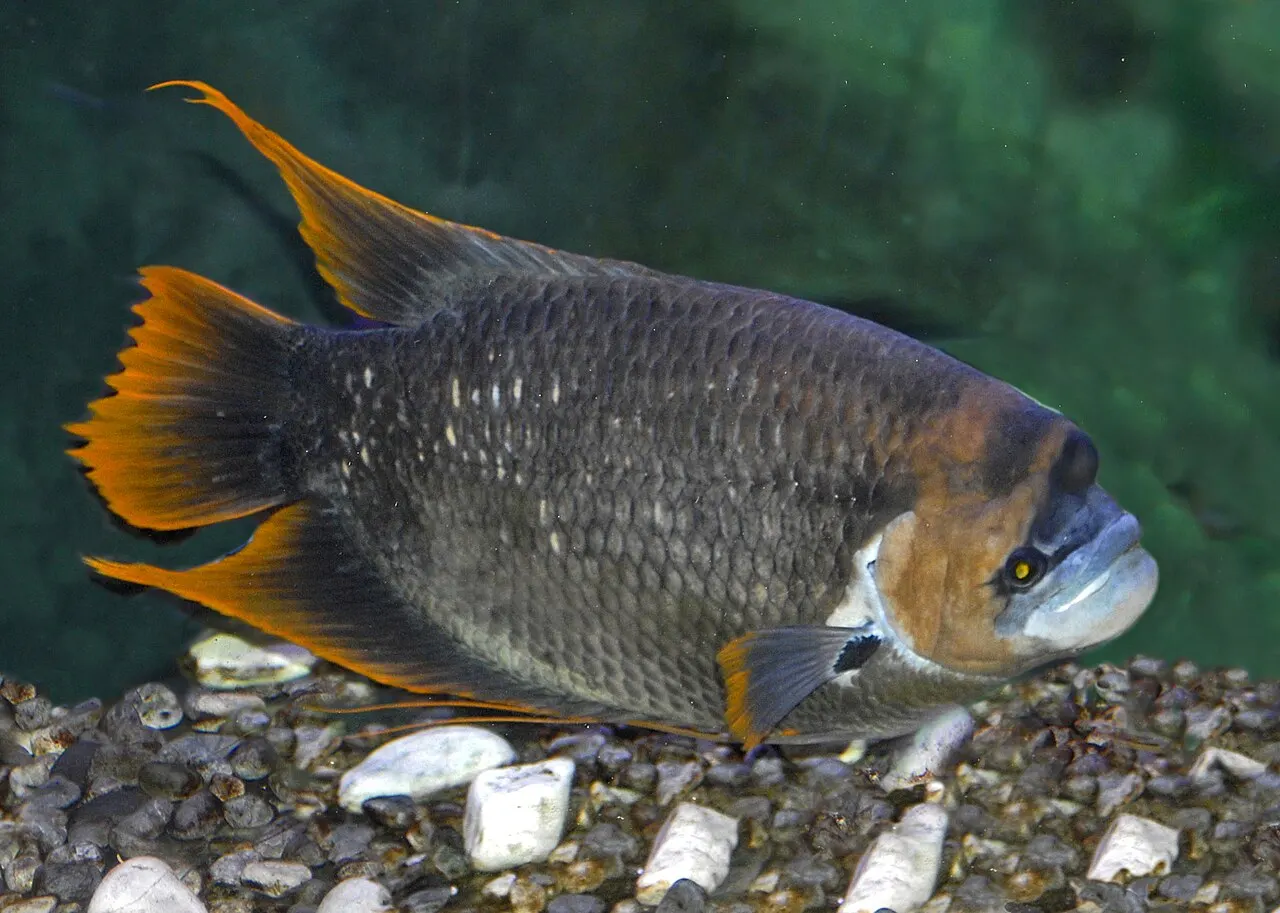
This is a big, heavy gourami with a blunt snout and a strong jaw. The body is deep, flattened from side to side and close to oval. It is grey-blue, grey-green or brown, darker along the back. A black eyespot sits at the base of each pectoral fin, with a larger one on the tail stalk.
Adult fins are edged in bright red and trail thread-like tips. Females are duller than males, and young fish are paler, gaining the red only as they age. In courtship, fish are reported to turn black. Most references give a maximum length of about 50 cm, though one aquarium dealer says 60 cm.
Where it lives
It is native to Borneo and known only from the Kinabatangan and Segama river basins in Sabah. Some older reports from Indonesia are thought to be mistakes, although FishBase still lists Indonesia. A close relative, Osphronemus septemfasciatus, is the gourami of Brunei, Sarawak and Kalimantan.
The Red List counts five locations and an extent of occurrence of about 4,600 square kilometres. Its habitat is permanent rivers and streams. Like other gouramis it gulps air at the surface, and FishBase lists it as an obligate air-breather.
Pins are Wikidata “endemic to” fields. Orange dots, when present, are GBIF occurrence tiles — survey bias included.
How it lives
Almost nothing has been published about its diet or breeding in the wild. In an eight-year study of the Segama River, only a few fish were reportedly caught, and it may already have vanished from the lower Kinabatangan. The Red List records the population trend as unknown, but says the area it occupies is still shrinking.
Why it is in trouble
The Red List names four ongoing threats: farming on an industrial scale, small-scale harvesting for use, soil erosion and silt washing into rivers, and herbicide and pesticide runoff. The scale and severity of each are listed as unknown. Habitat quality is judged to be declining across its small range, which is why it qualifies as Endangered under criterion B1ab(iii).
What is being done
The assessment lists site protection, protection of resources and habitat, and awareness work as the actions needed, and records no conservation measures in place. The species was only described in 1992, from aquarium stock that had been bred in Bangkok since about 1985. Before that it was long mistaken for a colour form of the common giant gourami.
Sources
Written for this catalog in our own words from the sources below, checked against them on 12 November 2026. Population figures are estimates and carry the year they were made. Status and assessment year: IUCN. 2026. The IUCN Red List of Threatened Species. Version 2026-1. iucnredlist.org.




