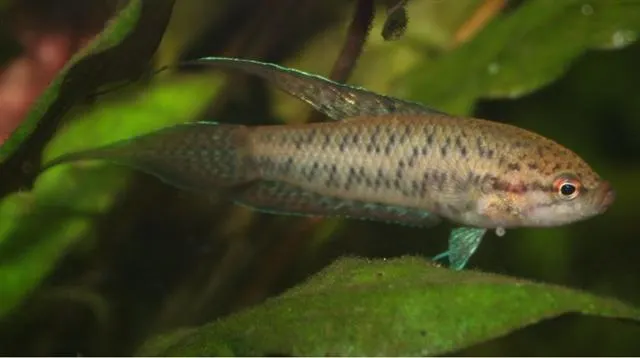
Endangered
Ornate paradisefish
Malpulutta kretseri
The ornate paradisefish (Malpulutta kretseri), also called the spotted gourami, is a tiny, shy stream fish found only in the wet zone of southwestern Sri Lanka. The IUCN Red List classed it as Endangered in 2019, with numbers falling as its forest streams are cleared, dammed and polluted.
How to recognise it
This is a very small gourami. Adults reach about 4 cm in total length according to FishBase, though most are around 2 cm; one aquarium reference gives a maximum of 50 mm standard length. Males are larger and more colourful than females, and they grow trailing extensions on the pelvic fins and on the unpaired fins.
Fin colour varies. Two forms have reddish or violet fins and a third is bluish. The bluish one was named as a race in 1958, but that name isn't valid, so all populations count as one species. It's the only species in its genus, and the fish was described in 1937.
Where it lives
It's endemic to Sri Lanka and confined to the wet zone in the southwest, where rain falls at 2,000 to 3,000 mm a year. Records come from the Gin, Kelani, Kalu, Nilwala and Bentota river basins. The IUCN assessment counts five locations at roughly 86 to 117 m above sea level, with an estimated extent of occurrence of about 5,000 square km and an occupied area of only about 96 square km.
It lives in shallow, slow, shaded forest streams with sand or silt covered in leaf litter, and dense plants along the banks. It stays near the bottom and is rarely found in open, sunlit water. It can also breathe air at the surface.
Pins are Wikidata “endemic to” fields. Orange dots, when present, are GBIF occurrence tiles — survey bias included.
How it lives
It eats small animals such as insect larvae, plankton and fish fry. Breeding is best known from aquarium work. The male builds a bubble nest, usually under a submerged leaf or an overhang, and the pair spawn in small batches. FishBase reports 100 to 200 whitish eggs that hatch in about two days, with the male guarding eggs and young.
Why it is in trouble
The IUCN lists herbicides and pesticides, dams, mining and quarrying, and small-scale harvesting among the threats, all tied to the loss and degradation of stream habitat. Most of the original wet-zone forest has been cleared. One hobbyist profile puts the loss at over 35 percent between 1990 and 2005, with only about 4.6 percent of old forest left by 2006, mostly in small fragments.
The IUCN gives the population trend as decreasing and records a continuing decline in habitat area.
What is being done
The fish is protected by law in Sri Lanka, and the IUCN records it in at least one protected area. The assessment lists habitat protection, awareness, captive breeding and species recovery as needed actions. It has no recovery plan or systematic monitoring scheme, according to the 2019 assessment. It still turns up in the aquarium trade now and then, and hobbyist guidance urges that captive breeding be prioritised.
Sources
Written for this catalog in our own words from the sources below, checked against them on 12 November 2026. Population figures are estimates and carry the year they were made. Status and assessment year: IUCN. 2026. The IUCN Red List of Threatened Species. Version 2026-1. iucnredlist.org.




