Endangered
Roraima bush toad
Roraima bush toad
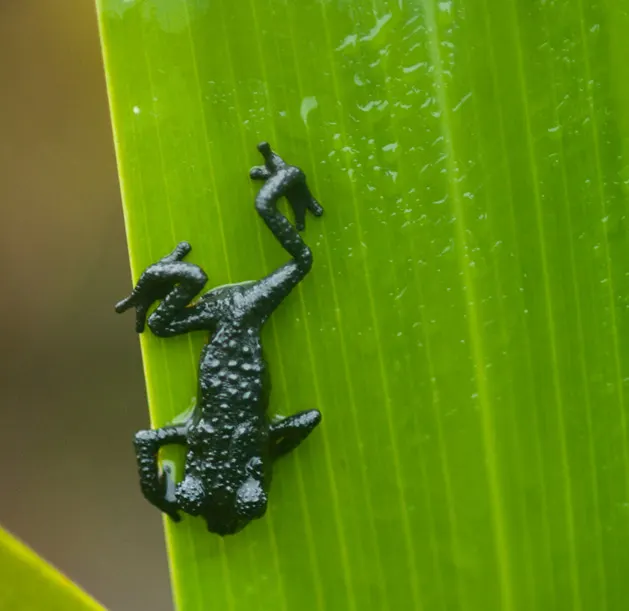
The Roraima bush toad is a tiny black toad that lives only on the rocky summit of Mount Roraima, where Venezuela, Guyana and Brazil meet, and on one neighbouring tepui. The IUCN Red List classed it as Endangered in 2024 because its range is so small, though its numbers are thought stable.
How to recognise it
It's a very small toad. The male specimen on which the species was based measured just 22 mm from snout to vent, and toads of this genus stay under about 26 mm. The body is black, with a throat and belly marbled with bright yellow or orange. The back is covered in tubercles of different sizes, and the webbing between fingers and toes is slight.
The genus also has a feature said to be unique among toads, opposable toe digits, which may help it cope with a rocky habitat. George Albert Boulenger described the species in 1895 from a specimen collected on Mount Roraima by J. J. Quelch and F. McConnell, and it carries Quelch's name.
Where it lives
It is known only from the summit of Mount Roraima, across the borders of Venezuela, Guyana and Brazil, and from nearby Wei-Assipu-tepui on the Brazil and Guyana border. The IUCN counts two locations and gives an elevation range of about 1,700 to 2,800 metres. Its habitat is high-altitude shrubland and bare rock.
Parts of its range lie inside Canaima National Park in Venezuela and Monte Roraima National Park in Brazil.
Pins are Wikidata “endemic to” fields. Orange dots, when present, are GBIF occurrence tiles — survey bias included.
How it lives
Unlike most toads, it is active by day and is usually found out on open rock. Toads of this genus reportedly develop directly, so the young hatch as small toads without a free-swimming tadpole stage.
Adults move little. A 2024 study in BMC Ecology and Evolution used harmonic radar tracking on 100 toads and capture-mark-recapture of 596 toads on Roraima-tepui. It found limited movements, strong seasonal swings in numbers, and an abundance estimate of about 12 million toads.
Why it is in trouble
Its listing rests on how small its range is. The IUCN names increasing fire frequency and intensity, recreational activities and shifting habitat among the threats, and records a continuing decline in the area it occupies. Tourist visits to the summit could disturb it, and random events could affect much of a population confined to one mountaintop.
Its status has changed over time. The Red List rated it Vulnerable in 2004 and 2020, and moved it to Endangered in 2024, with the population trend recorded as stable.
What is being done
The IUCN lists awareness work and policies and regulations as conservation actions needed, and notes that the species occurs in at least one protected area.
Sources
Written for this catalog in our own words from the sources below, checked against them on 12 November 2026. Population figures are estimates and carry the year they were made. Status and assessment year: IUCN. 2026. The IUCN Red List of Threatened Species. Version 2026-1. iucnredlist.org.




