Critically Endangered
Orconectes sheltae
Orconectes sheltae
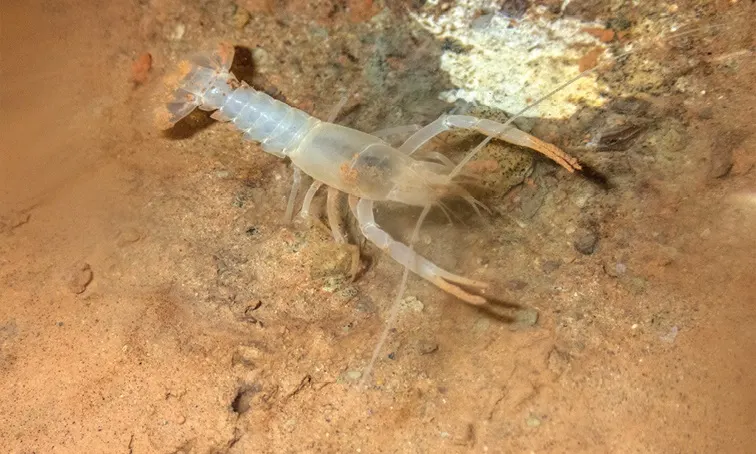
The Shelta Cave crayfish (Orconectes sheltae) is a small pale crayfish known from a single cave in Huntsville, Alabama. The IUCN Red List rated it Critically Endangered in 2010. After 31 years with no sightings, researchers found one in 2019 and another in 2020, proving it still survives.
How to recognise it
It's a small cave crayfish, only a couple of inches long, with small pincers. The 2019 specimen had thin, elongated claws, and the 2020 animal was described as small and white.
Cave biologists knew of it from the early 1960s, and John and Martha Cooper formally described it as a new species in 1997. A 2022 study in Subterranean Biology, using DNA, argued that it fits better in the genus Cambarus, so it may appear as Cambarus sheltae in newer papers.
Where it lives
The species is known only from Shelta Cave, a roughly 2,500 ft (760 m) cave system under northwest Huntsville in Madison County. The cave has an underground lake that reportedly reaches around 7 acres in winter and early spring, with the lake bed exposed at other times. The Red List counts one location and an area of occupancy of 0 to 1 square km, with the whole population in a single subpopulation.
The National Speleological Society owns and manages the cave as a preserve, and its headquarters sit directly above it. The cave is reportedly open only to members at certain times of year. It is also home to two other cave crayfish, Orconectes australis and Cambarus jonesi. The Alabama cave shrimp and the Tennessee cave salamander once lived there too.
Pins are Wikidata “endemic to” fields. Orange dots, when present, are GBIF occurrence tiles — survey bias included.
What happened to the population
About 115 individuals were confirmed between 1963 and 1975, and the species was never common. Only three have been confirmed since: one in 1988 and two in 2019 and 2020.
The cave's aquatic community crashed in the early 1970s. The 2022 study attributes the collapse to likely groundwater contamination and the loss of nutrients from a grey bat maternity colony that left after a poorly designed gate was installed. The cave shrimp and the salamander have not been relocated either.
Matthew Niemiller's team made 20 visual surveys of the cave's aquatic habitats between October 2018 and July 2021. They found 20 cave crayfish, only two of them this species. Niemiller netted an adult female on 31 May 2019 while snorkelling at about 15 ft (4.5 m) depth in North Lake. A student, Nate Sturm, spotted an adult male on 28 August 2020 in the West Lake area. No DNA from the species existed beforehand, so the team identified both by elimination.
Why it is in trouble
The cave sits in a developed neighbourhood, with subdivisions and busy roads overhead. The Red List names housing and urban areas as an ongoing medium-impact threat. It also lists herbicides and pesticides, recreational activities, work and other activities, and future droughts. Researchers add that urban growth may have changed how water seeps in and carried in more pesticides and heavy metals.
The assessment records the population trend as unknown. With so few animals found since the 1970s, the 2022 study describes the species as at high risk of extinction.
What is being done
The cave is already in protected hands, and the Red List records conservation sites as identified over the whole range. The 2022 study offers management and conservation recommendations. Its authors point out that cave life reflects groundwater health, and that the rediscovery suggests other long-unseen cave species may also persist.
Sources
Written for this catalog in our own words from the sources below, checked against them on 12 November 2026. Population figures are estimates and carry the year they were made. Status and assessment year: IUCN. 2026. The IUCN Red List of Threatened Species. Version 2026-1. iucnredlist.org.




