Endangered
Orbicella annularis
Orbicella annularis
Orbicella annularis, the lobed star coral, is a slow-growing reef coral of the western Atlantic, found from the Caribbean to the southern end of Florida's reef tract. Colonies can live for hundreds of years. The IUCN Red List assessed it as Endangered in 2022, after steep declines from bleaching and disease.
How to recognise it
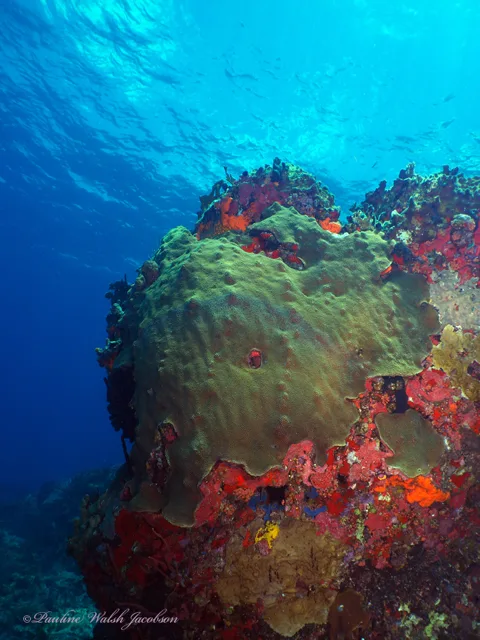
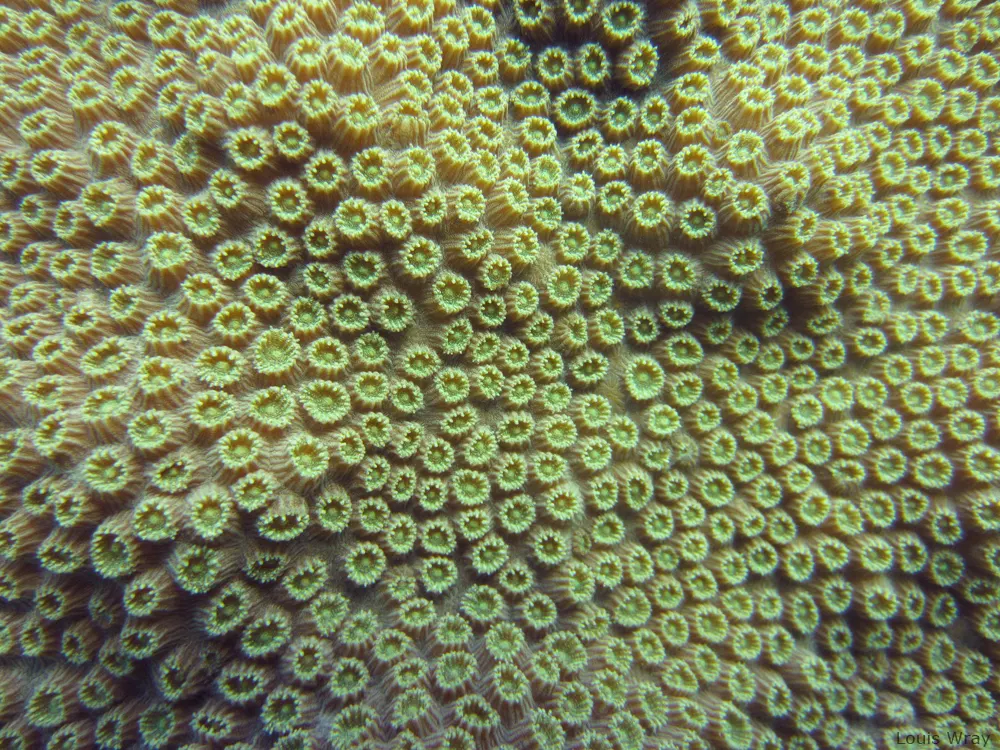
Lobed star coral builds massive, tan to dark brown colonies with lumpy, bulging surfaces. The individual cups, called corallites, are small and tightly packed. Some colonies in this genus have greenish tones around the polyp mouths.
For decades this animal was lumped together with two close relatives as one species, Montastraea annularis, that seemed to take different shapes in different light. Genetic work showed it was really a complex of at least three species: lobed star coral (O. annularis), mountainous star coral (O. faveolata) and boulder star coral (O. franksi). A 2012 revision placed them in the genus Orbicella. Telling them apart in the water takes practice.
Where it lives
It occurs through the Caribbean Sea, the Gulf of Mexico and southern Florida, with Palm Beach County marking the northern edge of its range. The IUCN assessment lists 42 countries and territories, from Bermuda and the Bahamas to Mexico, Panama, Colombia and Venezuela, and island groups such as the Cayman Islands, Puerto Rico and the Lesser Antilles.
It grows on coral reef and on rocky seabed, most often in water between about 0.5 and 20 metres deep. The IUCN records it as shallow as 0.5 metres and as deep as 82 metres. Reports for the wider star coral complex reach 90 metres.
Pins are Wikidata “endemic to” fields. Orange dots, when present, are GBIF occurrence tiles — survey bias included.
How it lives
Each colony is both male and female and reproduces by broadcast spawning, releasing eggs and sperm into open water once a year, several nights after the full moon in late summer. A colony reaches reproductive size at about 10 centimetres across, but growth is slow, roughly 1 centimetre a year, and very few young corals survive to settle and grow.
The three Orbicella species spawn on the same evening, and most reports say they are kept apart by a difference of a few hours. Timing appears to follow light levels, sunset and moonrise.
Why it is in trouble
The IUCN lists the population as decreasing and records a past reduction of about 50 percent. NOAA Fisheries says the species was common on Caribbean reefs but dropped dramatically in the 1990s and 2000s, mainly through bleaching and disease, and that surviving colonies have shifted from large to small. Ocean warming and acidification, land-based pollution, degraded habitat and unsustainable fishing add to the pressure. The IUCN also lists storms, sedimentation, coastal development and tourism among the threats.
Bleaching does lasting damage even to colonies that survive. A 2014 study in Panama in Marine Ecology Progress Series followed 526 tagged corals from three Orbicella species, lobed star coral among them, from 2002 to 2013, with bleaching events in 2005 and 2010. Spawning stayed reduced for several years afterwards, and colonies that never visibly bleached were affected too.
What is being done
In the United States the species is listed as threatened under the Endangered Species Act, in a rule covering 20 reef-building corals that took effect in October 2014. In 2023 NOAA designated critical habitat for five Caribbean corals, including this one, covering about 16,830 square kilometres of overlapping areas. It is also on CITES Appendix II. NOAA's interim recovery outline covers it alongside four other Caribbean corals.
The IUCN notes the species occurs in at least one protected area, and names site protection and management, habitat restoration, captive propagation and a genome resource bank among the relevant actions.
Sources
Written for this catalog in our own words from the sources below, checked against them on 12 November 2026. Population figures are estimates and carry the year they were made. Status and assessment year: IUCN. 2026. The IUCN Red List of Threatened Species. Version 2026-1. iucnredlist.org.