Critically Endangered
Orange-fringed Largemouth
Chetia brevis
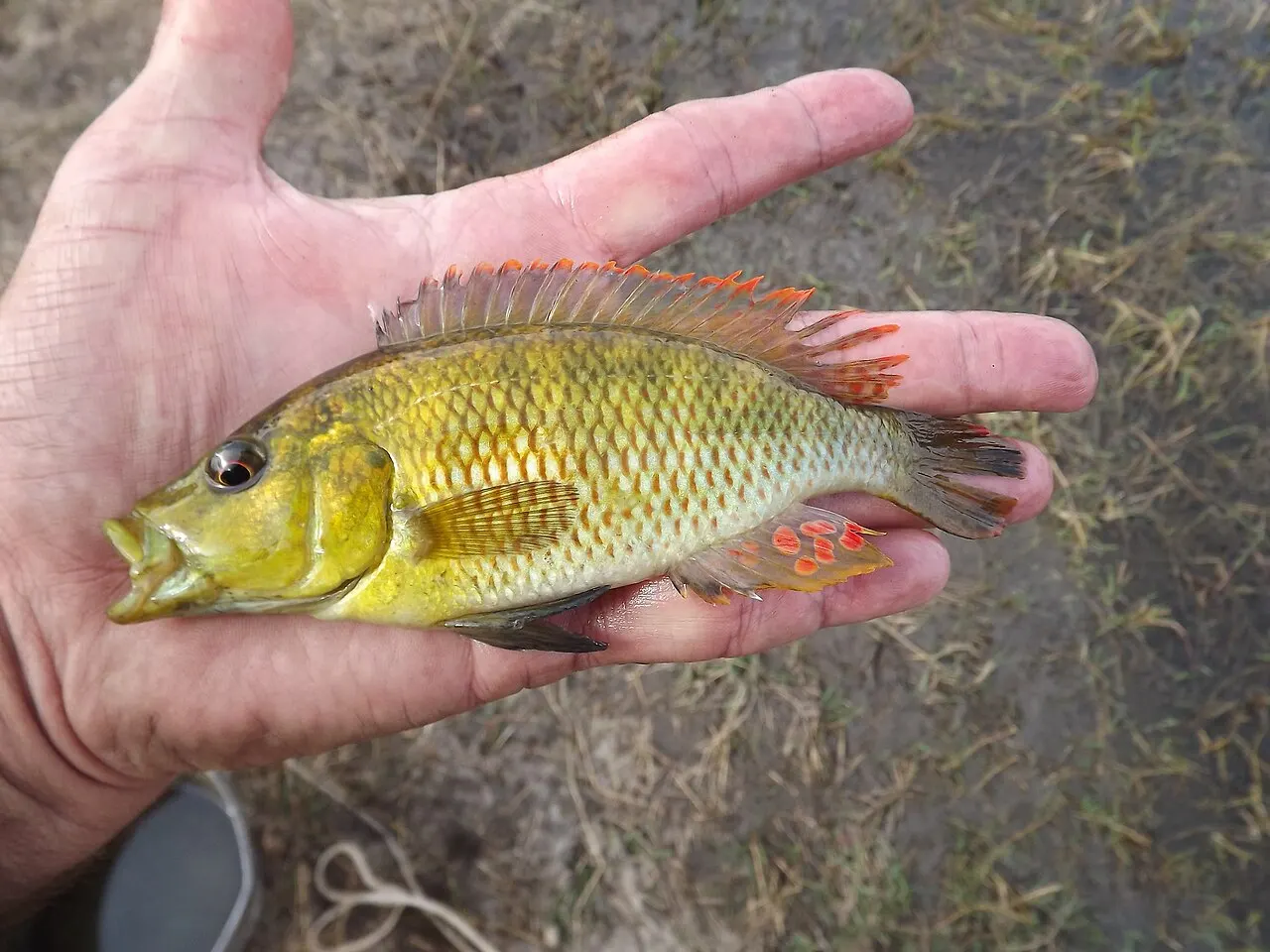
The orange-fringed largemouth (Chetia brevis), also called the orange-fringed river bream, is a small predatory cichlid from the Lomati River, which runs through Eswatini and South Africa. The IUCN Red List rates it Critically Endangered (assessed 2026). Its wild range has shrunk to a few kilometres of river.
How to recognise it
Chetia brevis is a small cichlid. Most large males are around 15 cm in total length, though researchers recorded a new size record of 22 cm for one male. Jubb described the species in 1968.
Breeding males show a yellow head, dark pelvic fins, orange edging on the upper part of the dorsal fin and egg-spots on the anal fin.
Where it lives
It is found in a single tributary of the Komati River system, the Lomati River. The river rises near Barberton in Mpumalanga, crosses into Hhohho Province in Eswatini, then returns to Mpumalanga. Historical records put its range from a little upstream of Ngonini in Eswatini (about 428 m above sea level) down to the Lomati-Komati confluence near Phiva (about 192 m). The Red List counts two locations.
Older references also give Mozambique's coastal lakes as part of the range. Surveys around Bilene found Chetia there, but genetic work suggests they may be a different species, and the 2026 Red List assessment lists only Eswatini and South Africa.
Pins are Wikidata “endemic to” fields. Orange dots, when present, are GBIF occurrence tiles — survey bias included.
How it lives
It hunts aquatic invertebrates and small fish. Breeding takes place in the warm summer months, and fish can breed in their first year. Females carry eggs and young in their mouths for about two weeks, then keep guiding the fry into vegetation for another week. Clutches run from about 20 eggs in first-time spawners to over 60 in older females, and the oldest fish observed were 4 to 5 years old.
Males are aggressive and territorial. In breeding tanks they defend arenas dug 20 to 30 cm across in the substrate.
Why it is in trouble
Introduced largemouth bass are the leading threat. Driekoppies Dam is where bass were first released into the system, and surveys there found only a few large males and no sign of breeding. The Red List also lists water abstraction for farming, dams, sedimentation and mining seepage.
A 2025 briefing note from the South African Institute for Aquatic Biodiversity put the original range at about 97 km of river. Fieldwork in Eswatini found fish in only 2.5 km, starting just above the Matsamo gauging weir, which blocks bass moving upstream. Earlier records show the species once lived 15 to 20 km further upriver, but none were found there. Surveys from 2021 raised the possibility that it was functionally extinct in South Africa.
What is being done
In 1975, fish were moved to three dams in Kruger National Park. Two have since dried up, and rangers have reported fish remaining in Stolznek Dam.
A new programme began in 2021 as a partnership between the South African Institute for Aquatic Biodiversity, the Mpumalanga Tourism and Parks Agency and the University of Mpumalanga, with a 2024 grant from the Mohamed bin Zayed Species Conservation Fund. Captive breeding, the first ever recorded for the species, worked readily, producing over 1,000 young between 2024 and 2025. By September 2025, 22 dams had been stocked in 30 releases using 2,744 fish (911 captive-bred, 1,833 wild-caught), and the upper Lomati in Eswatini had also been restocked. Landowners in the valley act as stewards of the fish. Early checks suggested more than half the stockings had succeeded, with larger natural dams doing best.
Sources
Written for this catalog in our own words from the sources below, checked against them on 12 November 2026. Population figures are estimates and carry the year they were made. Status and assessment year: IUCN. 2026. The IUCN Red List of Threatened Species. Version 2026-1. iucnredlist.org.




