Endangered
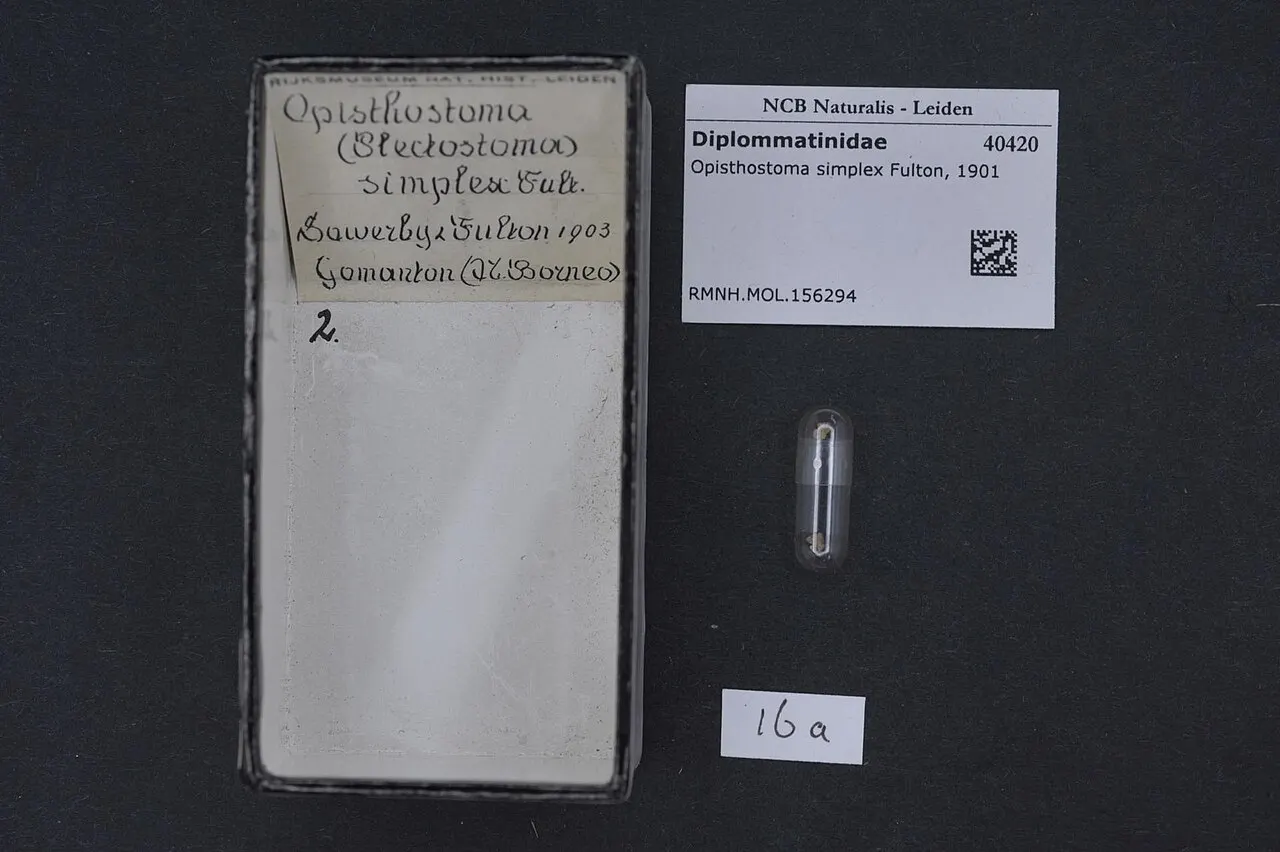
Opisthostoma simplex
Opisthostoma simplex
Plectostoma simplex, listed by the IUCN under its older name Opisthostoma simplex, is a tiny land snail from limestone hills in Sabah, Malaysian Borneo. It was assessed as Endangered in 2004 with a decreasing population, and only two populations are known, one at Gomantong and one north of Batu Laab.
What it is
This is a micro land snail in the family Diplommatinidae, a group whose shells are often oddly coiled. Hugh Fulton described it in 1901 as Opisthostoma simplex. Later work moved it to the genus Plectostoma, which is now the accepted name (GBIF treats the old name as a synonym), though the IUCN assessment still uses Opisthostoma.
The shell is very small. Published measurements give a spire height of roughly 1.5 to 2.2 mm and a total width of about 2.0 to 2.5 mm.
Where it lives
The species is restricted to Sabah. Taxonomic descriptions record just two populations: one at Gomantong and one on a limestone scarp north of Batu Laab. The IUCN habitat entry is subtropical or tropical moist lowland forest, and it classes the animal as terrestrial.
Plectostoma snails as a group live only on limestone hills, which are scarce in Southeast Asia. Because the hills are cut off from one another, many species in the genus occur on a single hill and nowhere else.
Pins are Wikidata “endemic to” fields. Orange dots, when present, are GBIF occurrence tiles — survey bias included.
Why it is in trouble
The IUCN assessed the species in 2004 as Endangered under criteria B1ab(iii)+2ab(iii), which rest on a small range, few locations and declining habitat quality, and recorded the population trend as decreasing. Its threat entries are ongoing fire (trend unknown) and logging or wood harvesting (motivation unknown), with ecosystem degradation as the stress.
The wider danger to limestone snails is well documented. A 2014 revision of Plectostoma, which catalogued 31 species, named quarrying for cement as the main cause of loss. One species, Plectostoma sciaphilum, is extinct after the hill it lived on was turned into concrete. Researchers called for cement companies to be barred from buying whole hills. No source reports quarrying at either known site for this species.
What is being done
The IUCN assessment lists no conservation actions in place for this snail, and the assessment itself dates from 2004. Whether its hills are formally protected is not documented in the sources available.
Sources
Written for this catalog in our own words from the sources below, checked against them on 12 November 2026. Population figures are estimates and carry the year they were made. Status and assessment year: IUCN. 2026. The IUCN Red List of Threatened Species. Version 2026-1. iucnredlist.org.
- IUCN Red List assessment, Opisthostoma simplex (2004)
- GBIF, Opisthostoma simplex Fulton, 1901
- Encyclopedia entry, Opisthostoma simplex
- Opisthostoma myspecies.info, Plectostoma simplex (Fulton, 1901)
- Mongabay, Newly discovered snails at risk of extinction (2014)
- ScienceDaily, Plectostoma revision release (2014)




