Critically Endangered
Opisthostoma decrespignyi
Opisthostoma decrespignyi
Plectostoma decrespignyi, listed by the IUCN under its older name Opisthostoma decrespignyi, is a small operculate land snail from Borneo, first described from Labuan Island. The Red List rated it Critically Endangered in 2004, flags it as possibly extinct, and names quarrying as the threat.
How to recognise it
No description of this species' own shell (size, colour, sculpture) turned up in the sources available, so what follows is true of the genus Plectostoma as a whole. In these snails the final part of the shell, called the tuba, leaves the main coil at an angle to its axis, which gives the shell a distorted look. A 2014 revision found that this made standard views of the shell hard to define.
Like other members of the family Diplommatinidae, it has an operculum, a small plate that closes the shell opening when the snail withdraws.
A name with a history
Henry Adams described the species in 1865, in a paper announcing a new genus of land shells from Labuan, an island off Borneo. Until 1880 it was the only Plectostoma species known. About 20 Plectostoma species had been described from Borneo by the early 1900s.
Adams also listed it in Opisthostoma, a genus the Blanfords had created in 1860 for a snail from India. Blanford suggested in 1867 that the two groups were subgenera, and Plectostoma was treated that way for a long time. A 2014 revision raised it to full genus level. MolluscaBase and GBIF now accept Plectostoma decrespignyi, while the IUCN assessment still carries the Opisthostoma name.
Where it lives
The IUCN assessment lists the snail from Sabah, in Malaysian Borneo, as endemic to Malaysia, with its presence marked as possibly extinct. The habitat it gives is subtropical or tropical moist lowland forest.
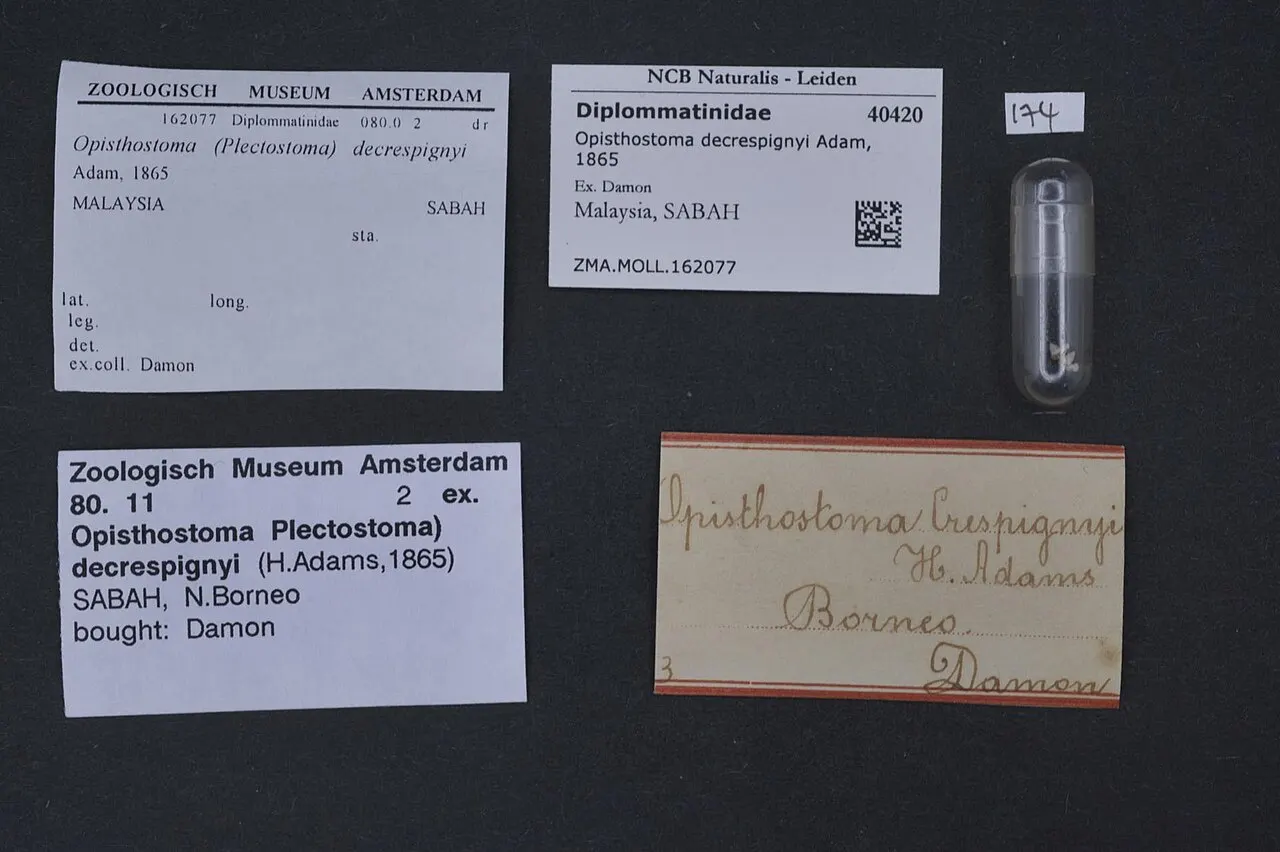
Museum specimens filed in GBIF under the old name carry labels from Labuan, from caves on an estate at Lahad Datu in Sabah (collected 1963 and 1964), and from other places in northern Borneo. Those identifications are unchecked, and the Lahad Datu cave records sit awkwardly with the forest habitat the IUCN gives. The 2014 revision treats the genus as one of limestone hills.
Pins are Wikidata “endemic to” fields. Orange dots, when present, are GBIF occurrence tiles — survey bias included.
Why it is in trouble
The assessment lists mining and quarrying as the threat, with ecosystem conversion and degradation as the effects. It describes the quarrying as past and unlikely to return.
A 2017 survey of Labuan's land snails in ZooKeys, by Phung, Yu and Liew, names Plectostoma decrespignyi as a land snail at risk of extinction. It reports that many species recorded on Labuan in the 1800s came from limestone outcrops in the south-east of the island, which were quarried away for Labuan Airport in the 1960s. That is a statement about Labuan's older snail fauna in general, not specifically about this species.
What is being done
The 2004 assessment records no conservation actions in place and gives the population trend as unknown. No survey aimed at this snail turned up in the sources consulted, so whether any survive remains an open question.
Sources
Written for this catalog in our own words from the sources below, checked against them on 12 November 2026. Population figures are estimates and carry the year they were made. Status and assessment year: IUCN. 2026. The IUCN Red List of Threatened Species. Version 2026-1. iucnredlist.org.
- IUCN Red List assessment, Opisthostoma decrespignyi (2004)
- MolluscaBase, Plectostoma decrespignyi
- GBIF species record, Opisthostoma decrespignyi
- GBIF occurrence search, Opisthostoma decrespignyi
- Liew, Vermeulen, Marzuki and Schilthuizen 2014, ZooKeys 393: Plectostoma revision (full text via Europe PMC)
- Phung, Yu and Liew 2017, ZooKeys 673: land snails of the west coast islands of Sabah
- Opisthostoma decrespignyi (encyclopedia entry)




