Critically Endangered
Himalayan quail
Ophrysia superciliosa
The Himalayan quail is a small, dark, long-tailed quail known only from two hill areas in Uttarakhand, India. It has not been reliably recorded since 1876 and is feared extinct. The IUCN Red List still rates it Critically Endangered, in its 2018 assessment, on the chance that a few birds survive.
How to recognise it
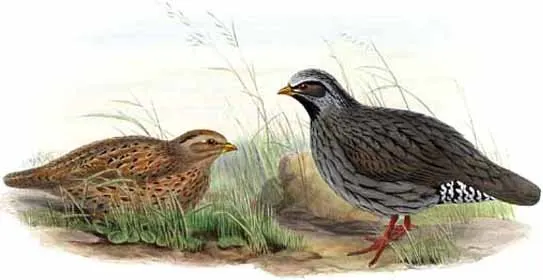
This was a medium-sized quail of the pheasant family, dark and soft-feathered, with a red bill and red legs. Males were streaked dark grey with a white forehead and a white eyebrow stripe. Females were brownish with dark streaks and a greyish brow. Both sexes had white spots before and behind the eye.
The tail is longer than in most quails, almost as long as the wing, and the feathers of the forehead are stiff and bristly.
Where it lived
All records come from the western Himalayas of Uttarakhand, between about 1,650 and 2,400 m. The two known areas are around Mussoorie and around Nainital. J. E. Gray described the species in 1846 from live birds in a private collection in England, and the two type specimens, collected at Mussoorie, are in the World Museum, Liverpool.
It favoured patches of tall grass and brushwood on steep hillsides, especially along the crests of slopes facing south or east.
Pins are Wikidata “endemic to” fields. Orange dots, when present, are GBIF occurrence tiles — survey bias included.
How it lived
The few observers who saw it found coveys of about five to ten, hiding in high grass and scrub. It flew only when flushed at close range, relied on its legs more than its wings, and gave a shrill whistle when disturbed. It ate grass seeds and was seen mostly at dawn and dusk.
Breeding probably took place around September. Records suggest it was absent in the wet season, from late June to mid-September, but where it went is unknown. Frank Finn suggested it might be a winter migrant, though he doubted this because of its short wings.
The record and the search
About twelve specimens exist in total. In November 1865 Kenneth Mackinnon shot a pair behind Mussoorie, and the last verified record is a bird collected by Major G. Carwithen near Nainital in December 1876, at about 2,100 m. By 1904 it was already considered a rarity.
Searches began with Salim Ali in 1977 and continued from 1987 to 1990 and from 1998 to 1999. The Uttarakhand Forest Department began its own effort in 2013. A 2020 preprint titled 'Gone in 40 years' reported a 65-day survey between September and December 2018, covering about 9.6 km2 around Nainital and Dehradun, with no sign of the bird.
That study found that much of the old range had been converted to farming or tourism use. Forest cover in the Mussoorie municipal area fell from about 50 km2 in 1960 to about 33 km2 in 1985. Grazing, grass-cutting, free-roaming dogs and tourist disturbance affect what habitat remains. It concluded that declaring the bird extinct may be justified, but argued that the chance of survival is useful for protecting its habitat.
What could still be done
The 2020 preprint recommends drones with thermal cameras, genetic work comparing museum specimens with field samples such as feathers, stricter grazing rules, sterilising free-roaming dogs and patrols in tourist areas. It also suggests that any rediscovery might be kept quiet until a stable population is protected.
Sources
Written for this catalog in our own words from the sources below, checked against them on 12 November 2026. Population figures are estimates and carry the year they were made. Status and assessment year: IUCN. 2026. The IUCN Red List of Threatened Species. Version 2026-1. iucnredlist.org.




