Endangered
Oligodon calamarius
Oligodon calamarius
Oligodon calamarius, known as Templeton's kukri snake or the reed-like kukri, is a nonvenomous, egg-laying snake found only in Sri Lanka. It lives in wet lowland forest and is rated Endangered on the IUCN Red List (2021 assessment), with a decreasing population and a fragmented range.
How to recognise it
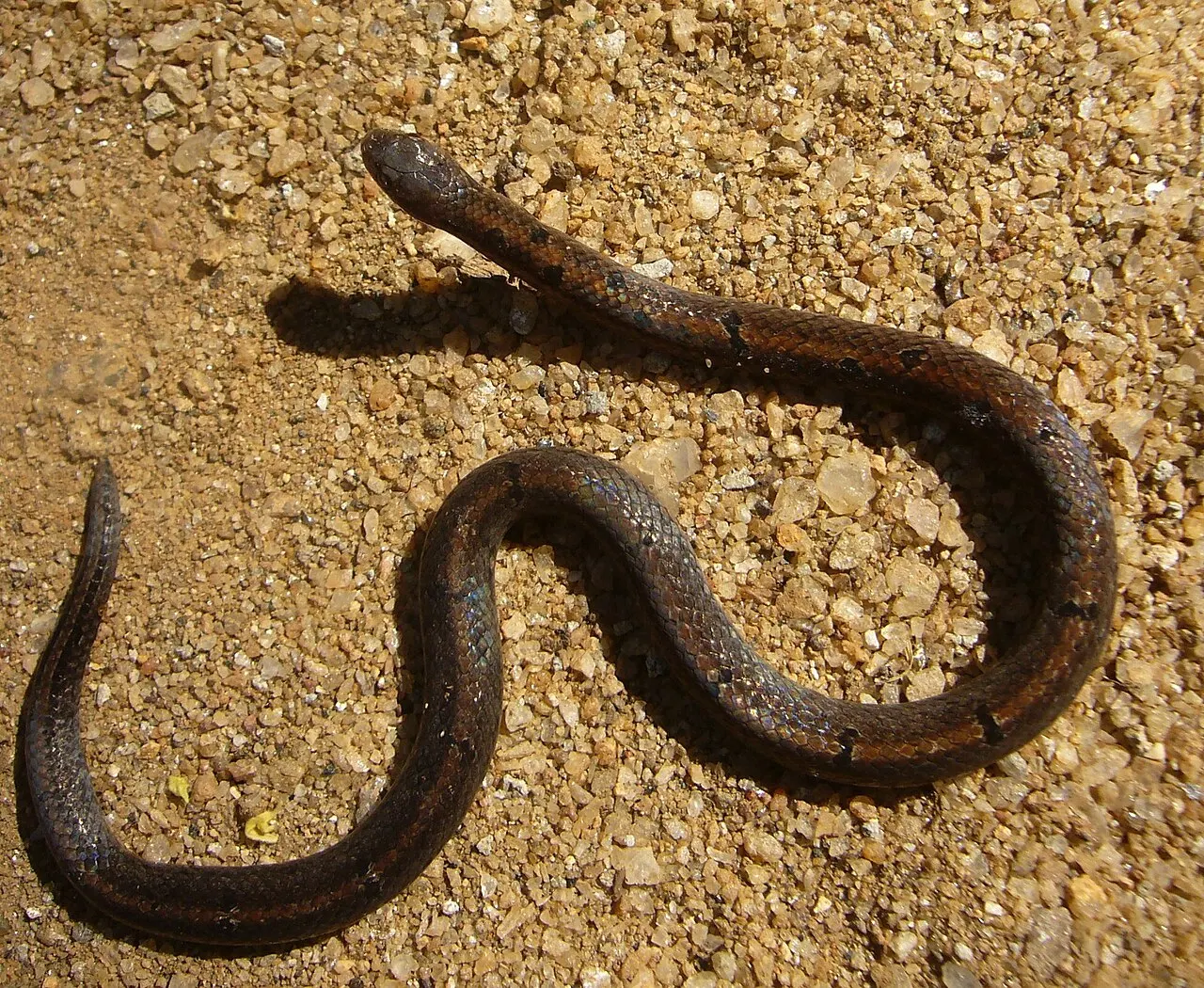
The back is light brown with a pale stripe down the middle. Across it run 18 to 24 narrow dark brown bands, each edged in a lighter shade, and these may cross the back completely or only in part.
The head is short and barely wider than the neck, and the pupil is round. A dark crescent crosses the forehead, with an elongated spot just behind it. The belly is cream with square black markings, giving a checkered look.
It is a nonvenomous, ground-dwelling snake.
Where it lives
The species is endemic to Sri Lanka. Records come mostly from the wet zone of the south-west and centre, including Udugama, Hewessa, Mathugama, Ratnapura, Balangoda and Peradeniya, plus Atweltota forest and the Sinharaja rainforest. Older listings that include India are regarded as errors.
The IUCN assessment gives moist lowland forest as its habitat and an estimated extent of occurrence of about 4,600 square km. One source reports it reaching about 1,800 m in elevation, but there is no firm upper limit.
Pins are Wikidata “endemic to” fields. Orange dots, when present, are GBIF occurrence tiles — survey bias included.
How it lives
Very little has been written about its daily life. It lays eggs, but no published study documents what this species eats in the wild, how active it is by day or night, or how it reacts to threats.
Other snakes prey on it. Researchers recorded an Indian rat snake (Ptyas mucosa) eating one at Atweltota forest in 2009, and a Sri Lankan wolf snake (Lycodon carinatus) eating one in Sinharaja in 2016.
Why it is in trouble
The 2021 Red List assessment places it in the Endangered category under criterion B1ab(iii), which means a restricted range, a severely fragmented population and continuing loss of habitat quality. The population trend is listed as decreasing.
The threats named are agro-industry farming and housing and urban expansion, both ongoing, though the assessment records their scale and severity as unknown. Forest conversion and degradation are the stresses involved. Because the snake is secretive and little studied, there is no population count.
What is being done
The snake occurs in at least one protected area. The Red List recommends habitat and resource protection and lists research needs: population size and distribution, life history and ecology, and threats. Sri Lanka's national fauna listing also rates it Endangered and shows it as legally protected.
Sources
Written for this catalog in our own words from the sources below, checked against them on 12 November 2026. Population figures are estimates and carry the year they were made. Status and assessment year: IUCN. 2026. The IUCN Red List of Threatened Species. Version 2026-1. iucnredlist.org.




