Critically Endangered
Ogasawarana yoshiwarana
Ogasawarana yoshiwarana
Ogasawarana yoshiwarana is a tiny land snail from Hahajima, one of the Ogasawara (Bonin) Islands of Japan. The IUCN Red List has rated it Critically Endangered since 1996. After its 1902 description it went unrecorded for a long time, then living snails were found again in the early 2000s.
How to recognise it
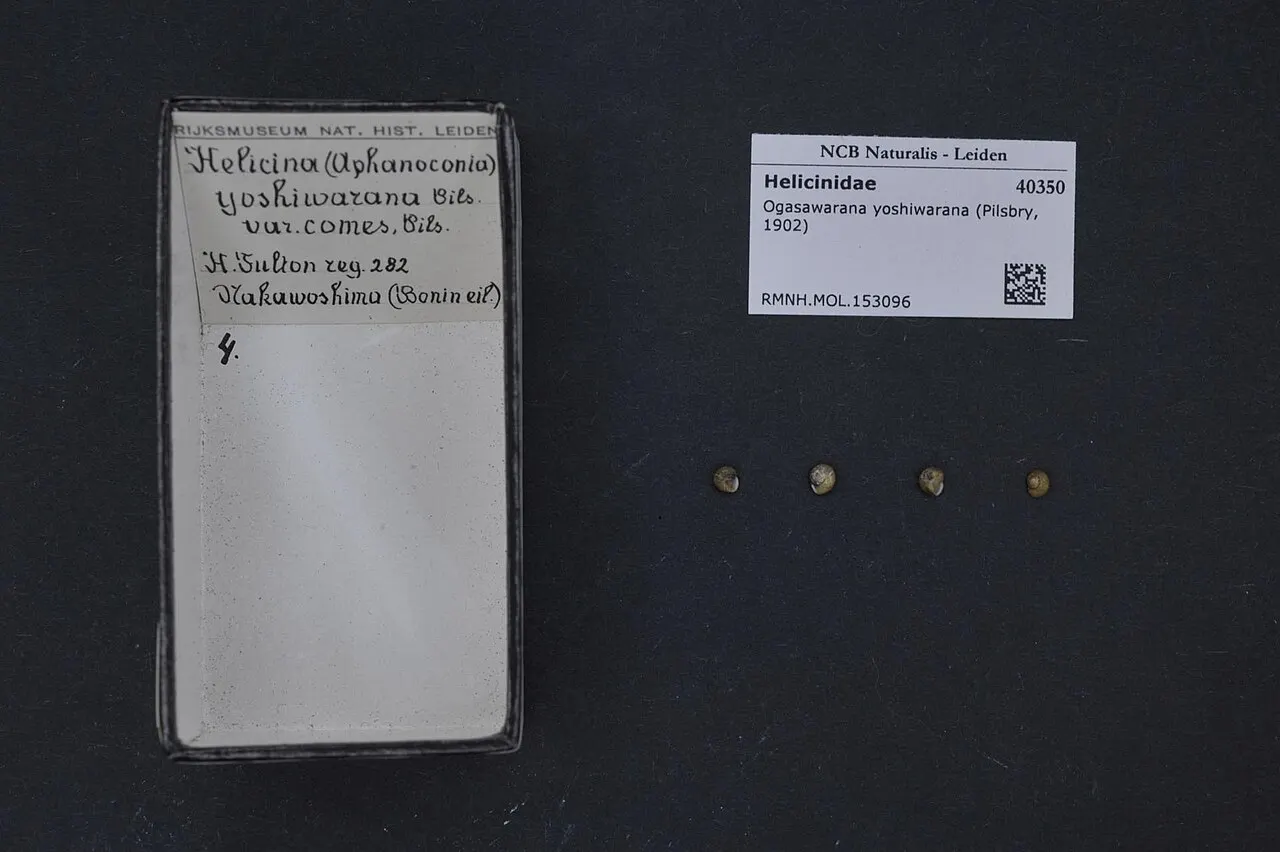
This is a helicinid, a land snail that closes its shell opening with a small lid called an operculum. The shell is a low, compact cone. In the original 1902 description by Henry Augustus Pilsbry, the shell was about 3.5 mm tall and 5.3 to 5.8 mm across, small enough to sit on a fingernail.
The surface is finely grooved in a spiral pattern, and the outer edge of the whorl is angular or rounded but compressed. Pilsbry also named two varieties. One had a strongly grooved upper surface. The other was smaller, about 2.2 mm tall and 4.5 mm wide, with delicate grooves.
Where it lives
The species is known only from Hahajima in the Ogasawara Islands, where it lives in the forested parts of a small island. It was recorded alive as recently as 2006 on the Higashizaki peninsula, a headland off the island's eastern coast, according to a 2007 paper in Pacific Science by Chiba, Davison and Mori.
Sources disagree on when snails were rediscovered: one catalogue of that paper's records gives November 2003 or October 2005, and gives the last earlier record as 1902 or before.
Pins are Wikidata “endemic to” fields. Orange dots, when present, are GBIF occurrence tiles — survey bias included.
Why it is in trouble
Nobody has counted this snail. The Red List entry (criteria A2ce, assessed in 1996 under an older version of the system) gives no population size, and the reason for its sparse numbers is not known. The encyclopedia entry reports that habitat loss is not a factor at Higashizaki, an area largely untouched by people and introduced species, though that statement has no citation.
Elsewhere on the islands, introduced predators are a suspect in snail declines. A 2007 study in Applied Entomology and Zoology found that Mandarina ponderosa, a larger ground-dwelling snail on Hahajima, was declining rapidly. The researchers suggested spreading predatory flatworms as a possible explanation, and framed it as a possibility rather than a proven cause. That study did not look at Ogasawarana yoshiwarana itself.
What is known about its life
Very little. No study of its diet, breeding or lifespan has been located, and published records of the species are mostly about where and when specimens were found.
Sources
Written for this catalog in our own words from the sources below, checked against them on 12 November 2026. Population figures are estimates and carry the year they were made. Status and assessment year: IUCN. 2026. The IUCN Red List of Threatened Species. Version 2026-1. iucnredlist.org.




