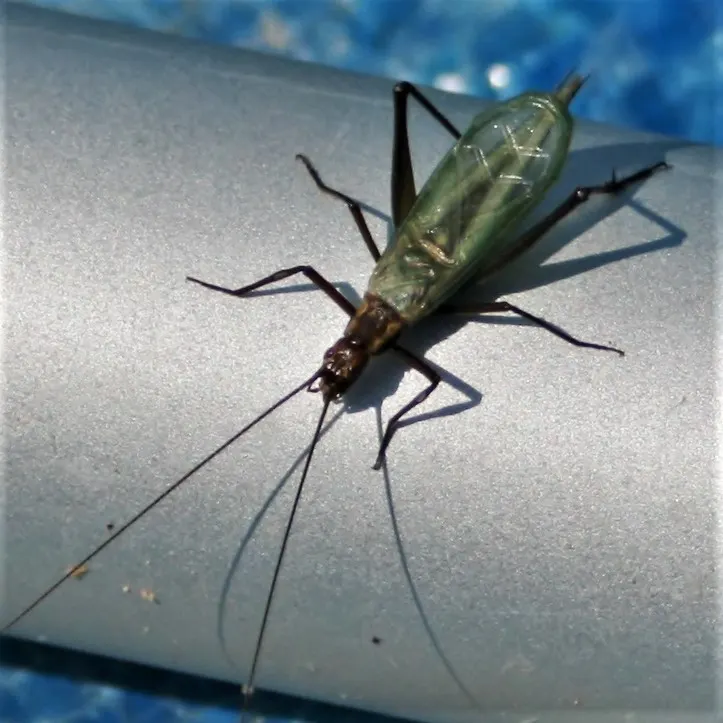
Endangered
Oecanthus laricis
Oecanthus laricis
The tamarack tree cricket (Oecanthus laricis) is a slender green-winged cricket that lives in tamarack swamps and fens around the Great Lakes, with records in the United States and reportedly Ontario. The IUCN Red List lists it as Endangered, but that assessment dates from 1996 and has not been updated.
How to recognise it
This is a small, narrow, slightly flattened cricket, 13 to 15 mm long, with a brown head, pronotum and legs and green forewings shorter than 12 mm. The green fades in pinned specimens. The pine tree cricket, which lives on pine and balsam fir, has forewings longer than 12 mm.
Its song is a trill at about 37 pulses per second at 25 degrees Celsius, with occasional interruptions. Males are mostly heard in the evening and at night.
Where it lives
It is tied to tamarack (American larch). In Michigan it lives in dense to open tamarack swamps and fens, on medium-height trees of roughly 6 to 13 m, in prairie fen and rich tamarack swamp. It has been found in both large intact wetlands and smaller disturbed ones. Michigan's natural features inventory holds 57 records from 20 counties, mostly in the southern Lower Peninsula, and cautions that much of the state has not been surveyed. Northeastern Ohio is also named, where the cricket has been associated with hemlock.
Pins are Wikidata “endemic to” fields. Orange dots, when present, are GBIF occurrence tiles — survey bias included.
How it lives
It stays high in the upper branches of tamarack, where it blends into the foliage. Adults are active from early August to mid-September, and there is one generation a year. Surveyors sweep-net tamarack foliage as high as they can reach, in the morning and evening, or listen for singing males at night.
Why it is in trouble
The 1996 IUCN assessment gives Endangered under criteria B1+2b, which refers to a small range, and lists the United States as the only country. It carries no population trend or threat details. Michigan classes it as Special Concern, meaning rare or uncertain but without legal protection, and it has no U.S. federal listing.
Michigan's management advice suggests the likely pressures: draining, filling and other changes to water flow in fens and tamarack swamps, cutting of tamarack, and shade from trees like red maple.
What is being done
Michigan recommends keeping and restoring prairie fen and tamarack swamp, avoiding drainage and tamarack cutting, removing shading maples where needed, and using prescribed fire conservatively. No species-specific recovery programme appears in the sources.
Sources
Written for this catalog in our own words from the sources below, checked against them on 12 November 2026. Population figures are estimates and carry the year they were made. Status and assessment year: IUCN. 2026. The IUCN Red List of Threatened Species. Version 2026-1. iucnredlist.org.




