Endangered
Fouta Djallon torrent frog
Fouta Djallon torrent frog
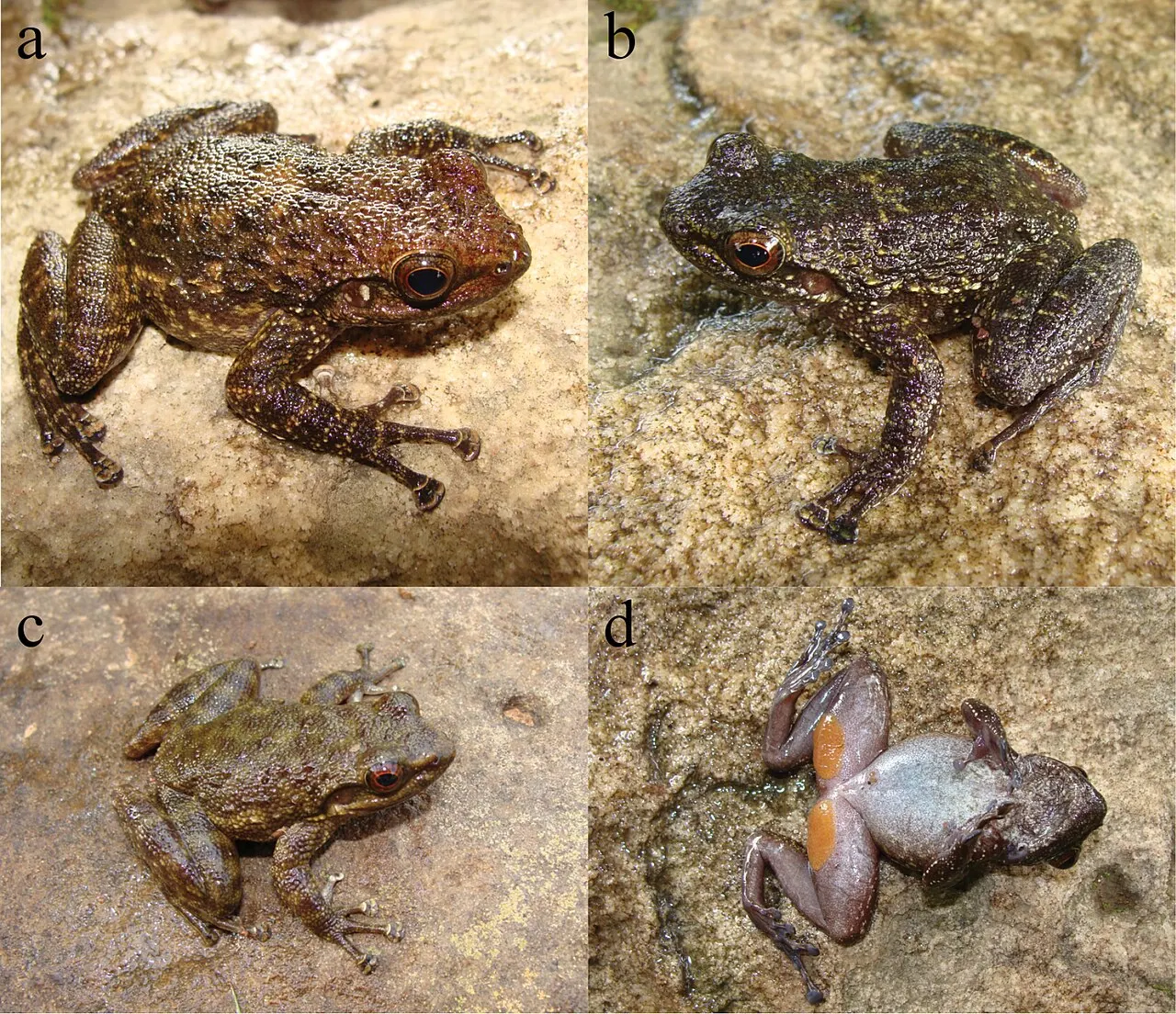
The Fouta Djallon torrent-frog (Fouta Djallon torrent frog) lives only in the highlands of Guinea, in West Africa. It was described as a new species in 2015, after being mistaken for a close relative for more than a century. The IUCN Red List rates it Endangered (2019 assessment), because it occupies one small area of fast streams where forest is being lost.
How to recognise it
This is a medium-sized frog. Adult males measure about 48 to 57 mm and females about 44 to 62 mm. Like other members of its family, the tooth-frogs, it has tusk-like projections on the lower jaw and curved teeth in the upper jaw. Its tadpoles have a sucker-like mouth.
Telling it apart from its relatives by eye is very hard. Until 2015 every frog of this kind was classed as one species, the torrent tooth-frog (Odontobatrachus natator). Genetic and body-measurement work then showed the group hid several species. A team led by Michael Barej described four new ones that year in the journal Zoosystematics and Evolution, and this frog was one of them.
Where it lives
It is endemic to Guinea and takes its name from the Fouta Djallon highlands, where it was found. Records run from about 650 to 900 m above sea level (the Red List gives 652 to 916 m).
The Red List counts the whole population as a single location, with an extent of occurrence of roughly 2,300 square kilometres. Its habitats are listed as moist tropical lowland forest and permanent streams, including waterfalls. Tooth-frogs in general live along strong currents and cascades in the few remaining patches of primary forest in the Upper Guinean forests.
Pins are Wikidata “endemic to” fields. Orange dots, when present, are GBIF occurrence tiles — survey bias included.
Why it is in trouble
The Red List gives the population trend as decreasing, with the area it occupies still shrinking. The threats it records are all ongoing: small-holder farming, housing and urban growth, and mining and quarrying. Each of them converts or degrades the forest and streams the frog depends on.
A small range makes things worse. When the 2015 team named the new species, they warned that West African torrent-frogs may all be at risk of extinction through habitat loss, and recommended an Endangered listing for each of the four. The Red List assessment records the frog as not occurring in a protected area.
What is being done
No dedicated recovery programme has been reported. The Red List assessment lists protection of the habitat and of sites as the conservation actions needed. Little has been published on the frog's diet, breeding or behaviour, so any recovery plan would start with survey and life-history work.
Sources
Written for this catalog in our own words from the sources below, checked against them on 12 November 2026. Population figures are estimates and carry the year they were made. Status and assessment year: IUCN. 2026. The IUCN Red List of Threatened Species. Version 2026-1. iucnredlist.org.




