Critically Endangered
Nyassachromis breviceps
Nyassachromis breviceps
Nyassachromis breviceps is a small cichlid fish endemic to the southern part of Lake Malawi. The IUCN Red List rated it Critically Endangered in 2018 and flags it as possibly extinct, because the last record from the lake dates from 1997.
How to recognise it
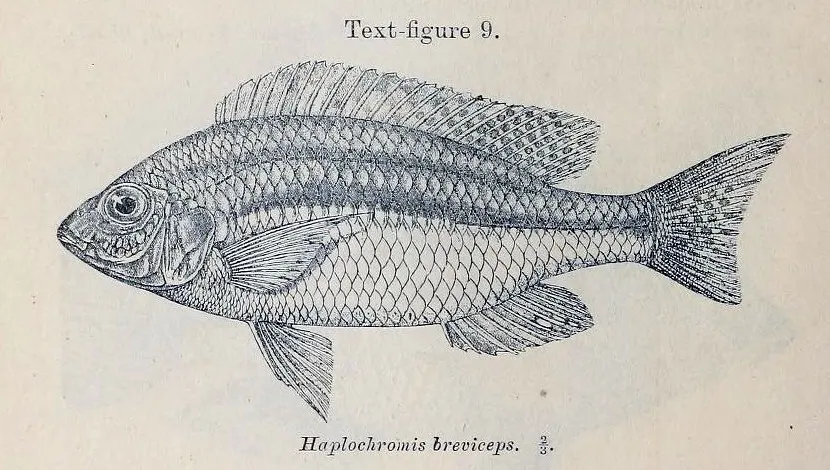
It was a modest cichlid reaching about 15.4 cm in total length according to FishBase, while the IUCN figure quoted elsewhere is a smaller 14.0 cm. Charles Tate Regan described it in 1922 under the name Haplochromis breviceps, and it was later moved to Cyrtocara and then to Nyassachromis.
Where it lived
It is endemic to Lake Malawi in Africa and was found only in the southern part of the lake, a freshwater, tropical habitat between about 12 and 15 degrees south. The IUCN treats it as a single location. If any survive, the area they occupy is estimated at just 4 square km. It lived near the bottom, at depths down to 16 m.
Pins are Wikidata “endemic to” fields. Orange dots, when present, are GBIF occurrence tiles — survey bias included.
How it lived
It preferred sandy bottoms and fed on phytoplankton. Breeding was reportedly from August to December. Females gather in open-water schools, while males dig a cave beside a rock as a spawning site. Unusually for the genus, males need small pebbles or stones to build it, so sand alone was not enough.
Why it is in trouble
The last record from Lake Malawi dates from 1997. That is why the species is labelled possibly extinct rather than simply endangered. The IUCN assessment gives the population trend as decreasing and the generation time as one to two years.
The suspected cause is overfishing by small-scale fishers. The IUCN lists subsistence harvest for food as an ongoing, low-impact threat.
What is being done
The IUCN records no conservation actions in place for this fish. Until surveys of the southern lake's sandy shallows either find it or fail to, it stays on the Red List as Critically Endangered, possibly extinct.
Sources
Written for this catalog in our own words from the sources below, checked against them on 12 November 2026. Population figures are estimates and carry the year they were made. Status and assessment year: IUCN. 2026. The IUCN Red List of Threatened Species. Version 2026-1. iucnredlist.org.




