Critically Endangered
Nubian flapshell turtle
Cyclanorbis elegans
The Nubian flapshell turtle (Cyclanorbis elegans) is a large softshell turtle of African rivers and wetlands. The IUCN Red List rated it Critically Endangered in 2016. Once found from West Africa to Sudan, it went unrecorded in the wild for decades before small populations turned up on the White Nile in 2017 and 2021.
How to recognise it
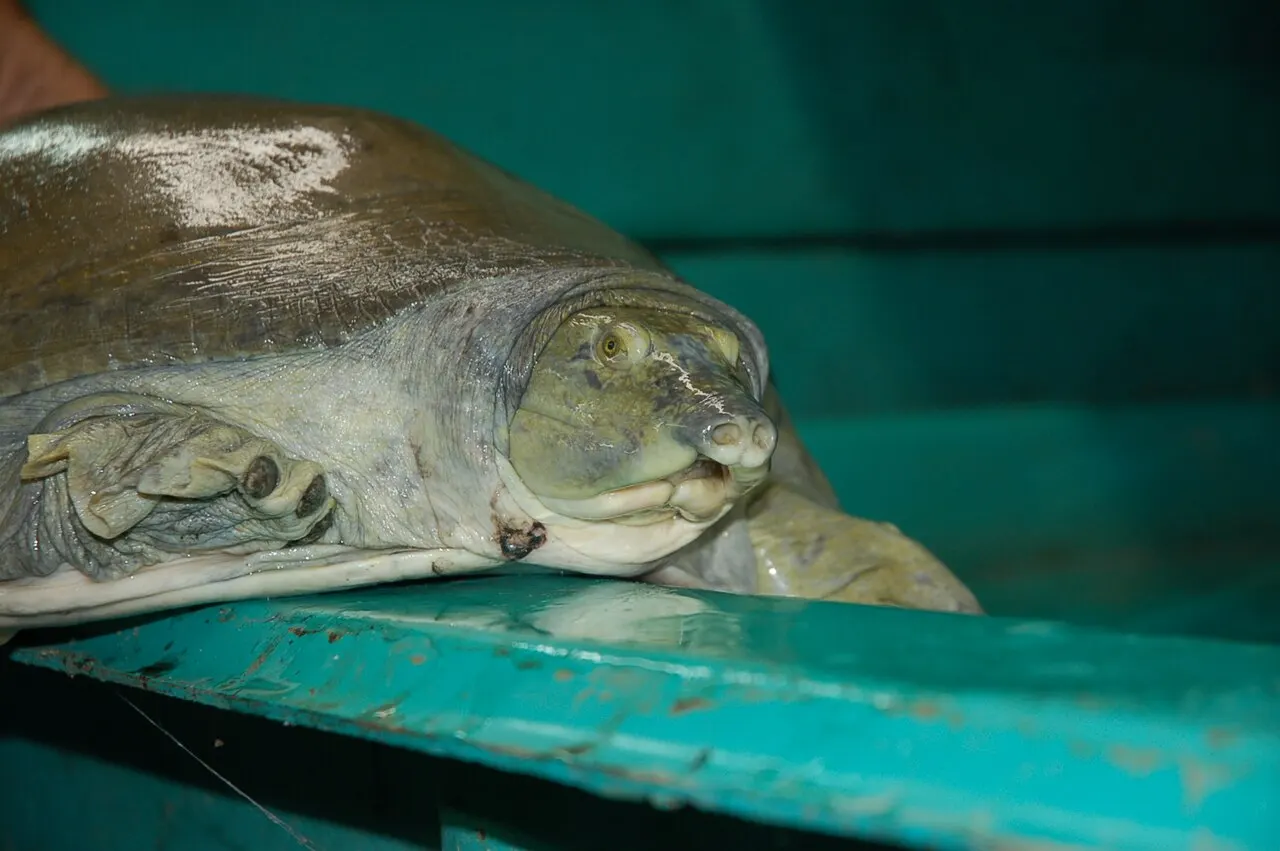
It is a big, flat, round-shelled turtle with a soft, leathery carapace instead of hard plates. It is the largest of the flapshell turtles. The largest recorded was a 676 mm male, and one museum account suggests the shell could pass 700 mm, while another reference gives about 60 cm. The shell is olive to brown with yellow or light-green spots along the edge, and the underside is yellow with dark spots. Hatchlings are bright green with large yellow spots, and young turtles have small tubercles and a low ridge down the back that fade with age. Males have longer, thicker tails than females.
Flaps of skin at the rear of the underside can cover the hind limbs. It is one of two flapshell species in the genus Cyclanorbis. The other, the Senegal flapshell, is smaller and has up to nine hardened patches on the underside, against two (occasionally four) in an adult Nubian flapshell.
Where it lives
It is a highly aquatic turtle of slow rivers, marshes and inland deltas, in the Sahel and Sudan savannah belt from northern Ghana to South Sudan. The Red List records it as present in Ghana, Togo, Nigeria, Cameroon, the Central African Republic, Chad, Sudan and South Sudan, with presence uncertain in Benin and Ethiopia, at elevations from sea level to about 400 metres.
It has disappeared from most of this range. A population was found in South Sudan's White Nile wetlands in 2017 and another in northern Uganda in 2021. A specimen collected in 1988 in Rio Muni, Equatorial Guinea, was a 51 cm turtle, and recent photographs reportedly came from near Salamat in Chad.
Pins are Wikidata “endemic to” fields. Orange dots, when present, are GBIF occurrence tiles — survey bias included.
How it lives
Its natural history is poorly known, and no data on clutch size or egg size have been published. The Rio Muni specimen held nipa palm fruit, crabs, snails and mud, which is a single record, not a full diet.
On the White Nile in South Sudan, females use three known nesting beaches communally each year. Bari fishermen there reportedly hold detailed knowledge of the turtle and its nesting sites.
Why it is in trouble
The 2016 assessment estimates a population reduction of about 80 percent in the past and about 90 percent ongoing, with a generation length of 25 years. It names harvest for food as the main threat, scored medium impact and affecting most of the population, with large dams a lesser one. Eggs are also collected by pastoralists on South Sudan's flood grasslands, and some turtles are reportedly taken for traditional medicine and exported to Asia.
More recent work adds detail. A 2021 note in Oryx reported that fishing bycatch and the collection of eggs and nesting females are the main threats. After interviewing about 300 fishermen along the White Nile in 2020, it found that four turtles caught near Mongalla were sold to expatriate Chinese residents for 250 to 400 euros each.
A 2024 expert-panel analysis led by Luca Luiselli named sand mining, overfishing by local fishers and refugees, and loss of nesting habitat as the main direct threats. Conflict, land mines and rising water demand from armed forces and civilians are also cited as pressures on its habitat.
What is being done
The Turtle Survival Alliance works with Luca Luiselli's team, the University of Juba and NICE Planet in Kampala. In South Sudan the work covers protecting the three nesting beaches, mapping potential distribution, surveying markets for poached turtles, community awareness and a proposed protected area. In Uganda it includes surveying the river and marshes, estimating population size and setting up community nest monitoring.
The species was added to CITES Appendix II in 2017, so international trade needs permits. The 2016 assessment recorded no recovery plan or monitoring scheme, and no population estimate has been published.
Sources
Written for this catalog in our own words from the sources below, checked against them on 12 November 2026. Population figures are estimates and carry the year they were made. Status and assessment year: IUCN. 2026. The IUCN Red List of Threatened Species. Version 2026-1. iucnredlist.org.
- IUCN Red List assessment, Cyclanorbis elegans (2016)
- Nubian flapshell turtle, encyclopedia entry
- Turtle Survival Alliance, South Sudan and Uganda
- Turtles of the World, Cyclanorbis elegans (Naturalis)
- Baker, Diagne and Luiselli 2015, Chelonian Research Monographs 5, account 089
- Zootaxa synopsis of Equatorial Guinea reptiles (Zenodo record)
- Owfi et al. 2021, Oryx 55(4), conservation news
- Threats analysis, Nubian flapshell turtle (2024, summary page)
- New CITES herp listings 2017, Reptiles Magazine




