Endangered
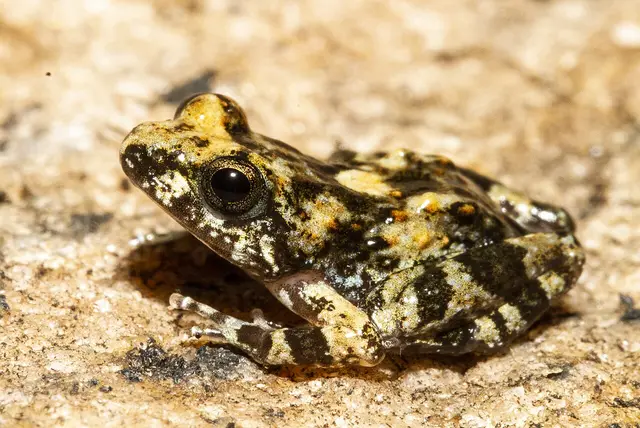
Nothophryne broadleyi
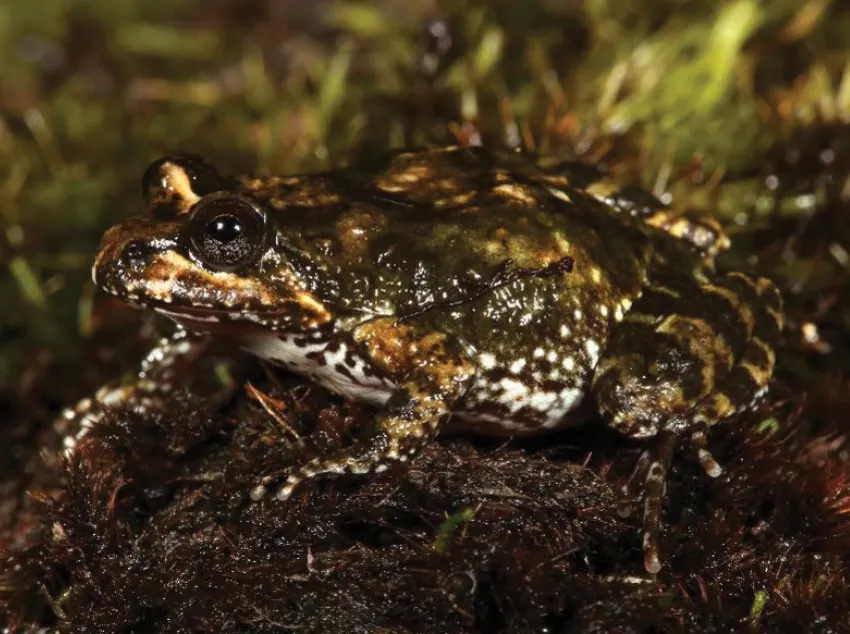
Nothophryne broadleyi
Broadley's mountain frog (Nothophryne broadleyi), also called the mongrel frog, is a small frog known only from Mount Mulanje in southern Malawi, where it lives among rocks from about 1,200 to 3,000 m. The IUCN Red List lists it as Endangered (assessed 2026), with a decreasing population.
Where it lives
Mulanje is a mountain massif in southern Malawi, and this frog is tied to it. The IUCN counts the whole range as a single location, estimates the area it occupies at about 372 square kilometres, and treats the species as non-migratory. At least part of the range lies in a protected area. The frog lives on rocky ground in montane forest and high-altitude grassland, and the IUCN also lists seasonal streams among its habitats.
For decades it was the only species in its genus. It was described by the herpetologist Poynton in 1963. Then in 2018 Conradie and colleagues described four more Nothophryne species in the African Journal of Herpetology, each living on its own isolated mountain in northern Mozambique: Mount Namuli, Mount Inago, Mount Ribáuè and the low inselbergs of Cabo Delgado Province. The paper's abstract says earlier genetic analyses point to an endemic species on each mountain isolate, and it places Broadley's frog only on Mulanje.
Pins are Wikidata “endemic to” fields. Orange dots, when present, are GBIF occurrence tiles — survey bias included.
How it lives
Little is written about its daily life, but its breeding is unusual in that it doesn't use ponds. Eggs are laid on saturated moss beside mountain streams that trickle over rock faces. After hatching, the young reportedly disperse across the wet rock. Older accounts describe it as abundant on Mulanje, breeding in large numbers.
Why it is in trouble
Its whole world is one mountain, so any change there matters. The IUCN lists small-holder farming, housing, and wood extraction among the pressures, with mining and quarrying also noted. Fires have become more frequent and more intense, and invasive pines recover quickly after a burn and gradually push out native vegetation. The assessment records the area it occupies as declining.
The Endangered listing rests on a small, shrinking range and the single location, not on a count of animals. No population size has been published.
What is being done
The IUCN records conservation sites identified across the frog's entire range. The IUCN lists site and area management as the main action in place. The 2026 assessment is the third in recent years, following Endangered listings in 2019 and 2020,, so the category hasn't changed.
Sources
Written for this catalog in our own words from the sources below, checked against them on 12 November 2026. Population figures are estimates and carry the year they were made. Status and assessment year: IUCN. 2026. The IUCN Red List of Threatened Species. Version 2026-1. iucnredlist.org.