Endangered
Norfolk Robin
Petroica multicolor
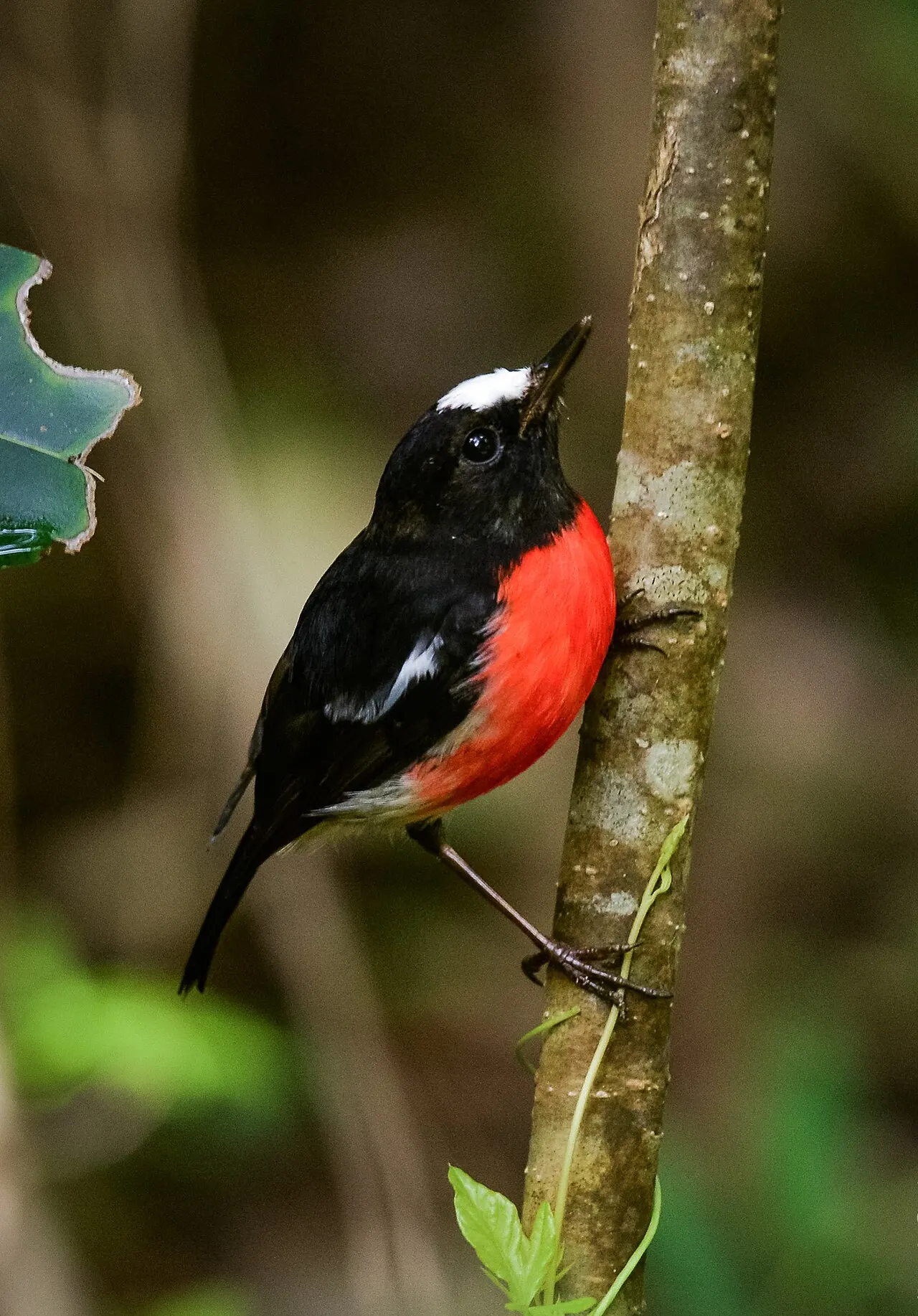
The Norfolk robin (Petroica multicolor) is a small songbird found only on Norfolk Island, an Australian territory in the Tasman Sea. The Red List rated it Endangered in 2023 and puts the population at about 750 mature birds. Males are black above, with a bright red breast and a white spot on the forehead.
How to recognise it
Males are easy to pick out. The back and head are black, the breast is bright red, and there is a white patch on the forehead, white bars on the wing and small white tips on the tail. The belly is white lower down.
Females and young birds are much plainer, mostly brown with a pinkish or warm-toned chest. The national park gives the length as 11.5 to 13.5 cm and the wingspan as 17 to 22 cm. The species was long treated as the same bird as the Australian scarlet robin, and was split from it as a separate species.
Where it lives
It occurs nowhere else but Norfolk Island. The Red List records it from Norfolk Island only, from sea level up to about 300 m. Most birds are in the Mt Pitt section of Norfolk Island National Park and in forest remnants nearby.
Subtropical moist forest is the main habitat, though some birds also use plantations. It favours native rainforest with a dense understorey and deep, damp leaf litter to forage in.
Pins are Wikidata “endemic to” fields. Orange dots, when present, are GBIF occurrence tiles — survey bias included.
How it lives
Norfolk robins eat a wide range of invertebrates. Pairs lay two to four eggs in a small nest made of plant material and spider web, with lichen and moss on the outside as camouflage.
The Red List gives a generation length of about 3.4 years.
Why it is in trouble
Numbers fell until the 1980s, when robins disappeared from many parts of the island. They then seemed to hold steady, with an estimated 400 to 500 pairs in 1988 and little change by 1997. The Red List now records a continuing decline in a population of roughly 700 to 800 mature birds.
Introduced black rats are the main problem. A 2023 study in the journal Emu followed 135 nests of five endemic Norfolk songbirds over four seasons. Predation caused about 80 percent of failed nests, and rats were behind about 61 percent of the nests that were raided. The robin was one of the species with lower nest survival and specialised habitat needs. A 2024 Monash University report put the share of robin nests raided by rats at 39 percent. Feral cats, farming and drought are also listed as threats.
What is being done
Rat and cat control and weed control take place on the island, and the Red List lists habitat restoration as a conservation action. Baiting is awkward, because the critically endangered Norfolk Island morepork, an owl, can be poisoned by eating poisoned rats. Since 2015, only first-generation and non-anticoagulant baits have been used during the owl's breeding season, October to February.
A recovery plan is in place. Moving some robins to nearby Phillip Island has been proposed for when regrowing habitat there is suitable, but no reintroduction has happened.
Sources
Written for this catalog in our own words from the sources below, checked against them on 12 November 2026. Population figures are estimates and carry the year they were made. Status and assessment year: IUCN. 2026. The IUCN Red List of Threatened Species. Version 2026-1. iucnredlist.org.




