Endangered
Nirodia belphegor
Nirodia belphegor
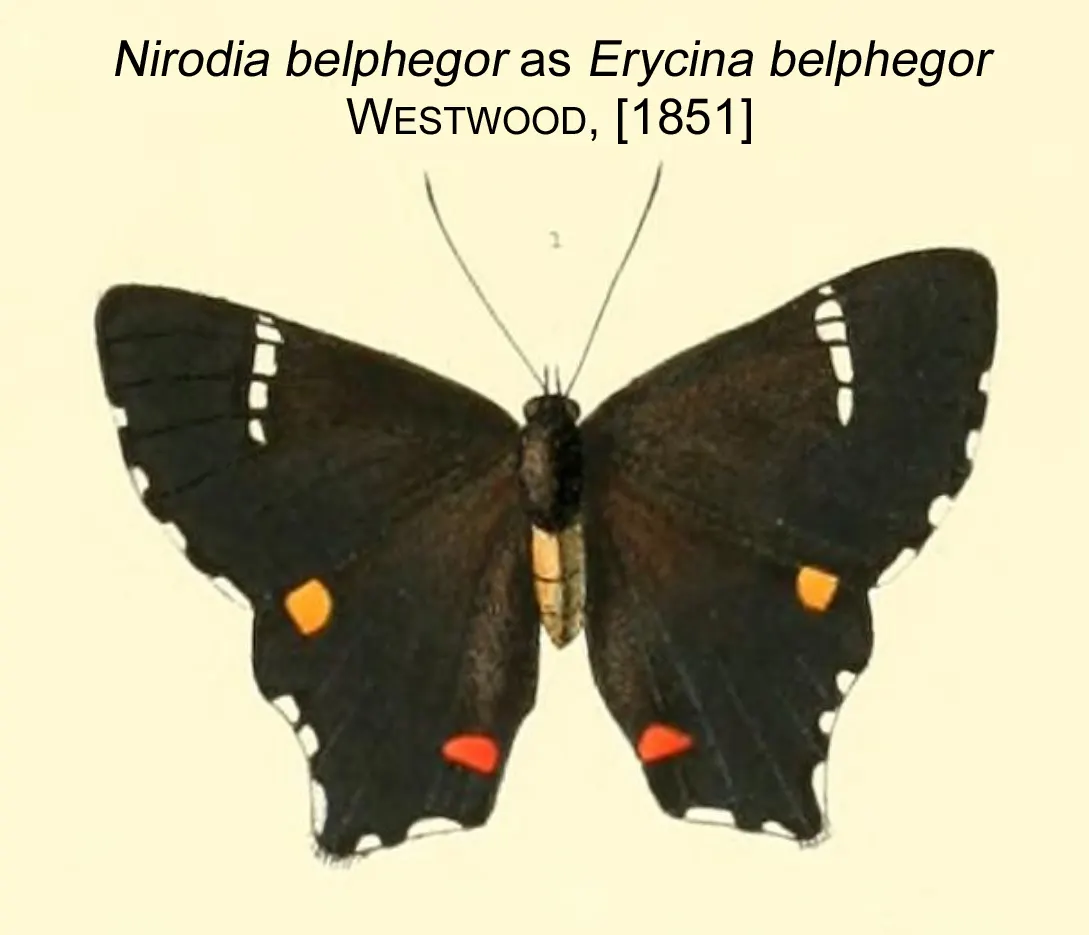
Nirodia belphegor is a butterfly found only in Brazil, where it lives on high, rocky mountain slopes in the southeast. The IUCN Red List carries it as Endangered on a 1996 assessment. A 2015 study moved it to the genus Rhetus, as Rhetus belphegor, and described it as critically endangered.
A species with two names
Westwood described the butterfly in 1851, and for a long time it sat alone in its own genus, Nirodia. Authors disagreed even about its family, with some placing it among the gossamer-wing butterflies (Lycaenidae) and others in the metalmarks (Riodinidae).
In 2015 Kaminski and colleagues studied its immature stages and its DNA. Their paper in the Journal of Insect Conservation showed that Nirodia sits inside the genus Rhetus, so the butterfly became Rhetus belphegor. The Red List and some other databases still list the older name, so both appear in the literature.
Where it lives
The species is endemic to Brazil. Museum records and citizen-science observations show that it is restricted to the Espinhaco mountain chain in the southeast, and that it occurs only above 1,000 m. Its habitat is campos rupestres, a high-altitude vegetation that grows on rocky outcrops.
It is the only member of its group to live in high mountains. Its close relatives are lowland butterflies.
Pins are Wikidata “endemic to” fields. Orange dots, when present, are GBIF occurrence tiles — survey bias included.
How it lives
Adults rest upside down on rock faces. Females hunt for host plants during the hottest part of the day and lay one or two eggs on the leaves of a small herbaceous shrub, Microstachys serrulata, a member of the spurge family.
The caterpillars pass through six stages and are densely covered in fine hairs. Unlike many of their relatives, they are not associated with ants. In the study, development from egg to adult took about 50 days.
Why it is in trouble
Few pressures have been documented. The butterfly lives in a narrow band of mountain habitat, and the 1996 Red List assessment rated it Endangered under criteria B1+2c, from an earlier version of the criteria for small, restricted ranges. It had been rated Vulnerable in 1994. The assessment records no threat details and no population figure.
The 2015 study called it critically endangered and argued that describing its early stages and settling its classification are needed for more effective conservation.
Sources
Written for this catalog in our own words from the sources below, checked against them on 12 November 2026. Population figures are estimates and carry the year they were made. Status and assessment year: IUCN. 2026. The IUCN Red List of Threatened Species. Version 2026-1. iucnredlist.org.




