Endangered
Nilgiri Long-tailed Tree Mouse
Vandeleuria nilagirica
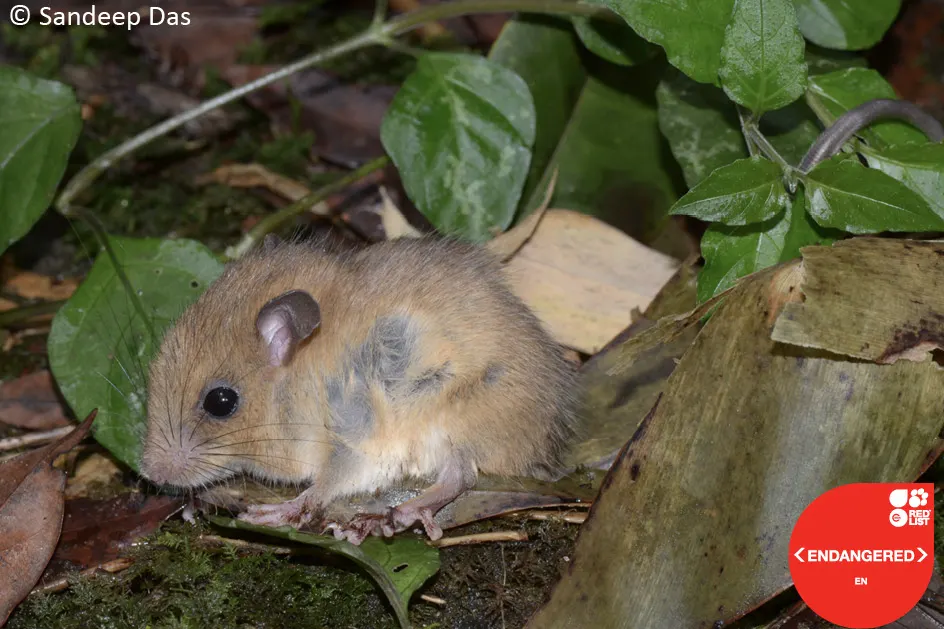
The Nilgiri long-tailed tree mouse (Vandeleuria nilagirica) is a small climbing rodent found only in the southern Western Ghats of India. The IUCN Red List has rated it Endangered since its 2016 assessment, with a decreasing population. It is most often caught in and around plantations, where its long tail helps it reach branches.
How to recognise it
It is a close lookalike of the Asiatic long-tailed climbing mouse (Vandeleuria oleracea), which shares parts of the same hills. Two features set it apart. In a 1992 comparison by Corbet and Hill, its tail was much longer than in any sample of the Asiatic species, and its underparts were whitish gray rather than pure white. A survey in Coorg also described it as slightly bigger and darker in the body, and rarely seen indoors.
Some researchers have folded it into the Asiatic species, and the original 1867 description has no surviving holotype. Corbet and Hill and the Mammal Diversity Database treat it as a separate species.
Where it lives
Thomas Jerdon described it from the summit of the Nilgiri Hills near Ootacamund (Udhagamandalam), in Tamil Nadu. Later records added Kutta in southern Coorg, and a survey between 2004 and 2008 extended the known range into central and northern Coorg, in Karnataka. The IUCN lists India as its only country.
It has been recorded between 900 and 2,100 m above sea level. The preferred habitat is subtropical or tropical moist montane forest, and the Coorg survey reported it from coffee, cardamom and banana plantations. The IUCN estimates its extent of occurrence at 8,343 square kilometres, with the area it actually occupies somewhere between 10 and 500 square kilometres.
Pins are Wikidata “endemic to” fields. Orange dots, when present, are GBIF occurrence tiles — survey bias included.
How it lives
It climbs. In Coorg it was trapped only in a banana plantation, and in a coffee plantation at about 950 m its presence was inferred from mint-smelling droppings around the traps, which suggested it reached the bait by hanging from overhead branches or the trap roof. Across 11,060 trap nights it made up 0.7% of all captures.
At Haleri Estate in northern Coorg (about 1,000 m), researchers counted 20 nests in one small part of a coffee estate. They judged the nests had been used in the breeding season (October to March) and then abandoned. Assuming an adult pair with two or three young in each, they estimated 80 to 100 animals in that patch.
Why it is in trouble
The IUCN reports a decreasing population, a severely fragmented range and a continuing decline in area. The listed threats are small-holder farming, agro-industry farming and agro-industry plantations, which take over land in the hills where it lives. The Coorg survey warned that land-use change and falling habitat quality are pushing endemic small mammals of the Western Ghats toward local extinction.
Plantations are a mixed picture. The IUCN rates them only marginally suitable habitat, and the Coorg survey found low small-mammal abundance in plantations overall (under 3.1%), even though this species uses some of them.
What is being done
The 2016 assessment calls for site protection and site management, and it records that the species is not known to occur in any protected area. Research needs listed include population size, distribution and trends, life history and ecology, and threats. Few animals have been caught anywhere, so solid population figures do not yet exist.
Sources
Written for this catalog in our own words from the sources below, checked against them on 12 November 2026. Population figures are estimates and carry the year they were made. Status and assessment year: IUCN. 2026. The IUCN Red List of Threatened Species. Version 2026-1. iucnredlist.org.




