Endangered
Niceforonia adenobrachia
Niceforonia adenobrachia
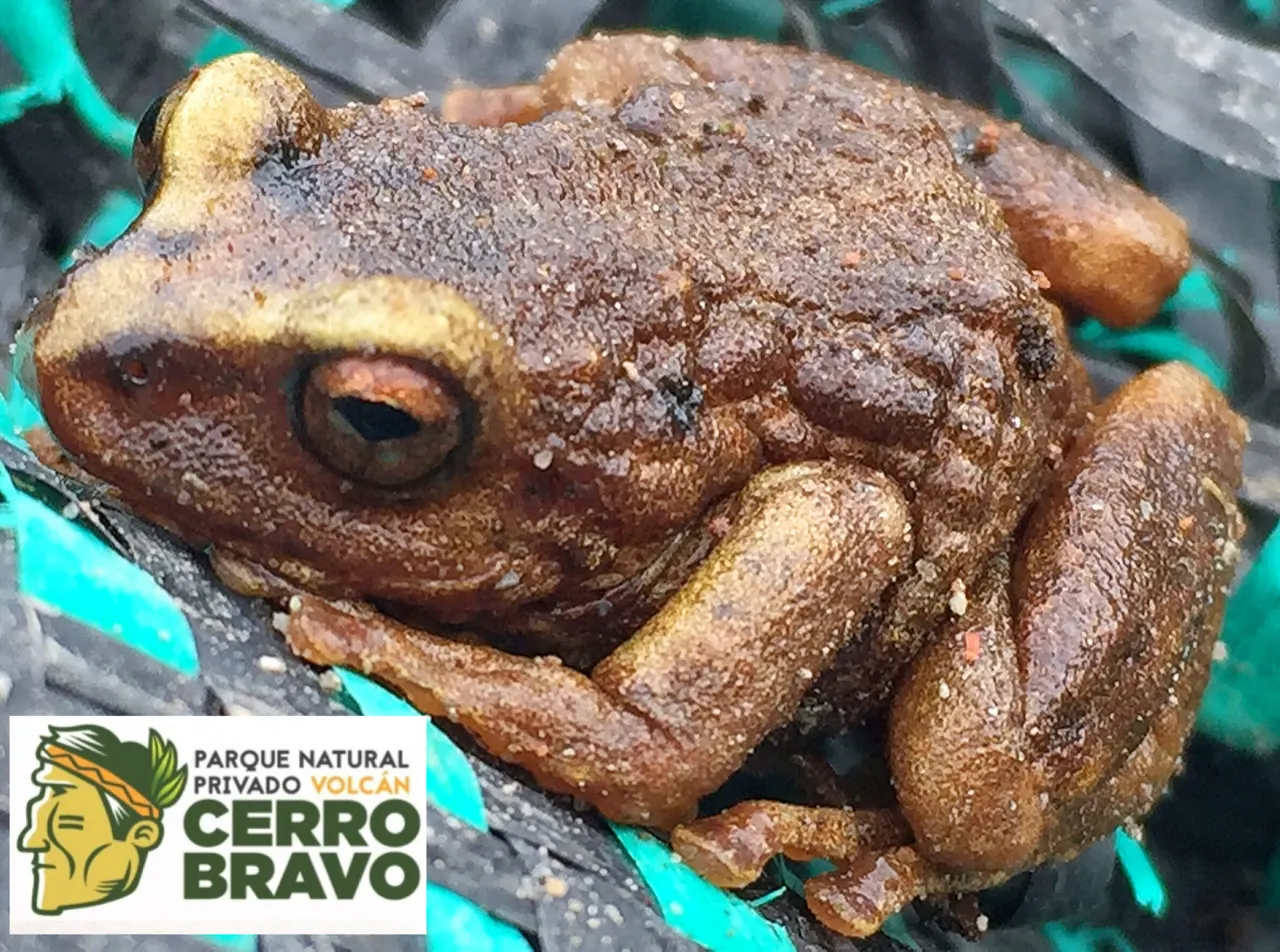
Niceforonia adenobrachia is a small frog of the high Andean páramo in Colombia's Central Cordillera, known from Caldas, Quindío, Risaralda and Tolima. The IUCN Red List rated it Endangered in 2017. It lives under rocks in high grassland and shrubland, where grazing, farming and mining are eating away its habitat.
How to recognise it
Ardila-Robayo, Ruiz-Carranza and Barrera-Rodriguez described it in 1996 under the name Phrynopus adenobrachius. It is a brown frog, light to dark, with smooth skin and scattered small bumps. Useful marks include a cream patch in the armpit and groin, bumps on the upper eyelid, a prominent tubercle on the ankle, and an eardrum that is hidden under the skin.
Where it lives
The frog is endemic to Colombia and belongs to the Central Cordillera. The type locality is Herveo, in Tolima. Records also come from Caldas and Quindío, and a 2025 report in Revista Latinoamericana de Herpetología added Risaralda.
It inhabits sub-páramo and páramo, the cold shrubby and grassy zone above the treeline. The IUCN gives an elevation range of 3,100 to 3,872 m and an extent of occurrence of about 2,213 square kilometres, and counts one to four locations. The single frog found in Risaralda in 2025 was an adult under a rock, less than five metres from a road, at 2,926 m.
The population is not thought to be severely fragmented, and the species occurs in at least one protected area.
Pins are Wikidata “endemic to” fields. Orange dots, when present, are GBIF occurrence tiles — survey bias included.
Why it is in trouble
The IUCN reports that the area the frog occupies is still shrinking and rates the population trend as decreasing. Threats named are small-holder grazing and farming, and mining and quarrying. The 2025 report adds deforestation and livestock farming to that list, and burning of páramo to improve cattle pasture is reportedly a cause of habitat loss. Population size has never been estimated.
What is being done
The IUCN assessment names site and habitat protection among the conservation measures for the species, and records that part of the range lies inside a protected area. No dedicated recovery programme or monitoring scheme is described for this frog. The 2025 report noted that its record came from a roadside and called for an assessment of possible effects on local populations.
Sources
Written for this catalog in our own words from the sources below, checked against them on 12 November 2026. Population figures are estimates and carry the year they were made. Status and assessment year: IUCN. 2026. The IUCN Red List of Threatened Species. Version 2026-1. iucnredlist.org.




