Critically Endangered
Kurdistan newt
Neurergus microspilotus
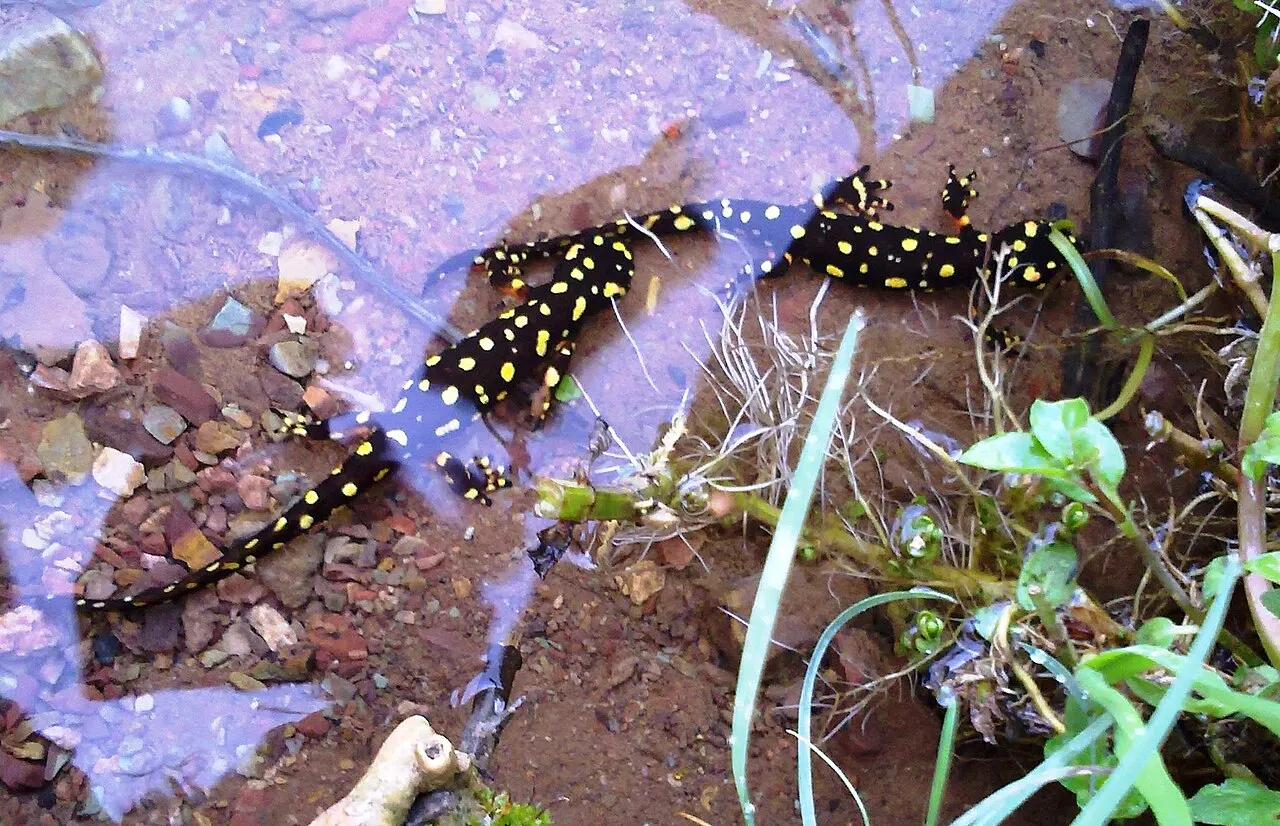
The Kurdistan newt (Neurergus microspilotus), also called the Avroman newt, is a black salamander with bright yellow spots that lives in a few mountain streams in the Zagros range of western Iran. The IUCN rated it Critically Endangered in 2009, with a decreasing population, though a later assessment of the wider Kurdistan newt lists Vulnerable.
How to recognise it
In the Kurdistan newt group, adults are black with bright yellow spots, and the front limbs carry larger orange spots. The spots on this form tend to be rounder than on its closest relative. Older larvae are spotted too, usually with dark spots on the belly.
Taxonomy isn't settled. The IUCN's 2009 assessment treated it as a species in its own right, while other authorities treat it as a subspecies of the Kurdistan newt (Neurergus derjugini), described in 1916. The two differ only slightly in mitochondrial DNA and a little more in one nuclear gene. A more recent IUCN assessment of the Kurdistan newt as a whole lists it as Vulnerable, so the 2009 Critically Endangered rating applies to this form only under the older, split classification.
Where it lives
The 2009 assessment lists Iran as the only country where it is confirmed, with Iraq and Turkey marked as uncertain. It was once thought to be confined to the Avroman mountains on the Iran, Iraq and Turkey border. Later fieldwork in Kermanshah and Kurdistan provinces found it in at least nine streams in narrow valleys of the Zagros oak forest, with almost no movement of newts between them.
Its habitat is permanent streams. The assessment gives an elevation of roughly 1,300 to 1,400 m. The wider Kurdistan newt group is recorded from small streams between about 1,300 and 1,865 m.
Pins are Wikidata “endemic to” fields. Orange dots, when present, are GBIF occurrence tiles — survey bias included.
How it lives
Like many salamanders, the male courts the female by waving his tail in front of her, then leads her to a sperm packet he has left in her path. For the Kurdistan newt group as a whole, breeding is reported from April to June, and a female may lay around 100 eggs, singly or in small groups on stream vegetation and rocks.
Why it is in trouble
Drought is a major pressure, because a series of severe droughts has dried breeding habitat, and some populations have already disappeared locally. Orchards and wheat fields draw water from the streams, and runoff from villages and farmland brings fertilizer, insecticide and herbicide that affect survival and reproduction. The 2009 assessment lists farming, drought, pesticides and collection of the animals themselves as ongoing threats.
Collection matters too. The newt has appeared increasingly in Iranian pet shops, and illegal export is reported to be growing. The assessment records use as pets and display animals, at national and international level.
What is being done
Since 2008, herpetologists at Razi University in Kermanshah have kept small captive groups and run a breeding program. In 2010 the Royal Zoological Society of Antwerp received a US$20,000 grant from the Mohamed bin Zayed Species Conservation Fund to set up an international breeding program based at Razi University, with field surveys, genetic studies, habitat protection and community education on water quality.
The oak forests where it lives are generally protected under Iranian national law, though enforcement needs improvement. The 2009 assessment notes that conservation sites have been identified across its whole range.
Sources
Written for this catalog in our own words from the sources below, checked against them on 12 November 2026. Population figures are estimates and carry the year they were made. Status and assessment year: IUCN. 2026. The IUCN Red List of Threatened Species. Version 2026-1. iucnredlist.org.




