Endangered
Nemachilichthys ruppelli
Nemachilichthys shimogensis
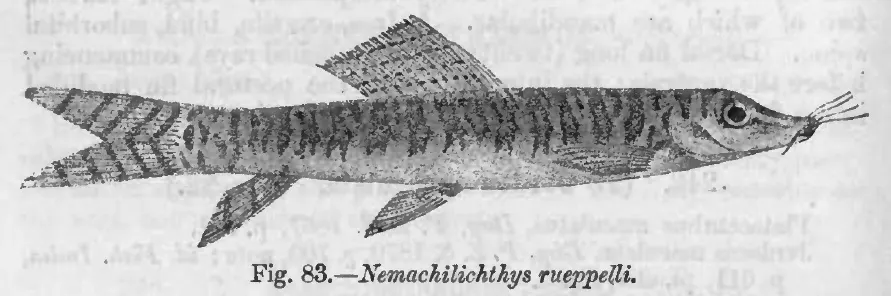
The Shimoga loach, or mongoose loach (Nemachilichthys rueppelli), is a small stone loach from fast rivers of the Western Ghats in India. It was assessed as Endangered in 2011 under the name N. shimogensis, because it occurs at only a few sites and its habitat is declining.
How to recognise it
It's a slim, nearly cylindrical fish that reaches about 85 mm in standard length. The snout is pointed, the eyes are relatively large, and the tail fin is deeply forked.
Males show 14 to 16 well-defined dark bars, while females have 11 to 14 fainter ones. Females are probably a little bigger and heavier-bodied.
A naming tangle
Two names were once used for what is now treated as one fish. Sykes described Cobitis rueppelli in 1839, and Narayan Rao described N. shimogensis in 1920 from the Thunga River at Shimoga. A 2015 study in Zootaxa by Keskar and colleagues found very small genetic differences (0.5 percent in one mitochondrial gene and 1.2 percent in another) and no clear body differences, and treated shimogensis as a junior synonym.
The IUCN Red List still uses the Shimoga loach name, N. shimogensis, so searches may turn up either.
Where it lives
It is known from the upper Krishna River system in the Western Ghats, with records from the Indrayani, Mula-Mutha, Nira, Krishna, Koyna, Hiranyakeshi and Tunga rivers. The IUCN lists the country as India, with Karnataka named, and the elevation as roughly 600 to 800 m.
It lives on the bed of moderate to fast streams and rivers, among aquatic plants and the submerged roots of bankside trees, over mud, silt, pebbles, small rocks and boulders. Flow and turbidity rise a lot in the monsoon.
Pins are Wikidata “endemic to” fields. Orange dots, when present, are GBIF occurrence tiles — survey bias included.
How it lives
In the wild it eats mostly small insects, worms, crustaceans and zooplankton. An aquarium profile describes it as naturally reclusive and peaceful, best kept in groups of four or more. Breeding has not been recorded.
Why it is in trouble
The IUCN assessment found four locations, an estimated area of occupancy of 60 square km, and a continuing decline in habitat area. It recorded the population trend as unknown and gave no population size. The threats listed are small-scale harvest, which includes use as food, and dams.
An aquarium source says the fish is now unlikely to occur below the Tunga and Bhadra confluence, and describes the Tungabhadra below it as heavily polluted.
What is being done
The IUCN assessment lists habitat and resource protection and a genome resource bank as conservation actions. It records that the fish occurs in at least one protected area, and that no recovery plan or monitoring scheme was in place in 2011.
Sources
Written for this catalog in our own words from the sources below, checked against them on 12 November 2026. Population figures are estimates and carry the year they were made. Status and assessment year: IUCN. 2026. The IUCN Red List of Threatened Species. Version 2026-1. iucnredlist.org.




