Endangered
Whitenose shark
Nasolamia velox
The whitenose shark (Nasolamia velox) is a slender requiem shark of the warm eastern Pacific, ranging from Baja California and the Gulf of California south to Peru. It is the only member of its genus. The IUCN rated it Endangered in 2020 because fishing is cutting its numbers.
How to recognise it
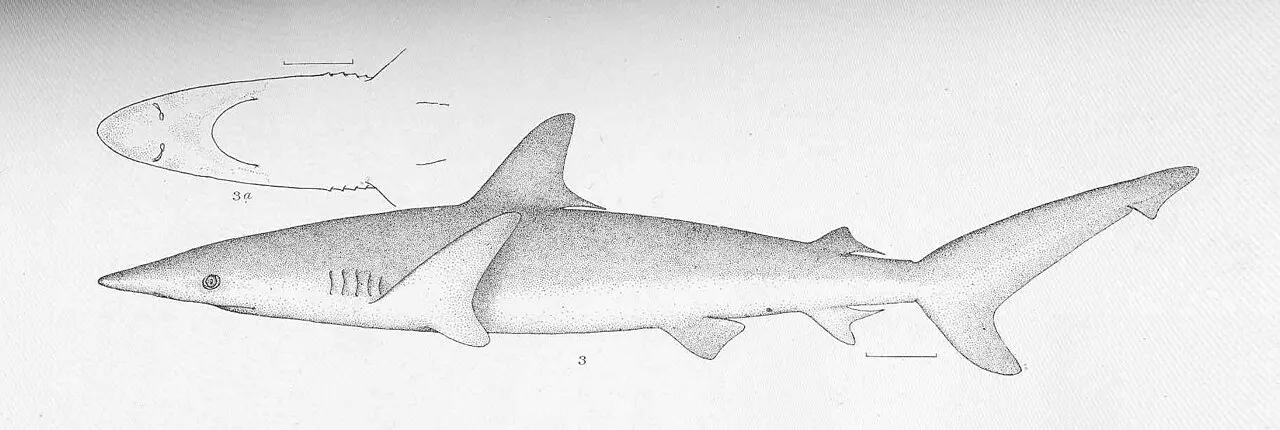
The whitenose has a slim body and a long, narrow, cone-shaped snout with very large nostrils set close together. The tip of the snout carries a dark spot with a pale outline. It is plain light grey or brownish grey above, without markings. FishBase gives a maximum length of 150 cm, and another description says adults do not exceed 1.6 m. The first dorsal fin is much bigger than the second, and the upper jaw carries 27 to 30 rows of teeth.
Where it lives
It lives on the continental shelf in tropical water, over sandy and sandy-mud bottoms and in estuaries. Depths run from the surface to about 192 m, though it is usually found between 15 and 24 m. The IUCN lists Mexico, Guatemala, El Salvador, Honduras, Nicaragua, Costa Rica, Panama, Colombia, Ecuador (including the Galapagos) and Peru in its range.
Pins are Wikidata “endemic to” fields. Orange dots, when present, are GBIF occurrence tiles — survey bias included.
How it lives
Whitenose sharks eat small bony fish such as anchovies, plus crabs. A study off Ecuador examined 24 sharks, 12 of them with empty stomachs, and found jumbo squid to be the most important prey overall.
The species gives birth to live young nourished through a placenta, five pups to a litter, each about 53 cm long. FishBase puts size at maturity from about 90 cm. The IUCN gives a generation length of 9 years, and FishBase rates its resilience to fishing as very low, with a population doubling time of over 14 years.
Why it is in trouble
Fishing is the main pressure. The IUCN lists small-scale fisheries, both targeted and accidental, and large-scale fisheries (accidental catch), all ongoing and affecting most of the population, with slow but significant declines. Industrial aquaculture is a smaller listed threat. The shark is taken for human food and processed into fishmeal. FishBase rates the fishery as minor, but the shark's slow breeding means it cannot take much pressure.
FishBase lists it as harmless to people.
What is being done
Little so far. The IUCN reports no recovery plan, no monitoring scheme and no harvest management plan in place, though the species does occur in at least one protected area. The assessment lists harvest and trade management, species recovery and site protection as needed actions, along with national-level measures.
Sources
Written for this catalog in our own words from the sources below, checked against them on 12 November 2026. Population figures are estimates and carry the year they were made. Status and assessment year: IUCN. 2026. The IUCN Red List of Threatened Species. Version 2026-1. iucnredlist.org.




