Endangered
Narrow-striped mongoose
Mungotictis decemlineata
The narrow-striped mongoose (Mungotictis decemlineata), known in Malagasy as boky-boky, is a small, daytime carnivore found only in the dry forests of western Madagascar. The IUCN Red List rated it Endangered in 2015, and its numbers are falling as forest is cleared for grazing and farming.
How to recognise it
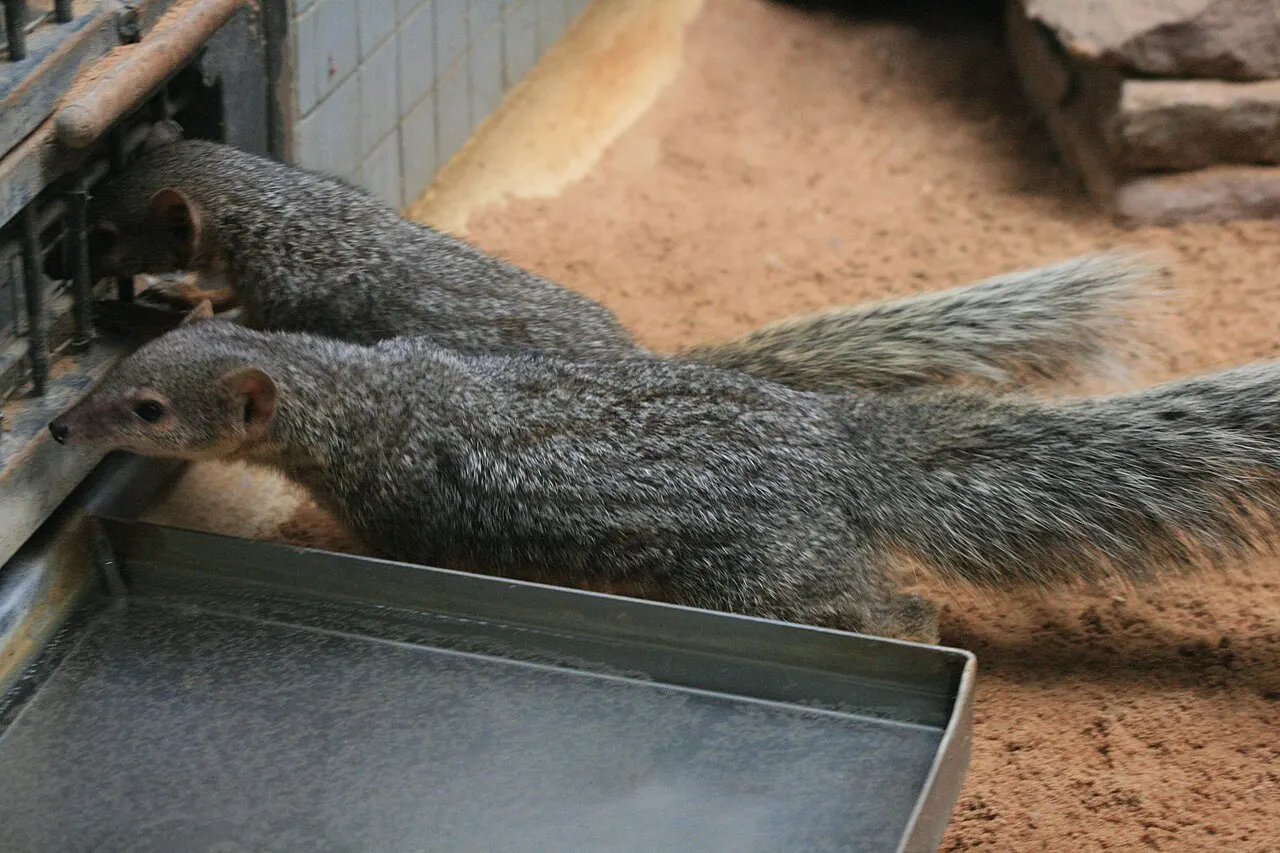
It's a slim, slightly-built mongoose with a grey-beige to grey coat marked by 8 to 10 dark stripes along the back and flanks. The bushy tail is ringed, the feet are hairless and the toes are partly webbed.
Body length is about 25 to 35 cm, with a tail of 23 to 27 cm, and adults weigh roughly 600 to 700 g. It belongs to the Eupleridae, the family of Madagascar's native carnivores, and is the only species in its genus.
Where it lives
The species is found only in western and southwestern Madagascar, in dry forest and dry shrubland, reportedly between the Tsiribihina and Mangoky rivers. It lives from sea level to about 125 m. Much of the detailed fieldwork has been done in Kirindy Forest in the Menabe region.
The Red List notes that it occurs in at least one protected area, but gives no figure for its range or numbers.
Pins are Wikidata “endemic to” fields. Orange dots, when present, are GBIF occurrence tiles — survey bias included.
How it lives
Narrow-striped mongooses are active by day. Much of the diet is invertebrates, especially insect larvae, with snails important in the rainy season. They also take eggs, small reptiles, birds and rodents. To get into eggs or hard-shelled prey, they hold the item and throw it repeatedly against a hard surface until it breaks.
Accounts of their social life disagree. An older educational source describes monogamous pairs that split into pairs, all-male units and mother groups in winter. Fieldwork described in other references found stable groups of 1 to 3 females with their young, and separate units of 2 to 4 males whose ranges overlap several female groups, with mating where they meet. The exact system is still being worked out.
Females usually have a single young per season. Birth timing is reported as October to December in one account and a breeding peak in February and March in another. Gestation is given as roughly 74 to 106 days. One account says only about 28 percent of young survive. Home ranges average around 3 square kilometres.
Why it is in trouble
The IUCN lists nomadic grazing and shifting agriculture as threats, both of which convert and degrade the dry forest and shrubland the mongooses depend on. The assessment records ongoing declines in habitat area, number of locations and subpopulations, and estimates an ongoing reduction of about 50 percent, with another 50 percent projected, though the time windows aren't stated.
It also lists competition, disturbance and unintended deaths as pressures. No population count is given. Generation length is estimated at 5.9 years.
What is being done
Conservation measures listed by the IUCN are site protection and management, and the species does occur inside at least one protected area. The assessment treats the causes of decline as reversible in principle, though they aren't fully understood.
Sources
Written for this catalog in our own words from the sources below, checked against them on 12 November 2026. Population figures are estimates and carry the year they were made. Status and assessment year: IUCN. 2026. The IUCN Red List of Threatened Species. Version 2026-1. iucnredlist.org.




