Critically Endangered
Naked characin
Gymnocharacinus bergii
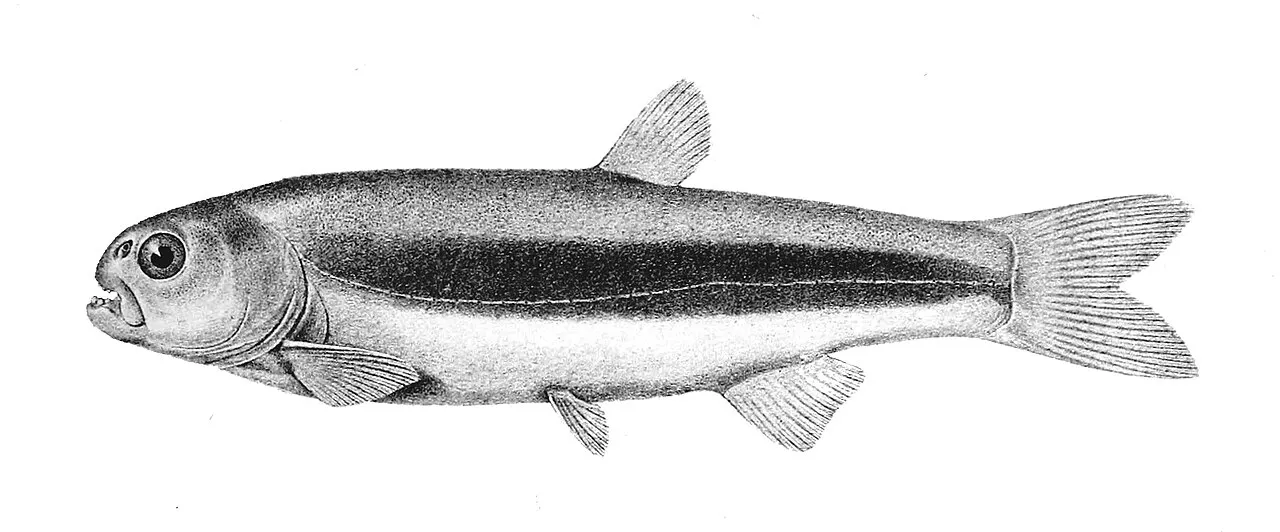
The naked characin (Gymnocharacinus bergii) is a tiny Patagonian fish found only in the warm headwaters of the Valcheta stream in Río Negro, Argentina. Adults have no scales. The IUCN Red List rated it Critically Endangered in 2019, with invasive fish, disease and livestock all pressing on its single small home.
How to recognise it
It grows to about 7.5 centimetres at most. The name comes from its adult form, which has lost its scales entirely. Juveniles still have them, which is how field biologists have separated young from adult fish when surveying.
Its family placement is unsettled. It is the only species in its genus, and specialists have not agreed on which characin family it belongs to.
Where it lives
By the Rufford Foundation's description, it is the only endemic fish of arid Patagonia. The Valcheta runs for about 80 kilometres across the Somuncura plateau in Río Negro, but the characin occurs only in roughly the first 10 kilometres, where the stream rises from thermal springs. That warmth is thought to be why this relict species survived there.
The Red List treats the whole population as one location, at about 500 to 800 metres above sea level, in geothermal wetlands and streams.
Pins are Wikidata “endemic to” fields. Orange dots, when present, are GBIF occurrence tiles — survey bias included.
How it lives
A 2013 and 2014 field project led by Hernán Povedano found the fish most abundant at the very start of the stream and less common downstream. It favoured warm, quiet, clear water with some vegetation, which it uses for food and shelter. It was scarce or absent where water ran fast or where livestock trampling had fouled the stream. A generation is about a year.
That project sampled 128 sites, resampled 39 of them, and found the fish at 22 of the 39. From counts along about 16 percent of its range, the team extrapolated a minimum of roughly 20,000 fish. That figure predates the die-off described below.
Why it is in trouble
Rainbow trout and brook trout, both introduced, eat small fish, and in the 2013 and 2014 surveys trout were found closer to the springs than ever recorded. Stomach contents of four trout showed small-fish remains, though the prey could have been the characin or the introduced silver tetra. The Rufford Foundation reports that its range shrank by 70 percent between 1990 and 2016, mainly because of invasive rainbow trout.
The silver tetra (Cheirodon interruptus) is a newer problem. Povedano's team found it in the Valcheta, about 240 kilometres from where it was previously known, living alongside the characin and eating similar food. The Rufford Foundation says a protozoan illness, white spot disease, arrived with an invasive fish, and that a mass die-off in 2018 killed about 80 percent of the global population. Livestock trampling, wild boar and an unusual flood in 2013 add further strain.
What is being done
Povedano's project produced a preliminary conservation action plan, school workshops, a banner at the Valcheta museum, and a planned permanent exhibit at the La Plata museum. A later project, led by Sofía Quiroga, aimed to fence a spring against livestock, replant native vegetation, remove invasive fish from a key stretch and create a sanctuary linking the surviving groups. The Red List lists invasive species control, site management, awareness and training among its conservation actions, and records a monitoring scheme but no recovery plan.
Sources
Written for this catalog in our own words from the sources below, checked against them on 12 November 2026. Population figures are estimates and carry the year they were made. Status and assessment year: IUCN. 2026. The IUCN Red List of Threatened Species. Version 2026-1. iucnredlist.org.




