Critically Endangered
Alagoas antwren
Myrmotherula snowi
The Alagoas antwren (Myrmotherula snowi) is a tiny insect-eating bird of Brazil's northeastern Atlantic Forest, now reduced to a single forest reserve in Alagoas state. The IUCN Red List rated it Critically Endangered in 2021, with fewer than 50 individuals estimated. Some field counts since suggest fewer still.
How to recognise it
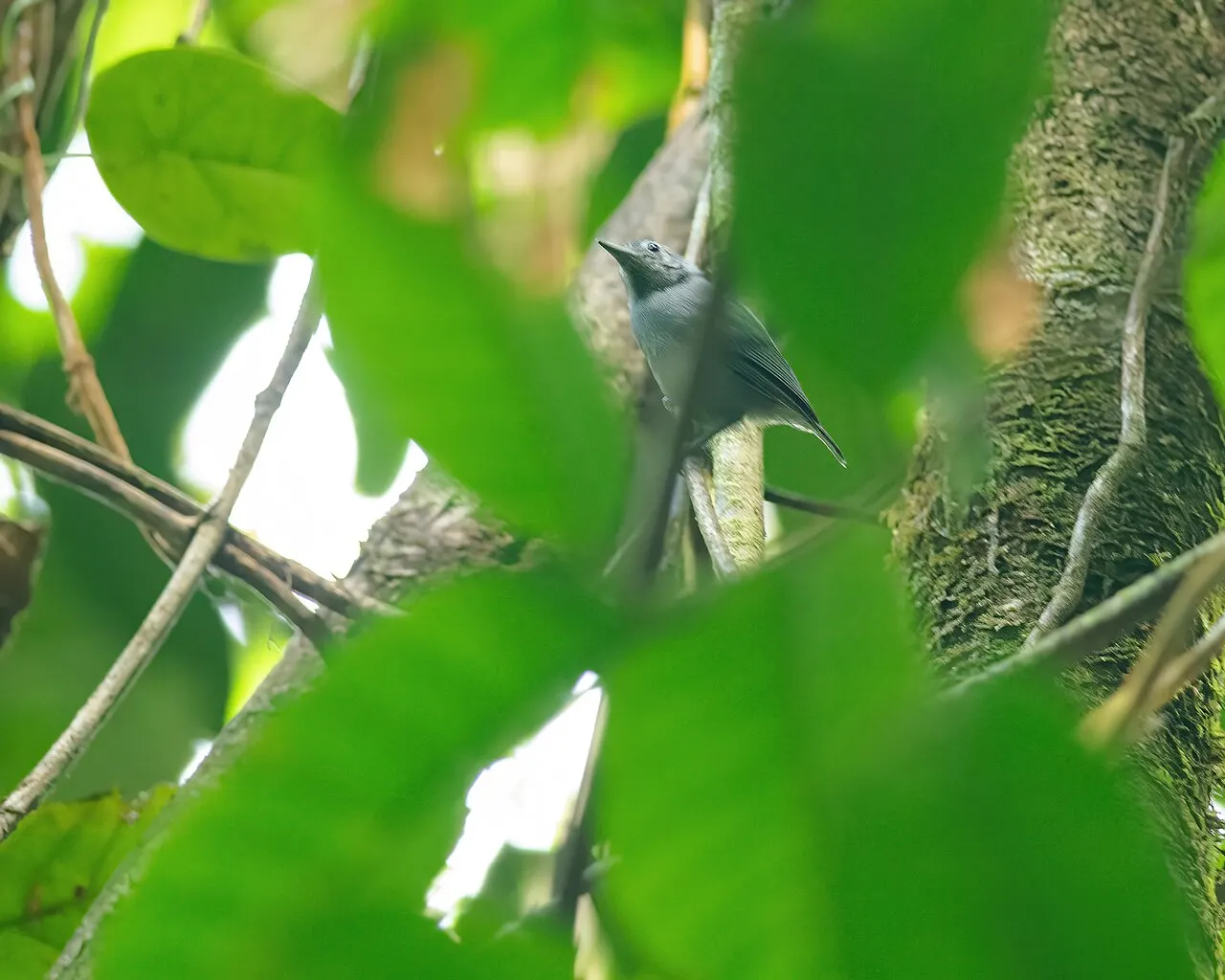
It is a small antbird with a short tail, 9.5 to 10.5 cm long and weighing about 8 to 11.5 g. Males are almost entirely gray, paler below than above, and the throat feathers have black bases with gray tips. Females are mostly rufous-brown, with darker wing coverts and a paler throat and cheeks. Both sexes have a brown eye and gray legs.
The song is a series of high, sharp notes that drop in pitch. It was long treated as a subspecies of the unicolored antwren (Myrmotherula unicolor) and is now ranked as its own species. The species name honours the British ornithologist David Snow.
Where it lives
The bird was first found in 1979 near Murici, in Alagoas, and for years that was the only place it was known. Early in this century it turned up at several sites in Pernambuco, roughly 500 km to the north. By about 2020 it was again recorded only at Murici. All records are between 430 and 790 m above sea level, in fragments of lowland evergreen forest. The IUCN lists 5 to 10 locations and Brazil as the only country.
Murici's forest reportedly shrank from about 70 square kilometres in the 1970s to about 30 by 1999, heavily disturbed and broken up.
Pins are Wikidata “endemic to” fields. Orange dots, when present, are GBIF occurrence tiles — survey bias included.
How it lives
It is a year-round resident that reportedly forages in pairs, searching live and dead leaves in the understory, usually 5 to 8 m above the ground. A 2016 to 2017 study at Murici tracked three pairs and found home ranges averaging about 1.3 hectares. That study did not see the species in mixed-species flocks, which many forest birds rely on, though other monitoring recorded a few pairs joining them.
Its nesting was almost unknown until a 2021 study found four nests. Each was a deep cup of fungal threads and dry leaf pieces set in a branch fork 1.1 to 1.6 m up. The first nest, found in November, held two eggs and both parents incubated them, but it was apparently raided by a predator after three days. The other nests held damaged eggs or were empty. The researchers proposed that laying happens in October and November and chicks fledge in December and January.
Why it is in trouble
Atlantic Forest in this region was cleared for pasture, sugarcane and timber, and little is left. The IUCN lists farming and ranching among the threats, and other accounts add fires spreading from plantations, wood cutting and hunting. Because the bird lives near the top of its altitude range, it may also be vulnerable to climate change.
Counts vary widely. The IUCN's 2021 assessment gives a population size of 1 to 49 individuals and says the trend is downward. Surveys at Murici between August 2016 and June 2017 recorded 37 birds, about 25 of them adults. Monitoring data from the conservation group SAVE Brasil, reported in 2022, put it at fewer than 10.
What is being done
Murici was recognised as an ecological station in 2001 and covers about 6,000 hectares, but a 2022 report said it had not been fully put into effect and that pasture still occupied large areas inside it. SAVE Brasil has worked in the region since 2000 on restoring forest, linking fragments with corridors, supporting private reserves and bird-friendly farming.
The IUCN records an action recovery plan and a monitoring scheme in place, and says the species is not held in captivity. Actions it lists as relevant include habitat restoration, captive breeding, reintroduction and payments to landowners. The 2021 nest study suggested testing nest protection, rebuilding mixed-species flocks, moving birds to nearby patches and trying captive breeding.
Sources
Written for this catalog in our own words from the sources below, checked against them on 12 November 2026. Population figures are estimates and carry the year they were made. Status and assessment year: IUCN. 2026. The IUCN Red List of Threatened Species. Version 2026-1. iucnredlist.org.




