Endangered
Scalloped antbird
Myrmoderus ruficauda
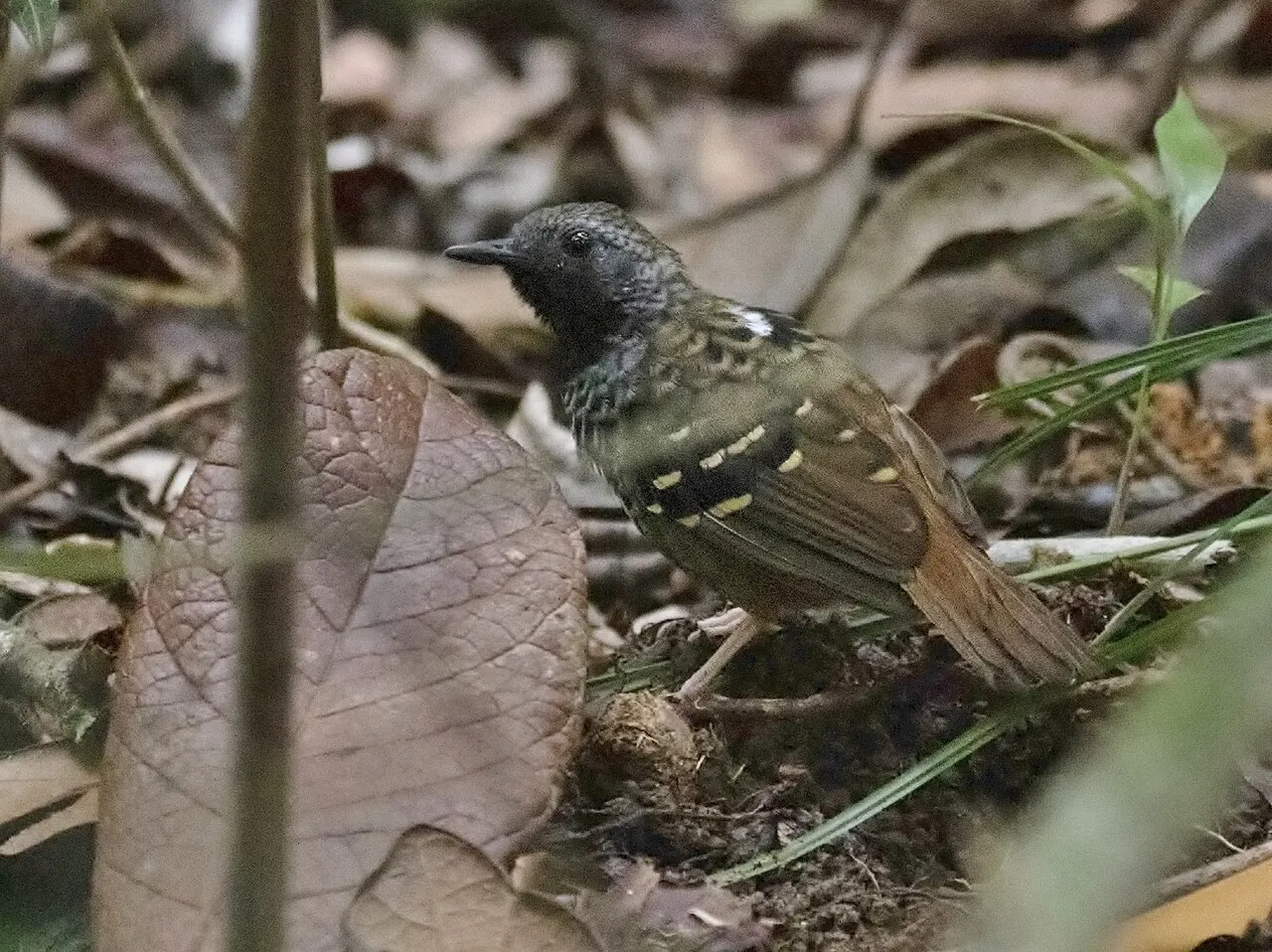
The scalloped antbird (Myrmoderus ruficauda) is a small, mostly ground-dwelling forest bird found only in Brazil's Atlantic Forest. The IUCN Red List classed it as Endangered in 2018, with an estimated 600 to 1,700 mature birds left in scattered forest patches. Males wear black feathers edged in white, giving the scalloped look.
How to recognise it
It's a small bird, about 14 to 15 cm long, and it spends most of its time on or near the forest floor. Males have a black face and throat, and a black breast with broad white feather edges that make the scalloped pattern. The rump and tail are rufous, and a white patch sits between the shoulders.
Females are browner above, with a white throat and a pale breast marked with black scalloping and spots. Two subspecies are recognised. The northern one, soror, is a little larger and paler than the nominate form.
Where it lives
The species is endemic to Brazil and its range is split in two. The nominate form lives in the south-east, in southern Bahia, far eastern Minas Gerais and Espírito Santo. The subspecies soror lives well to the north, in forest between Paraíba and Alagoas.
It prefers humid evergreen forest and older regrowth, usually in dense understorey with vine tangles. It has been described as a lowland bird, found mostly below about 600 to 650 m. Yet at Pedra Talhada in Alagoas, researchers recorded it mainly in upland forest, up to 883 m, the highest point of that forest.
Pins are Wikidata “endemic to” fields. Orange dots, when present, are GBIF occurrence tiles — survey bias included.
How it lives
Scalloped antbirds hop through leaf litter, flipping and probing it for food. They don't follow army ant swarms. Parents bringing food to nestlings at Pedra Talhada carried mostly whole arthropods, including spiders, centipedes, cockroaches and locusts, plus small frogs. The birds sometimes foraged in loose groups of their own species and only rarely alongside other birds.
The nest is a compact cup of dry leaves set on the ground, often ringed by a loose crown of leaves that helps hide it. Every clutch recorded there had two eggs. Both parents incubate and feed the young. Incubation lasted 15 to 18 days and the chicks left the nest after 10 to 13 days, before they could fly well, and the parents kept feeding them.
Between 1990 and 2016, Studer and colleagues found 41 nests at Pedra Talhada. Twenty-seven failed, seven succeeded and seven had an unknown outcome. Estimated nest success was about 22 percent. The team treated that as a sign of heavy predation, which is common among tropical birds.
Why it is in trouble
Most of Brazil's Atlantic Forest has been cleared, and what remains is broken into fragments. The IUCN's 2018 assessment counts the species' population as severely fragmented and still declining, spread over somewhere between 11 and 100 locations. The listed threats are farming and ranching, more frequent fires, and small-scale harvesting that unintentionally harms the forest. In the north-east, logging and clearance for sugarcane and pasture have fragmented much of the forest. Farther south, most forest has gone to plantation agriculture.
It has been rated Endangered since 2000, after earlier listings as threatened in 1988 and Vulnerable in 1994 and 1996.
What is being done
Several private and government reserves hold the species, though many are small. Pedra Talhada Biological Reserve in Alagoas, created in 1989 and covering 4,469 ha of forest, is one place where its breeding has been studied. The IUCN lists site protection and management as the conservation measures in place. It also records that no recovery plan exists.
Sources
Written for this catalog in our own words from the sources below, checked against them on 12 November 2026. Population figures are estimates and carry the year they were made. Status and assessment year: IUCN. 2026. The IUCN Red List of Threatened Species. Version 2026-1. iucnredlist.org.




