Endangered
Mugilogobius latifrons
Mugilogobius latifrons
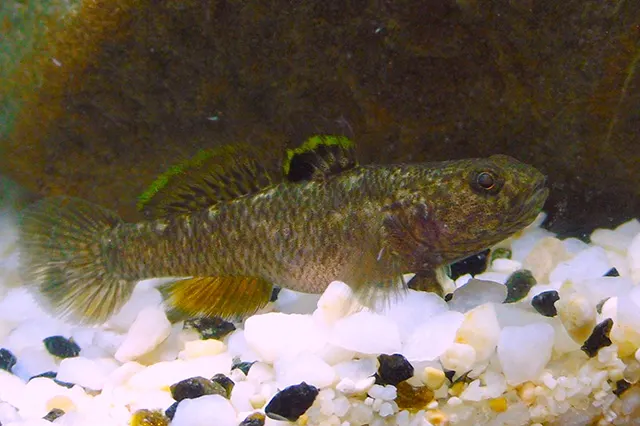
Mugilogobius latifrons is a small goby found only in the Malili Lakes of central Sulawesi, Indonesia. It lives in very shallow water and in streams, and grows to under 5 cm. The IUCN assessed it as Endangered in 2019, with a decreasing population and habitat under pressure from erosion, dams and invasive fish.
What it is
This is a goby in the genus Mugilogobius, described by the zoologist George Boulenger in 1897 under the name Gobius latifrons. It has since moved through other genus names, including Tamanka and Vaimosa, before settling in Mugilogobius. Adults reach about 4.7 cm in total length.
Where it lives
The species is endemic to Indonesia and known only from the Malili Lakes system on Sulawesi. This is a group of five interconnected lakes, including Matano, Mahalona and Towuti. Water flows from Matano to Mahalona to Towuti, and out through the Larona and Malili rivers to Bone Bay. Although the lakes are linked, each one has its own mix of animals, and many species live in just one of them.
The Red List counts three locations and describes the population as severely fragmented. It lists lakes of more than 8 hectares and permanent streams as its habitat, and the species is usually found in extremely shallow water. A 2014 paper in the Raffles Bulletin of Zoology, which described a second goby from Lake Towuti, recorded this species in streams of the Malili drainage and suggested from DNA data that the lakes' Mugilogobius gobies may form a species flock, a group of closely related species that evolved in one place. That was put forward as a possibility, not a result.
Pins are Wikidata “endemic to” fields. Orange dots, when present, are GBIF occurrence tiles — survey bias included.
Why it is in trouble
The IUCN assessment gives three threats. The most serious is soil erosion and sedimentation, which affects most of the species' range and is linked to rapid declines. Dams of unknown size and an introduced cichlid, Amphilophus trimaculatus, are also listed, both rated as low impact.
Other introduced fish, including Nile tilapia, flowerhorn cichlids and plecostomus catfish, are reported to prey on or compete with native animals in the lake system, and a 2025 study found that local fishers' catches have shifted from mainly native fish to mainly introduced ones. Endemic shrimps from the lakes are also sold for aquariums, so the system is under several pressures at once.
What is being done
The Red List records no conservation actions for this goby specifically. It does note that the species occurs in at least one protected area. The Critical Ecosystem Partnership Fund has prioritised the Malili lake system for biodiversity funding, and in November 2015 Burung Indonesia invited groups to apply for small grants for work there.
Sources
Written for this catalog in our own words from the sources below, checked against them on 12 November 2026. Population figures are estimates and carry the year they were made. Status and assessment year: IUCN. 2026. The IUCN Red List of Threatened Species. Version 2026-1. iucnredlist.org.
- IUCN Red List assessment, Mugilogobius latifrons (2019)
- Mugilogobius latifrons
- Mugilogobius hitam, a new species of freshwater goby from Lake Towuti (Larson et al., 2014)
- Poso and Malili Lake System, Paradise of Endemic Fishes (Burung Indonesia, 2015)
- Fisheries in the Malili ancient lake complex: from endemic to introduced species (2025)




