Endangered
Mountain stream salamander
Ambystoma altamirani
The mountain stream salamander (Ambystoma altamirani) is a dark mole salamander of cold mountain streams in central Mexico, west and south of the Valley of Mexico. The IUCN Red List reassessed it as Endangered in 2025, with a decreasing population. Habitat change and introduced trout are among its threats.
How to recognise it
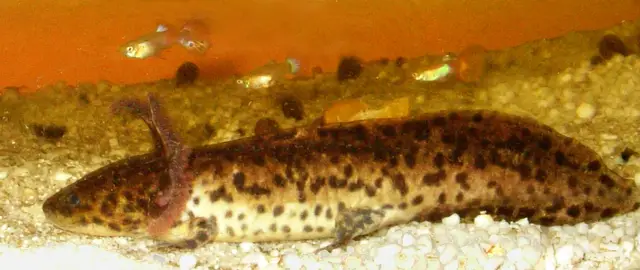
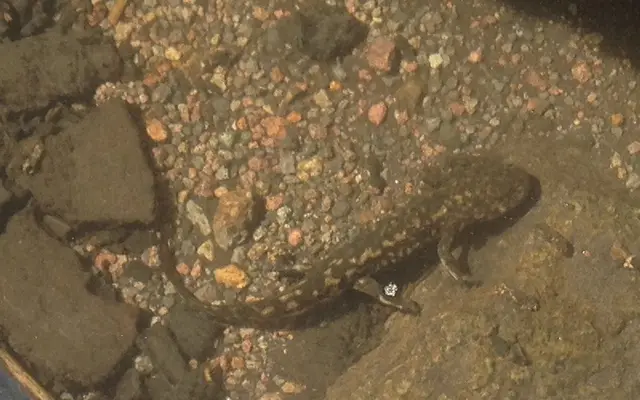
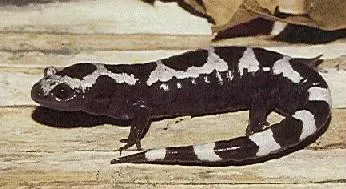
It's a slender salamander that reportedly reaches about 115 mm (4.5 inches) in total length, with a tail of roughly 50 mm. The back and sides are purplish black and the belly is a purplish lavender. The edges of the lips, the tips of the toes and the fin along the underside of the tail are cream coloured.
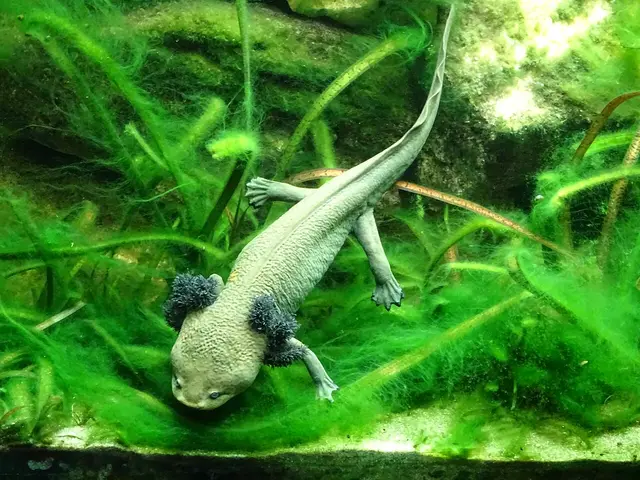
Like other mole salamanders, young animals hatch in water as gilled larvae. As they grow they develop limbs and can leave the water, losing their gills and tail fin. Some individuals, both larvae and adults, stay in the streams all year.
Where it lives
The species is endemic to central Mexico. Its streams run through cool pine and pine-oak forest at high elevation, and it also turns up in streams that cross cleared pasture. The Red List gives a recorded elevation span of 2,450 to 3,487 m.
The Red List gives the locations as the State of Mexico, Morelos and the Federal District (Mexico City area), and counts the species at a single location in the sense used for assessments. Its extent of occurrence is put at about 1,564 square km. Listed habitats are moist montane forest, permanent streams and pastureland.
Pins are Wikidata “endemic to” fields. Orange dots, when present, are GBIF occurrence tiles — survey bias included.
How it lives
Larvae live only in streams. Adults can be found both on land and in the water, and they go back to streams to breed. Eggs are laid and given no parental care.
A 2024 study in Villa del Carbon, State of Mexico, sampled four sites monthly between September 2022 and August 2023 and counted 1,186 animals. Numbers were linked to factors such as oxygen saturation, temperature, sunlight and bacterial contamination of the water. Sites with the most animals held more adults, mainly females.
Why it is in trouble
The Red List records a decreasing population and a continuing decline in the area it occupies. Its threat list covers housing and urban growth, tourism and recreation areas, recreational activities, soil erosion and sedimentation, the abstraction of water from streams, and accidental harm from small-scale harvesting. Named problem species are listed too.
Introduced rainbow trout are a particular worry. In 2016 and 2017 a survey of four streams in Lagos de Zempoala National Park, where the salamander had been reported before, found it in only one, a small cold stream without fish. The other three held trout. The author, Guerrero de la Paz, proposed that trout had caused local losses there. Illegal logging and stream pollution are also reported as problems.
The 2024 Villa del Carbon study found populations falling during its year of monitoring and concluded the habitat is not being adequately conserved.
What is being done
Part of the range lies in a protected area, and the Red List records land and water protection already in place. It calls for site and habitat protection, policy and regulation, site management, control of invasive or problem species and restoration of habitat. Mexican law reportedly gives the salamander Special Protection status.
Vargas-Gomez and Chaparro-Herrera, who ran the 2024 study, say protecting the species is urgent and call it an umbrella species, meaning that keeping its streams in good condition should help other life there too.
Sources
Written for this catalog in our own words from the sources below, checked against them on 12 November 2026. Population figures are estimates and carry the year they were made. Status and assessment year: IUCN. 2026. The IUCN Red List of Threatened Species. Version 2026-1. iucnredlist.org.