Endangered
Mountain anoa
Bubalus quarlesi
The mountain anoa (Bubalus quarlesi) is a dwarf wild buffalo of the forests of Sulawesi and the nearby island of Buton in Indonesia. The IUCN Red List classed it as Endangered in 2016, estimating fewer than 2,500 mature animals and a declining population, mainly because of hunting.
How to recognise it
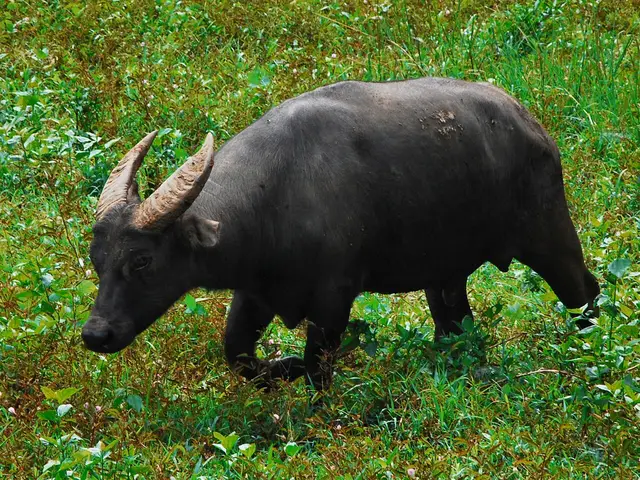
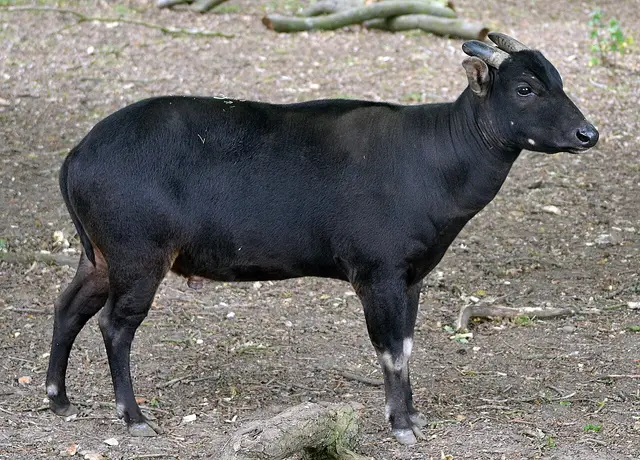
It looks like a miniature water buffalo, standing about 70 cm at the shoulder, which makes it one of the smallest wild cattle. Adults are dark brown to black, and both sexes carry short, straight, smooth horns that are round in cross-section. Reported weights vary widely, from 56 kg for a single measured animal to around 150 kg in other accounts.
Telling it from the lowland anoa is hard, because many of its distinguishing features are shared by young lowland anoas. Whether the two are separate species is still debated, and the IUCN notes that zoo animals can show features of both. A mitochondrial DNA study of ten specimens found large genetic differences between animals identified as each type, which supports two species. The IUCN and the Global Biodiversity Information Facility both list the mountain anoa as its own species.
Where it lives
It is found only on Sulawesi and Buton. It has been confirmed across most of central Sulawesi and in northern Buton, and older reports place it on the northern peninsula and part of the southeastern one. It is usually recorded at 1,000 to 2,300 m but has been found near sea level.
It prefers dense forest with thick undergrowth, close to water and away from people. Protected areas thought to hold important populations include Lore Lindu National Park, Bogani Nani-Wartabone National Park and Tanjung Peropa Nature Reserve.
Pins are Wikidata “endemic to” fields. Orange dots, when present, are GBIF occurrence tiles — survey bias included.
How it lives
Mountain anoas usually live alone or in pairs and are mostly active in the morning. In Lore Lindu they have been recorded eating grasses, sedges, ferns, tree seedlings and herbs. They wallow in water and mud and visit mineral springs and salt licks.
In captivity, they mature at 2 to 3 years, usually have one calf a year and live 20 to 30 years. Wild breeding may be slower. Gestation is given as roughly 9 to 10 months for anoas in general. Little is known about life in the wild.
Why it is in trouble
Hunting for meat is the main threat, along with loss of forest to farming and gold mining. Even large protected areas such as Lore Lindu hold subpopulations that are reported to be declining because of heavy hunting.
The IUCN thinks fewer than 2,500 mature animals remain and that no subpopulation exceeds 250. No island-wide or regional survey has been done. Numbers have fallen since the late 19th century, steeply in some areas between 1980 and 2000, with the worst declines reported around Gorontalo and Buol Toli-Toli. Trade in live animals and body parts is not thought to be a serious threat.
What is being done
The mountain anoa is fully protected under Indonesian law and listed in CITES Appendix I. In 2013 the Indonesian Ministry of Forestry published a conservation action plan for anoas covering 2013 to 2022, aimed at reducing hunting and illegal trade and keeping habitat intact. The IUCN says it is too early to judge its effect.
A small number of mountain anoas are held in captivity, but breeding has been hindered by the difficulty of assigning captive anoas to the right species. Genetic and body-shape research is under way to settle how many anoa species there are.
Sources
Written for this catalog in our own words from the sources below, checked against them on 12 November 2026. Population figures are estimates and carry the year they were made. Status and assessment year: IUCN. 2026. The IUCN Red List of Threatened Species. Version 2026-1. iucnredlist.org.