Endangered
Dunn's spinytail lizard
Morunasaurus groi
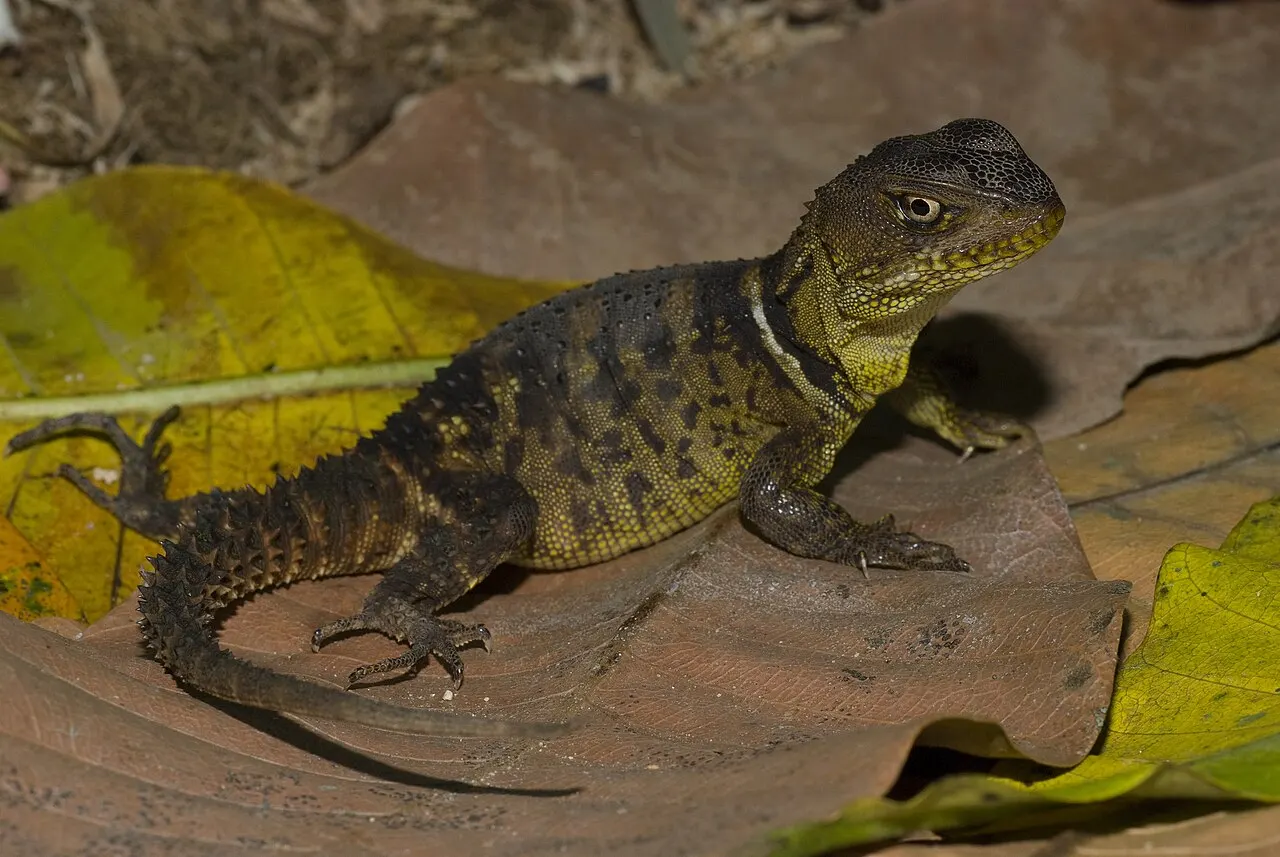
Dunn's spinytail lizard (Enyalioides groi), also called Gro's manticore, is a spiny-tailed forest lizard of central Panama and northwestern Colombia. The IUCN Red List rated it Endangered in 2016. It is known from only three locations, and the 2016 assessment gives its occupied area as about 12 square kilometres.
How to recognise it
This is a hoplocercid, a small family of South American lizards with spiny, tapering tails. The tail is roughly circular in cross section, longer than the body, and covered in small spines. There are also projecting spines on the thigh, shin and foot, and the lizard has no parietal eye, the light-sensing spot on top of the head that many lizards keep.
Males are reportedly reddish-brown with dark bands across the back, a red neck with a partial white collar and a scarlet chin. Females look similar but lack the scarlet chin and have a yellow belly.
Where it lives
The species is known from central Panama and northwestern Colombia. The type locality, where the first specimens came from, is Valle de San Antón in Panama. The Reptile Database gives an elevation of 700 to 805 metres for the Colombian (Antioquia) record, and the IUCN gives a range of 600 to 900 metres across the species, in moist lowland tropical forest.
The IUCN counts three locations. It also reports that the lizard is not a migrant and occurs in at least one protected area.
Pins are Wikidata “endemic to” fields. Orange dots, when present, are GBIF occurrence tiles — survey bias included.
How it lives
It lays eggs. Little else about its habits is documented in the sources, and the IUCN lists no population size and records the population trend as unknown.
Why it is in trouble
The Endangered rating (criterion B2ab(ii,iii)) rests on a very small area of occupancy and on a continuing decline in the area and quality of its habitat. The threat the IUCN names is housing and urban development, which converts and degrades the forest where the lizard lives.
Because the animal is so little studied, the true state of its populations is hard to judge. A rating based on shrinking habitat can mean the species is stable in the forest that remains, or that it is declining unseen.
What is being done
The IUCN lists habitat and natural process restoration, resource and habitat protection, and site and area protection as the relevant actions, and notes that the species occurs in at least one protected area. No programme aimed specifically at this lizard shows up in the sources.
The species has also been renamed. Emmett Reid Dunn described it in 1933 as Morunasaurus groi. A 2023 study of hoplocercine lizards in the Bulletin of Phylogenetic Nomenclature found that it groups with two Enyalioides species, E. heterolepis and E. laticeps, and it is now placed in that genus. The name reportedly honours Lord Gro, a character in E. R. Eddison's novel The Worm Ouroboros.
Sources
Written for this catalog in our own words from the sources below, checked against them on 12 November 2026. Population figures are estimates and carry the year they were made. Status and assessment year: IUCN. 2026. The IUCN Red List of Threatened Species. Version 2026-1. iucnredlist.org.




