Endangered
Mlanje Mountain chameleon
Nadzikambia mlanjensis
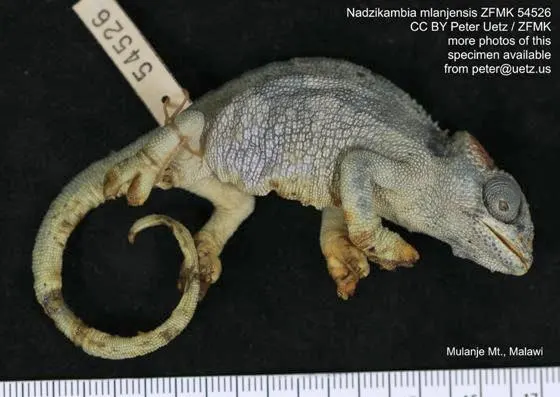
The Mlanje Mountain chameleon (Nadzikambia mlanjensis) is a small forest chameleon found only on Mount Mulanje in southern Malawi. The IUCN Red List rates it Endangered (assessed 2014) and says its numbers are falling. It lives in a few patches of mountain forest covering a very small area.
A chameleon with a tangled classification
This is a small chameleon, and one of only two species in the genus Nadzikambia. The genus name comes from the word for chameleon in Chichewa, a language of Malawi. The herpetologist Donald Broadley described the species in 1965, first under the genus Chamaeleo. It lays eggs rather than giving birth to live young.
Its classification has been revised more than once. In 1986 Klaver and Böhme moved it in with the South African dwarf chameleons (Bradypodion), but that grouping was later shown to be an error, and a genus of its own was recognised in 2006. Descriptions of its size and colour are hard to find in the sources available.
Where it lives
The type locality is the forest of the Ruo Gorge on Mulanje Mountain, and the species is known only from the Mulanje massif. The Red List counts five separate locations, at elevations from about 1,100 to 1,900 m, all in montane forest.
The area it actually occupies is tiny. The IUCN estimates its area of occupancy at 61 square kilometres and its extent of occurrence at 220 square kilometres (2014). Mulanje itself is a granite massif of about 650 square kilometres that rises above 3,000 m out of the surrounding plain, and its forest patches are scattered across it.
Pins are Wikidata “endemic to” fields. Orange dots, when present, are GBIF occurrence tiles — survey bias included.
Why it is in trouble
The Red List describes the population as severely fragmented and still declining, with the forest it depends on shrinking. The main ongoing threat is small-holder farming, which clears and degrades forest. Large-scale agriculture caused rapid losses in the past but is considered unlikely to return. Possible future mining is also listed.
Invasive pines are a further problem. The IUCN says their spread is transforming the forest, and the introduced Mexican pine is described as highly invasive to the Mulanje cedar. For the mountain as a whole, illegal logging of cedar and increasingly frequent fires are also reported.
What is being done
Nearly all of the chameleon's range, an estimated 91 to 100 percent of the population, falls inside a protected area, and a regional management plan for the area exists. Even so, the assessment noted that the forest was not protected in practice, since illegal activity continued.
The IUCN recommends better enforcement against illegal forest clearing, removal of invasive pines, and restoring forest to make the remaining patches larger and healthier. In 2014 it noted there was no systematic monitoring scheme or recovery plan. Population size has never been counted, and it is not known whether the species tolerates altered habitat or lives on the nearby Mount Mchese.
Sources
Written for this catalog in our own words from the sources below, checked against them on 12 November 2026. Population figures are estimates and carry the year they were made. Status and assessment year: IUCN. 2026. The IUCN Red List of Threatened Species. Version 2026-1. iucnredlist.org.




