Endangered
Mitchell's rainforest snail
Thersites mitchellae
Mitchell's rainforest snail (Thersites mitchellae) is a large, night-active land snail from the subtropical rainforest of far northern New South Wales, Australia. The IUCN Red List lists it as Endangered (assessed 1996). Its dark shell with two yellow bands makes it easy to tell from other local snails.
How to recognise it
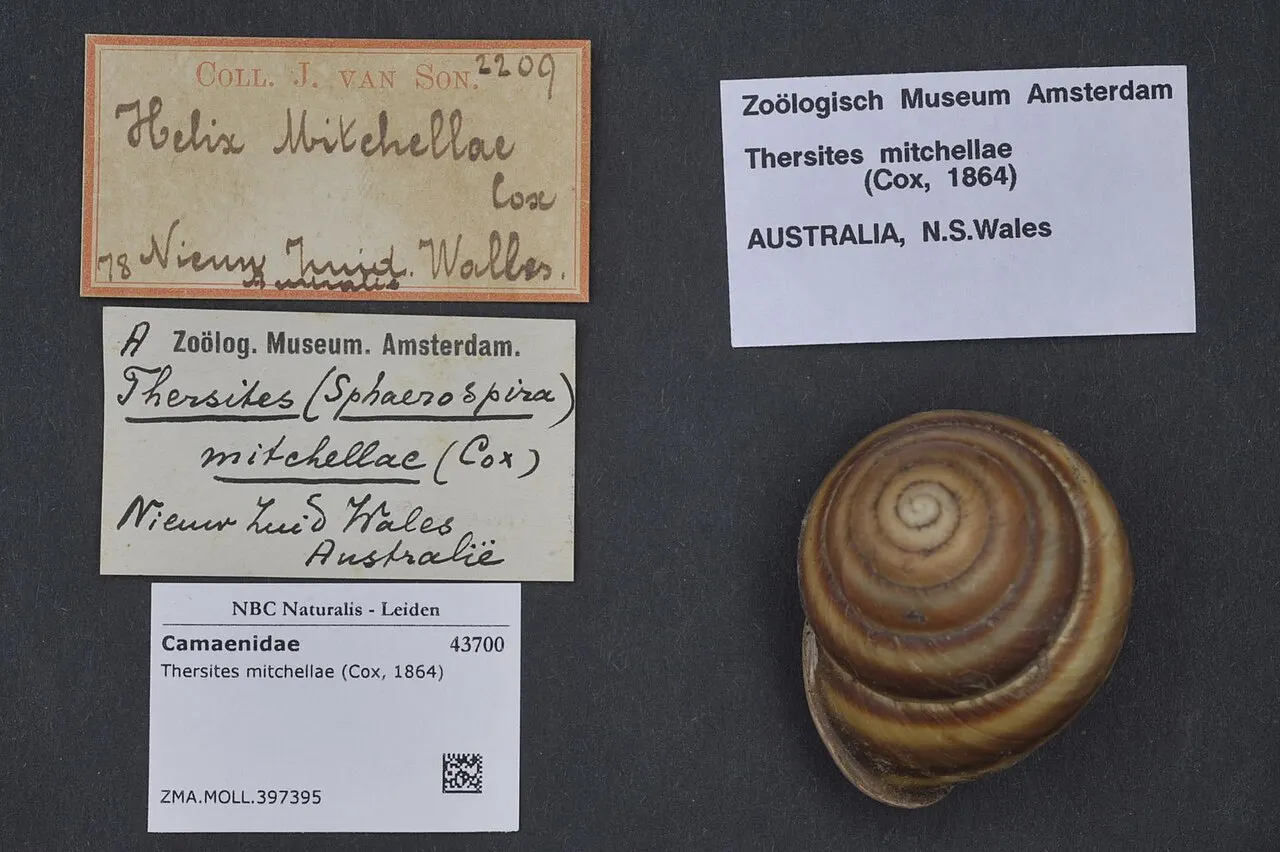
This is a big snail. The shell can reach about 55 mm across and 50 mm high, with a triangular outline in side view and a thickened lip around the opening. The colour runs from deep reddish chestnut to nearly black, crossed by two bold yellow bands. The body is black, with a thin pale line down the back.
Where it lives
The snail belongs to the coastal plain of the NSW north coast, between the Richmond and Tweed rivers. It has also turned up in a few nearby higher spots, including the Wilsons River area and Mount Jerusalem. Its home is remnant lowland subtropical rainforest and swamp forest on alluvial soil, and slightly raised ground around wetland edges with palms and fig trees is especially favoured.
Stotts Island Nature Reserve, in the Tweed River near Murwillumbah, holds the largest known population and the largest single area of remaining habitat. In 2001 the NSW Minister for the Environment declared the reserve critical habitat for the snail, the first such declaration in the state. A 1997 listing determination described the species as once common from the Tweed south to Ballina, and by then reduced to two small, separate populations. Few specimens had been collected: four from Stotts Island between 1977 and 1981, and one from Cunbebin Wetland behind Byron Bay in 1996.
Pins are Wikidata “endemic to” fields. Orange dots, when present, are GBIF occurrence tiles — survey bias included.
How it lives
It spends its time mostly in the leaf litter on the forest floor and sometimes under loose bark on tree trunks, and it has also been recorded sheltering in the bases of palm fronds. It comes out at night. Its food is leaf litter, fungi and lichen. Noisy pittas are known to eat these snails, cracking the shells open on rocks or other hard surfaces.
Why it is in trouble
Most of the lowland rainforest, swamp forest and wetland margin it depended on has been cleared for farming and building, leaving small patches. Small patches suffer from edge effects, grazing by stock, fire and weeds. Introduced rats are a concern, and the snail appears very vulnerable to predation by introduced mammals and by birds. Herbicides and pesticides used near its habitat, dieback caused by the root-rot fungus Phytophthora cinnamomi, changes to water flow and, on the coastal floodplain, sea level rise are also listed as threats.
Under NSW law it has been listed as Endangered since March 1997. Under national law it is Critically Endangered, a higher category than the 1996 IUCN listing.
What is being done
A recovery plan was published in 2001. Suggested actions include protecting rainforest and wetland edges from fire, stock and weeds, keeping even small habitat patches, controlling rats near habitat, avoiding snail baits and pesticides, and surveying for new populations. People who find a live snail are asked to report it and leave it where it is.
The name itself may not last. A 2025 revision of the genus Thersites by Zhang, Cassis and Kohler, published in the Zoological Journal of the Linnean Society, combined genome-scale DNA data with shell and anatomy measurements. It folded T. mitchellae into the more widespread eastern Australian snail T. novaehollandiae as a junior synonym, to keep that species group monophyletic. The Red List, NSW and national lists still use the older name.
Sources
Written for this catalog in our own words from the sources below, checked against them on 12 November 2026. Population figures are estimates and carry the year they were made. Status and assessment year: IUCN. 2026. The IUCN Red List of Threatened Species. Version 2026-1. iucnredlist.org.
- IUCN Red List assessment (1996)
- NSW Threatened Species profile, Mitchell's rainforest snail
- NSW Scientific Committee final determination (1997)
- Tweed Regional Museum, Mitchell's rainforest snail
- Zhang, Cassis and Kohler (2025), Zoological Journal of the Linnean Society, abstract via Crossref
- Declaration of critical habitat, Stotts Island Nature Reserve (NSW Environment and Heritage)
- Thersites novaehollandiae (Wikipedia)




