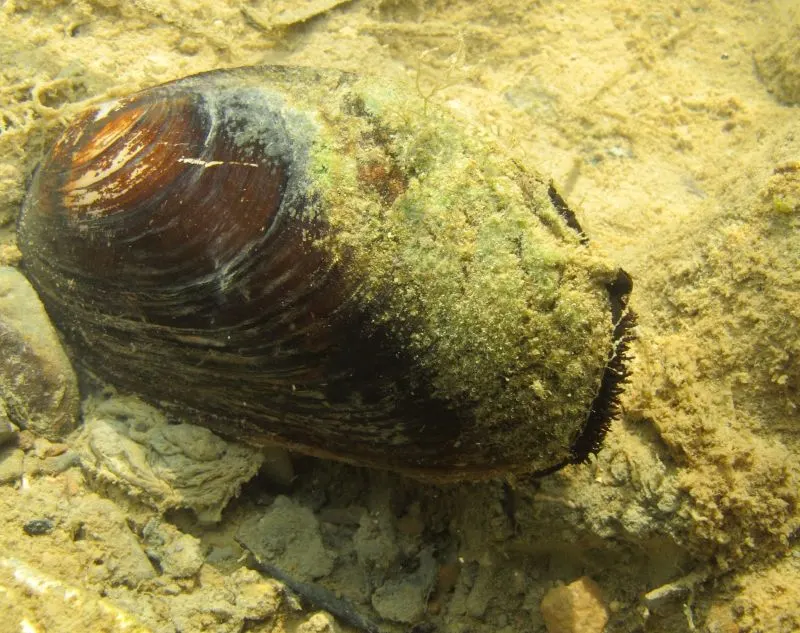
Critically Endangered
Microcondylaea bonellii
Microcondylaea bonellii
Microcondylaea bonellii is a slim freshwater mussel that once lived in rivers and lakes from Switzerland to the western Balkans. The IUCN Red List (2024) rates it Critically Endangered. Small, isolated populations remain in northern Italy, Slovenia, Croatia, Montenegro and Albania, while it is listed as extinct in Switzerland and Greece.
How to recognise it
The shell is elongated and flattened from side to side, reaching about 99 mm long and 45 mm wide. Living animals are light brown to brown, and empty shells often turn dark brown or black.
One feature sets it apart from other European freshwater mussels. The papillae around its siphon branch like a tree, while those of its relatives are undivided. That makes identification possible without disturbing a mussel buried in the sediment.
Some references use the name Microcondylaea compressa for the same animal.
Where it lives
It favours weakly flowing rivers, lakes and other still water with a fine sandy bed containing some clay. It lives fully buried and does not tolerate large swings in conditions.
It has been recorded in Switzerland, Italy, Slovenia, Croatia, Montenegro, Lake Ohrid and Greece. It is listed as extinct in Switzerland and Greece and possibly extinct in Lake Ohrid, though a 2022 paper calls the only Greek record, from Lake Trichonis, doubtful. The range is now broken in two by the Dinaric Alps.
In Slovenia, a 2019 survey of known and likely sites found living mussels only in the lower Vipava River, a population limited to about 16 km of river and cut off from the others. The Lijak Stream, the type locality, held none.
In August 2021, researchers sampling the Skadar Lake basin in Montenegro found one living population, in the Zeta River near Podgorica. The species had not been mentioned in Montenegro since 1909.
Pins are Wikidata “endemic to” fields. Orange dots, when present, are GBIF occurrence tiles — survey bias included.
How it lives
Like other freshwater mussels, it filters phytoplankton and small suspended particles from the water. Females release larvae in whitish, elongated packets that probably resemble caddisfly larvae and may attract fish. No host fish has been confirmed.
One reference gives a lifespan of about 5 to 6 years.
Why it is in trouble
The 2022 Zeta River paper, in the journal Diversity, describes a patchy range shaped by habitat loss under human pressure. It notes that many remaining populations face pressure from economic activity and tourism, and that suitable habitat is shrinking quickly.
Examples are specific. Riverbed changes in north-eastern Italy, for instance along the Torrente Versa, have reduced the area where the mussel can live. In Montenegro, tourism and infrastructure development around Lake Skadar are a concern. In Slovenia, river engineering works and development continue to threaten key stretches of the Vipava.
Because the populations are separated, a loss in one stream is unlikely to be made good by mussels arriving from elsewhere. The researchers did find a hopeful sign: the populations on both sides of the Alps show relatively high genetic diversity, and the Zeta River mussels shared three mitochondrial gene variants.
What is being done
The species is listed in Annex V of the EU Habitats Directive. The Slovenian survey (Govedic and Bizjak Govedic, 2019) urged strict application of the legislation that protects it and its habitat, and the Montenegro team called for conservation priorities to be set urgently and for strict protection of the habitats it uses.
Sources
Written for this catalog in our own words from the sources below, checked against them on 12 November 2026. Population figures are estimates and carry the year they were made. Status and assessment year: IUCN. 2026. The IUCN Red List of Threatened Species. Version 2026-1. iucnredlist.org.




