Endangered
Transitional colilargo
Microakodontomys transitorius
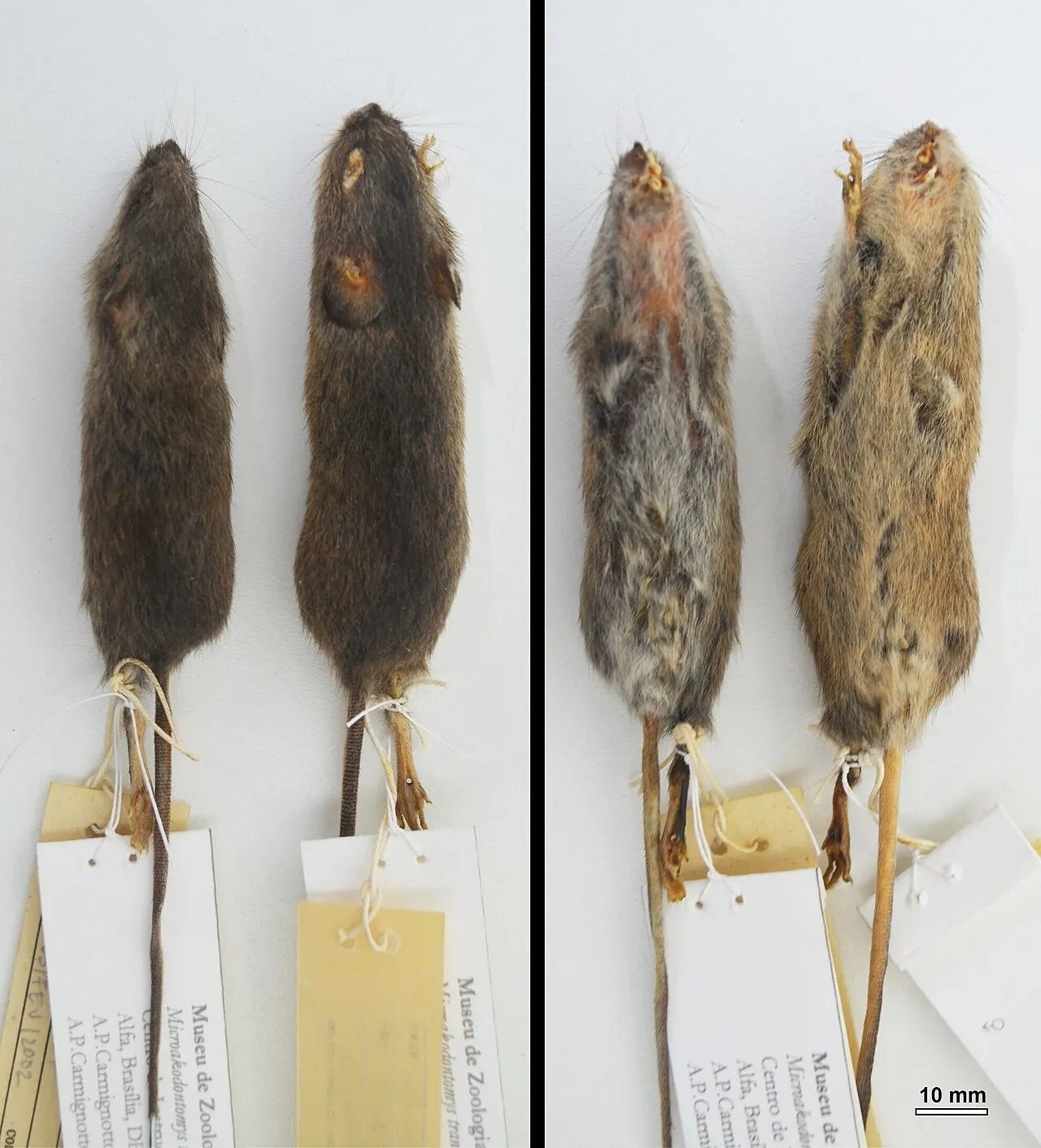
The transitional colilargo (Microakodontomys transitorius) is a tiny long-tailed mouse from the cerrado of central Brazil. It was described from a single animal caught near Brasilia in 1986, and the IUCN rated it Endangered in 2018. It is the only species in its genus.
How to recognise it
The only specimen described in detail, the holotype, measured 70 mm from head to rump with a 93 mm tail, so the tail is about 133% of the body length. The back is ochre-buff lined with blackish, the underparts are washed with ochre, and a narrow blackish band runs along each side of the snout from the nose tip to the corner of the eye.
Those snout stripes and smaller ears are the main outward differences from the mice of the genus Microryzomys, which it otherwise closely resembles. A small ridge on the lower molars, the mesolophid, is absent.
Where it lives
The first specimen was collected on 14 July 1986 by Philip Hershkovitz and Scott Lindbergh in Brasilia National Park, about 20 km northwest of the capital, at around 1,100 m. It was taken at the edge of campo limpo, wet grassland on a valley side. Hershkovitz thought it was probably rare, since it turned up once in five weeks of intense trapping.
The IUCN lists Brazil as the only country and counts two locations, with an area of occupancy of 32 square kilometres and an extent of occurrence of about 18,000 square kilometres. It lists moist subtropical or tropical shrubland and seasonally wet grassland as habitat, and records that the species occurs in at least one protected area. Nothing about its diet or breeding appears to have been published.
Pins are Wikidata “endemic to” fields. Orange dots, when present, are GBIF occurrence tiles — survey bias included.
Why it is in trouble
The IUCN reports a decreasing population, a severely fragmented range and a continuing decline in habitat area. Threats it lists include housing and urban areas and several kinds of farming and plantation, each scored as low impact. With only two locations and a small occupied area, even modest habitat loss matters.
The assessment lists no conservation actions in place beyond occurrence in a protected area, and it names population size, distribution and trends, and threats as research needs.
Naming and classification
Hershkovitz described the genus in 1993 as a rodent transitional between two groups of South American mice, the akodonts and the oryzomyines, which fits the name transitorius. Later researchers led by Weksler reportedly argued that it is an odd member of the genus Oligoryzomys instead. The IUCN and GBIF still list it as a separate species.
Sources
Written for this catalog in our own words from the sources below, checked against them on 12 November 2026. Population figures are estimates and carry the year they were made. Status and assessment year: IUCN. 2026. The IUCN Red List of Threatened Species. Version 2026-1. iucnredlist.org.




