Endangered
Mexclapique
Girardinichthys viviparus
The Chapultepec splitfin, known in Mexico as the mexclapique, is a small live-bearing fish from the lakes of the Valley of Mexico. The IUCN lists it as Endangered (assessed 2019, after a Critically Endangered rating in 1996). Most of its original wetlands around Mexico City are gone, and it survives in a few urban lakes.
How to recognise it
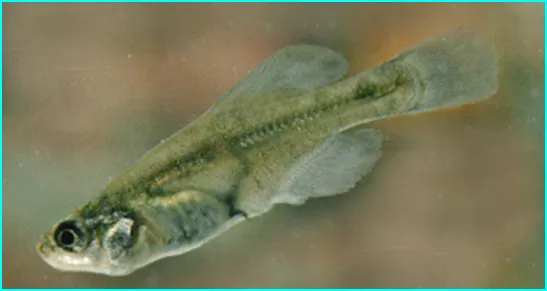
This is a small silvery fish. Males reach about 6.5 cm in total length and females stay smaller, at around 5 cm. Males have noticeably larger dorsal and anal fins than females, and they can look marbled blackish-grey. Females are silvery with a darker back.
During courtship the colour differences between the sexes sharpen, and the male's fins darken and can turn nearly black. The species belongs to the Goodeidae, a family of Mexican live-bearing fishes, and shares its genus with the darkedged splitfin.
Where it lives
The species is endemic to Mexico and is the only goodeid native to Mexico City. Before the capital grew, it probably lived throughout Lake Texcoco and the lakes connected to it, including Xochimilco, Xaltocan, Chalco and Zumpango. An early naturalist, Bustamante, wrote in 1837 that it was exceedingly common in the city's lagoons and irrigation channels.
Today it is found in remnants of those waters. It persists in three artificial lakes in Chapultepec Park (Viejo, Menor and Mayor), with its stronghold in Lago Mayor, in small numbers at Xochimilco and Zumpango, and in moderate numbers at Alameda Oriente near the city airport. It disappeared from Lake Texcoco and Lake Chalco during the 20th century.
A drainage channel let it reach the upper Pánuco basin, where it was recorded in the Tula River system. The fish in Laguna de Tecocomulco in Hidalgo are an introduced stock. The IUCN counts five locations at roughly 2,250 to 2,550 metres, with an extent of occurrence of 1,830 to 2,900 square kilometres and an area of occupancy of only 48 to 80 square kilometres.
Pins are Wikidata “endemic to” fields. Orange dots, when present, are GBIF occurrence tiles — survey bias included.
How it lives
It lives in lakes, marshes and pools of fresh water, in cool tropical conditions of roughly 20 to 22 degrees C. It has small, sharp teeth and a gut about as long as its body, which points to a carnivore, and it probably eats mosquito larvae and small insects at the surface.
Females give birth to live young. Gestation lasts about 55 days and a female bears roughly 25 young at a time. Breeding reportedly continues for most of the year except the coldest months, with births from about February to October. It was the first fish of the killifish group (cyprinodonts) in which live birth was observed, as early as 1769.
People and the fish
Bustamante recorded that poor people in Mexico City once ate the fish with a sauce, and it was sold dried. Numbers have fallen so far that it no longer plays a part in the food trade, and it is not targeted for the aquarium trade.
Why it is in trouble
Its home range sits under one of the largest cities in the world. Centuries of drainage turned the old lake system into a few remnants, and the historical range is estimated to have shrunk by more than 65 percent. The remaining waters suffer from pollution, water treatment problems and introduced fish. Common carp and tilapia were stocked in the Chapultepec lakes, and fish there carry parasites including an anchor worm and an Asian tapeworm.
Xochimilco and Zumpango add industrial wastewater with heavy metals and nutrient enrichment. The IUCN also lists water abstraction, sinking groundwater, sewage, run-off and pesticides. Lago Mayor is vulnerable when it is drained for maintenance, and plans to expand the airport threaten the Alameda Oriente population.
What is being done
The species occurs in at least one protected area, and part of its range at Xochimilco lies inside a Ramsar wetland site. It is also kept in captivity. The IUCN lists site protection, habitat restoration, awareness work, captive breeding and species recovery as actions the species needs. A monitoring and breeding project at a university laboratory in Morelia is reported, and it appears to be the only targeted effort.
The 2019 assessment rates the fish Endangered, an improvement on the Critically Endangered rating of 1996, but the population trend is still decreasing.
Sources
Written for this catalog in our own words from the sources below, checked against them on 12 November 2026. Population figures are estimates and carry the year they were made. Status and assessment year: IUCN. 2026. The IUCN Red List of Threatened Species. Version 2026-1. iucnredlist.org.




