Endangered
Metacnemis valida
Metacnemis valida
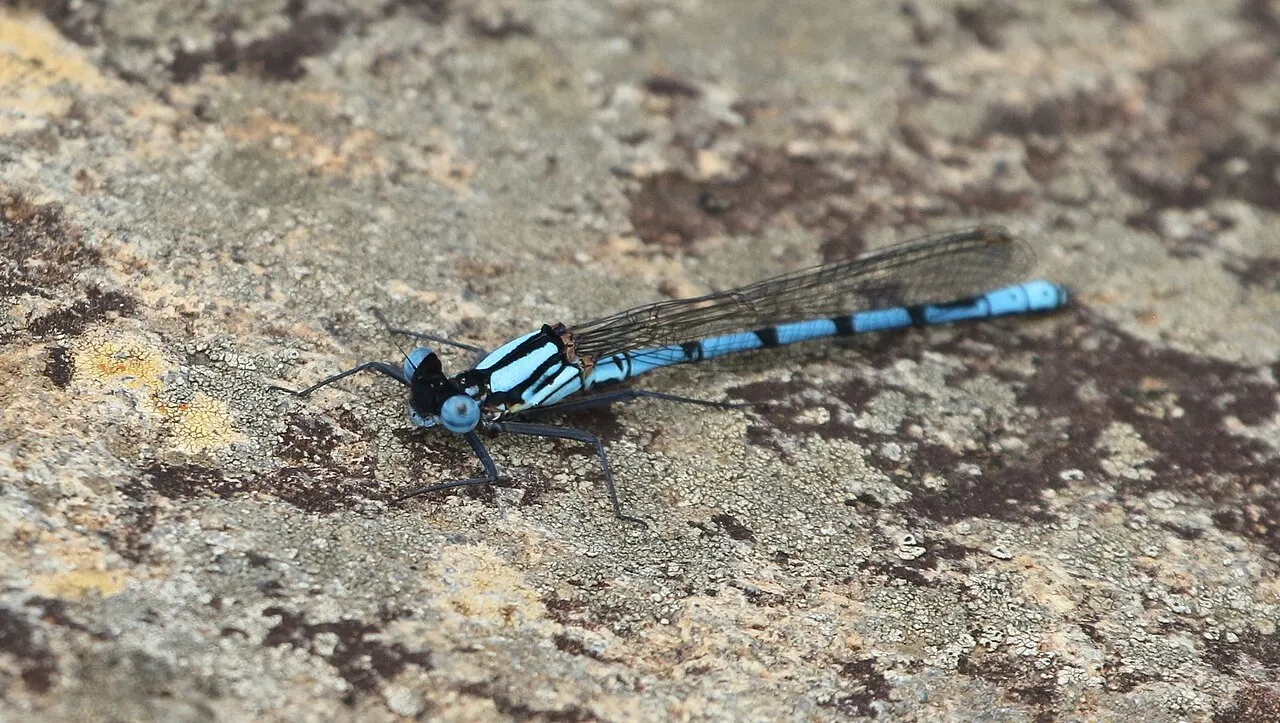
The blue riverjack (Metacnemis valida) is a medium-sized damselfly found only in South Africa, where it hunts and perches along clean, rocky rivers in the Eastern Cape. The IUCN Red List rated it Endangered in 2018, with a decreasing population. Males are a striking bright blue and black.
How to recognise it
This is a sturdy damselfly for its group, reaching about 41 mm in length with a wingspan around 56 mm. Males are bright blue marked with black bands and stripes, and they're described as distinctive and easy to identify.
Females are harder. They look much like females of the savanna riverjack (Mesocnemis singularis), but they carry a pale diagonal band on the sides of the thorax, which the savanna riverjack lacks. The two don't share a range, so confusion is unlikely in the field. The species was described by Hagen in 1863 and belongs to the family Platycnemididae, the white-legged damselflies.
Where it lives
The blue riverjack is endemic to South Africa. A regional guide places it in the Eastern Cape, with records running from near Humansdorp in the south to Bizana in the north. The IUCN assessment lists only Eastern Cape Province and South Africa among its locations.
Its habitat is permanent rivers and streams. It favours fast-flowing, rocky stretches with clean, clear, shallow water and plenty of rocks. The IUCN counts five locations, with an estimated area of occupancy of 32 square kilometres and an extent of occurrence of about 4,765 square kilometres (2018).
Pins are Wikidata “endemic to” fields. Orange dots, when present, are GBIF occurrence tiles — survey bias included.
How it lives
Adults perch on rocks at the water's edge in sunny, open spots, and now and then on overhanging or emergent plant stems. They often settle on rocks in midstream, and females are frequently seen close to males. If disturbed, a riverjack flies low and fast over the water.
The flight season runs mainly from November to March, the southern summer.
Why it is in trouble
The blue riverjack doesn't tolerate damaged rivers. The regional guide points to muddy, turbid water from soil erosion and to alien trees on riverbanks that shade the water as the main threats. The IUCN threat list also records soil erosion and sedimentation, plus effects from named species, which may refer to the alien trees.
The 2018 assessment calls the population decreasing and describes the stresses as ecosystem degradation and conversion. It does not describe the population as severely fragmented, and it gives no estimate of how many adults remain.
What is being done
No dedicated recovery programme turns up in the sources. The IUCN assessment lists habitat and natural process restoration, site and area management, and benign introduction as relevant actions.
Sources
Written for this catalog in our own words from the sources below, checked against them on 12 November 2026. Population figures are estimates and carry the year they were made. Status and assessment year: IUCN. 2026. The IUCN Red List of Threatened Species. Version 2026-1. iucnredlist.org.




