Endangered
Melanophidium khairei
Melanophidium khairei
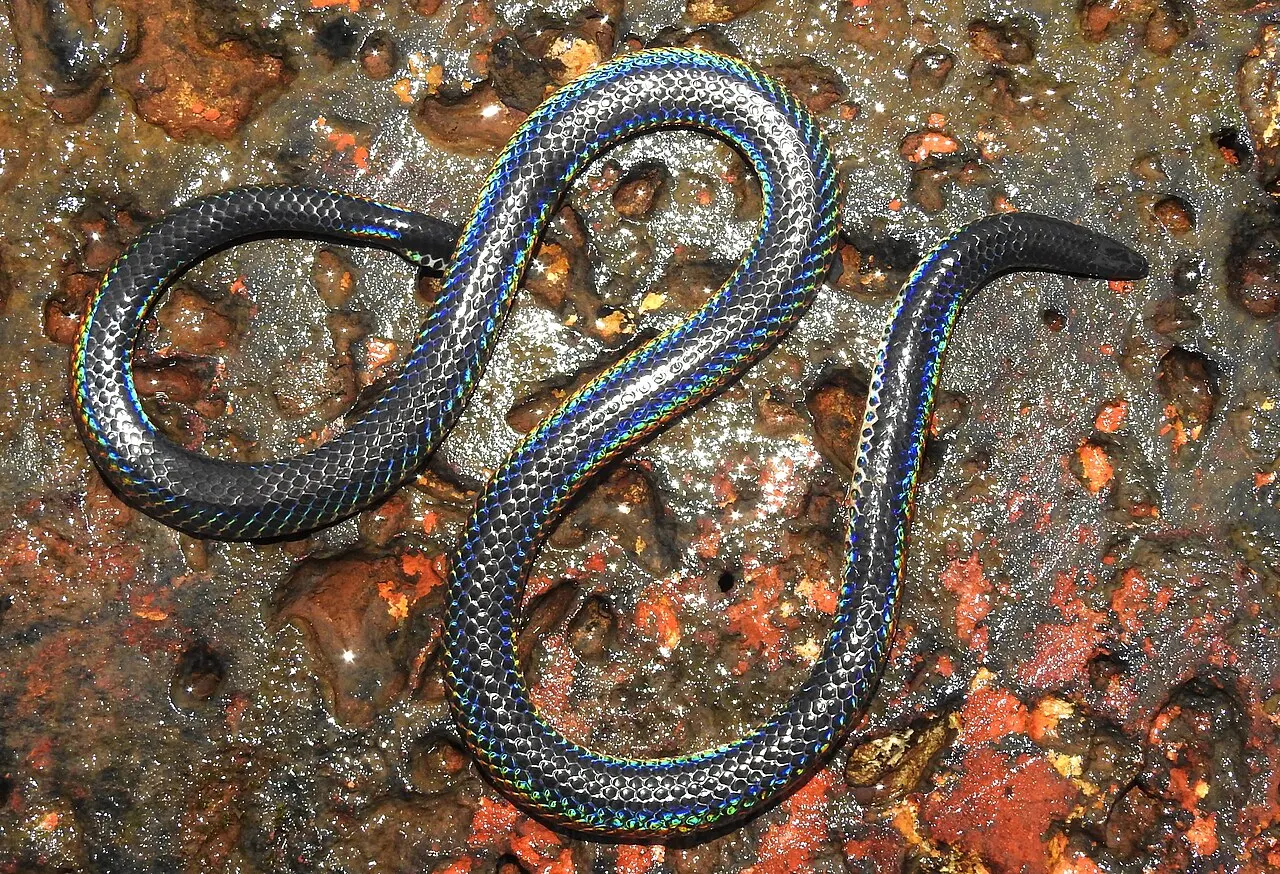
Khaire's black shieldtail (Melanophidium khairei) is a burrowing snake of the Western Ghats in India, known from southern Maharashtra, Goa and northern Karnataka. It was described only in 2016. The IUCN lists it as Endangered (assessed 2019, published 2021) because its forest habitat is fragmented and declining.
How to recognise it
Melanophidium khairei is a shieldtail, a family of small burrowing snakes (Uropeltidae) with a short, blunt tail. This one is piebald and punctate, meaning patterned in pale and dark with fine dots. That pattern led to it being mistaken for Melanophidium punctatum, though many of its scale characters are closer to another species, M. wynaudense.
Compared with M. punctatum it has fewer than 13 pairs of scales under the tail and a short, flattened terminal scute. No body size is given in the sources checked.
Discovery and naming
David Gower, Varad Giri, Ashok Captain and Mark Wilkinson described the species in a 2016 Zootaxa paper that reviewed the whole genus, using eight specimens. It was the fourth Melanophidium species and the first added to the genus in 144 years. The type locality is Amboli, in Sindhudurg district, Maharashtra, at 715 m.
The name honours Neelimkumar Khaire, director of the Katraj Snake Park in Pune, for his contributions to the knowledge and conservation of snakes.
Where it lives
It is the most northerly of its genus, which otherwise occurs in the Peermede Hills of Kerala and the Anamalai Hills of Tamil Nadu. The IUCN gives its range as Maharashtra, Goa and Karnataka, at 500 to 800 m, in subtropical or tropical moist lowland forest, with an extent of occurrence of about 3,000 km2.
A 2023 note in Reptiles & Amphibians reported it at Navanagere near Sirsi in Uttara Kannada, about 90 km south of the previous southernmost record at Verle in Goa. The snake was found on 6 July 2018 in a mixed plantation of areca nut, coffee and black pepper at 611 m. A second animal was found at Vaddi Ghat in August 2018, roughly 38 km to the west.
Pins are Wikidata “endemic to” fields. Orange dots, when present, are GBIF occurrence tiles — survey bias included.
Why it is in trouble
The IUCN rates the species Endangered because its habitat is severely fragmented and continuing to decline. Housing development and roads are the threats named, though their scale is unknown. The population trend is unknown and no population size is given. The species occurs in at least one protected area, and site protection is listed as a conservation action.
Sources
Written for this catalog in our own words from the sources below, checked against them on 12 November 2026. Population figures are estimates and carry the year they were made. Status and assessment year: IUCN. 2026. The IUCN Red List of Threatened Species. Version 2026-1. iucnredlist.org.
- IUCN Red List assessment, Melanophidium khairei (2021)
- Khaire's black shield-tail snake (encyclopedia entry)
- The Reptile Database, Melanophidium khairei
- Science News, new shieldtail species discovered in India
- Nova Taxa summary of Gower et al. 2016, Zootaxa 4085(4)
- Pai, Sharma and Gazdar (2023), Reptiles and Amphibians 30 e19115 (PDF)




