Endangered
Megalobulimus parafragilior
Megalobulimus parafragilior
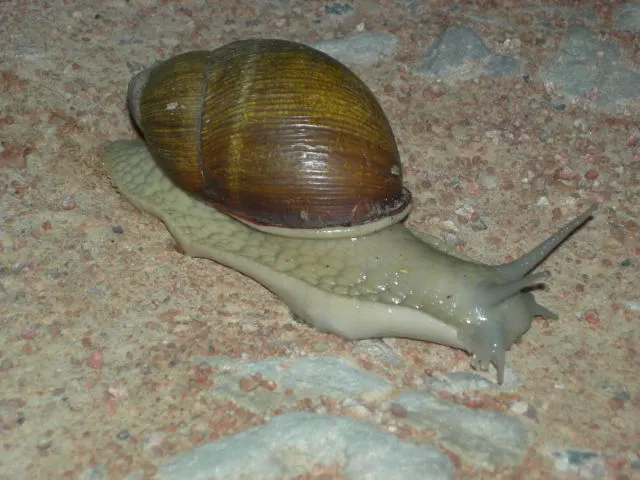
Megalobulimus parafragilior is a large land snail from the Atlantic Forest of southeastern Brazil, known mainly from the Serra do Mar in São Paulo state. It has no common name. The IUCN Red List lists it as Endangered, but that rating dates from 1996 and has never been updated.
What it is
It is an air-breathing land snail in the family Strophocheilidae, in the genus Megalobulimus, a group of big South American snails. J. L. M. Leme and L. F. Indrusiak described it in 1990. The name points to its resemblance to Megalobulimus fragilior, a species named by Hermann von Ihering in 1901.
Two specimens photographed for a Brazilian mollusc database measure about 84 and 85 mm, and the average size given there is around 80 mm.
Where it lives
The type locality is Cubatão, São Paulo, at roughly 400 m above sea level, in Atlantic Forest of the Serra do Mar. The IUCN records it as occurring only in Brazil, and it has reportedly also been found in Paraná, though the Brazilian database lists São Paulo alone. GBIF holds just five records: specimens from the south of Iguape and from Peruíbe on the São Paulo coast, a sample with no locality, and a 2026 observation from São Paulo state. That is a very thin trail for a snail of this size.
Pins are Wikidata “endemic to” fields. Orange dots, when present, are GBIF occurrence tiles — survey bias included.
How it lives
Almost nothing has been published on its own habits. A Brazilian database describes it as living in the soil, under leaf litter or partly buried, and as probably feeding on plants.
Closer relatives are better studied. A 2017 study of captive Megalobulimus paranaguensis in a park in Santos described the genus as nocturnal, with snails burying themselves in soil or leaf litter by day and during dormancy. Captive snails laid only about nine eggs each per year, and 31 percent hatched. Those figures are for another species, but they hint at why large Megalobulimus snails may recover slowly from losses.
Why it is in trouble
The 1996 IUCN assessment gives criterion D, a criterion for very small or restricted populations, and lists Brazil as the only country. Its structured data records no threats, no population trend and no conservation actions.
The 2017 study lists M. parafragilior among the Atlantic Forest Megalobulimus species whose populations have declined, and says clearance of the forest has reduced populations across the genus. It adds that many M. paranaguensis were accidentally killed in campaigns against the invasive giant African snail, a risk that may apply to other large native snails too.
Sources
Written for this catalog in our own words from the sources below, checked against them on 12 November 2026. Population figures are estimates and carry the year they were made. Status and assessment year: IUCN. 2026. The IUCN Red List of Threatened Species. Version 2026-1. iucnredlist.org.




