Endangered
Maui Alauahio
Paroreomyza montana
The Maui alauahio (Paroreomyza montana) is a small yellow Hawaiian honeycreeper that survives only on the forested slopes of Haleakala on east Maui. The IUCN Red List rated it Endangered in 2023. Numbers have fallen in recent decades, and avian malaria is pushing the birds toward higher ground.
How to recognise it
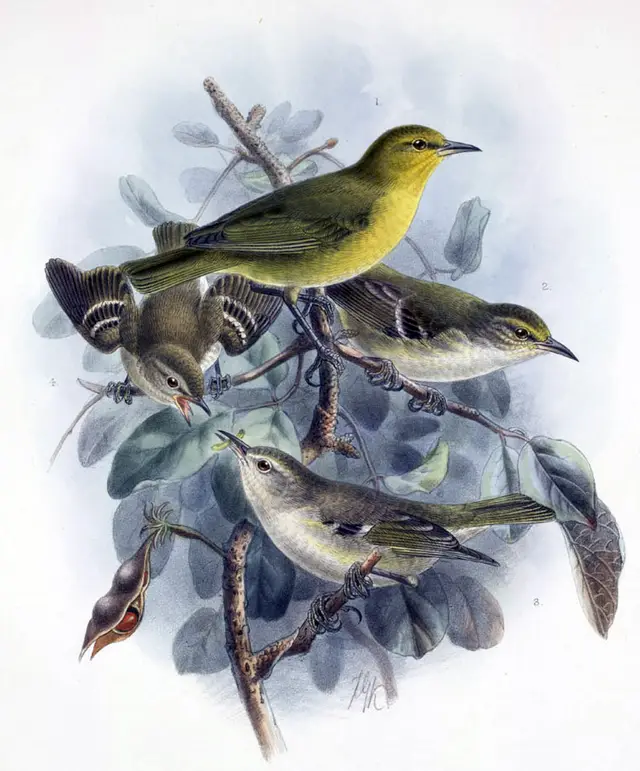
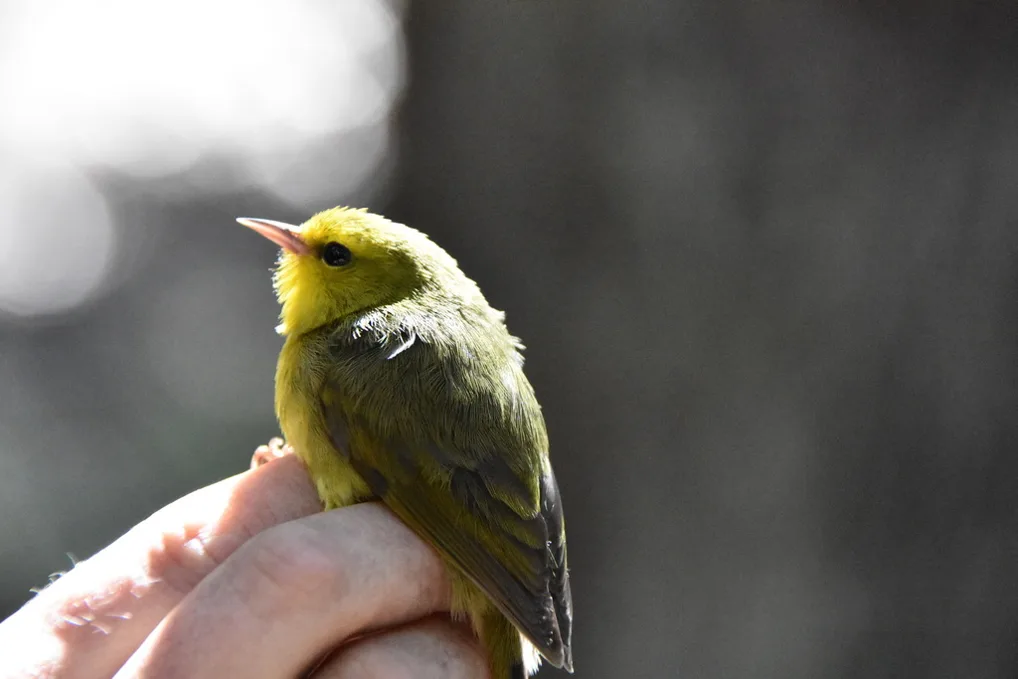
A small, active, insect-eating bird about 11 cm long. Males are bright golden yellow on the face and underparts and olive green above, and females have the same pattern in muted colours. The bill is straight and dark above. The Hawaii amakihi, a similar yellow bird, is less yellow, has a curved bill and shows more black between the eye and the bill.
The song is a lively whistled phrase or a longer warble, and the call is a sharp cheep. On Maui the alauahio often forms the nucleus of mixed flocks of forest birds.
Where it lives
The species once ranged beyond Maui. A form on Lanai, Paroreomyza montana montana, is extinct, and only the Maui form, P. m. newtoni, survives.
The surviving birds live on east Maui at about 900 to 2,500 m. The IUCN lists moist montane forest, plantations, dry forest, dry savanna and high-altitude shrubland among their habitats, and puts the area they actually occupy at about 124 square kilometres. Hosmer Grove in Haleakala National Park and Polipoli Springs State Recreation Area are the usual places to look for one.
Pins are Wikidata “endemic to” fields. Orange dots, when present, are GBIF occurrence tiles — survey bias included.
How it lives
Alauahio forage along trunks and branches, flipping over lichen and bark to find moths, beetles, spiders, leafhoppers, lacewings and small wasps. They work native trees and shrubs such as ohia, koa and pilo.
Pairs reportedly breed between March and August. Young birds can stay with their parents for up to 20 months, and the non-breeding second-year birds often help at the nest. Helpers were recorded at about 96% of pairs in native forest but only 20 to 30% in disturbed habitat. Young birds reportedly first breed in their third year.
Why it is in trouble
Surveys on Haleakala show a long slide. A 2017 survey, reported by Judge and colleagues in the Journal of Field Ornithology, covered about 91% of the range and estimated 99,060 birds (95% confidence interval 88,502 to 106,954), 41% below the highest estimate, from 1992. A 2022 forest bird survey report put the population at about 57,000 (57,123, standard error 7,715), against roughly 200,000 in the late 1990s.
The IUCN's 2023 assessment gives 60,000 to 70,000 mature individuals, which it equates roughly to the 2017 estimate of all birds. The figures differ because of survey year and because the IUCN counts only adults, but the direction is the same. The IUCN records a continuing decline in both numbers and range.
The main driver is avian malaria, spread by mosquitoes of the genus Culex. The alauahio is highly susceptible, and about 75% reportedly die after an infected bite. Mosquitoes struggle in the cold, so warming lets the disease climb the mountain, and the retreat from lower elevations fits that pattern. The IUCN's threat list also includes introduced species, habitat change, farming and grazing, and storms.
What is being done
Managers on Maui have begun tackling the mosquitoes themselves, using the incompatible insect technique and aerial application of a larvicide that targets mosquito larvae. The 2022 survey report calls such actions urgent for the island's forest birds.
The species occurs in at least one protected area, and the IUCN records a recovery plan and invasive species control as in place. No systematic monitoring scheme is recorded. Habitat restoration and reintroduction are listed as further actions the species needs.
Sources
Written for this catalog in our own words from the sources below, checked against them on 12 November 2026. Population figures are estimates and carry the year they were made. Status and assessment year: IUCN. 2026. The IUCN Red List of Threatened Species. Version 2026-1. iucnredlist.org.