Critically Endangered
Masked julie
Julidochromis transcriptus
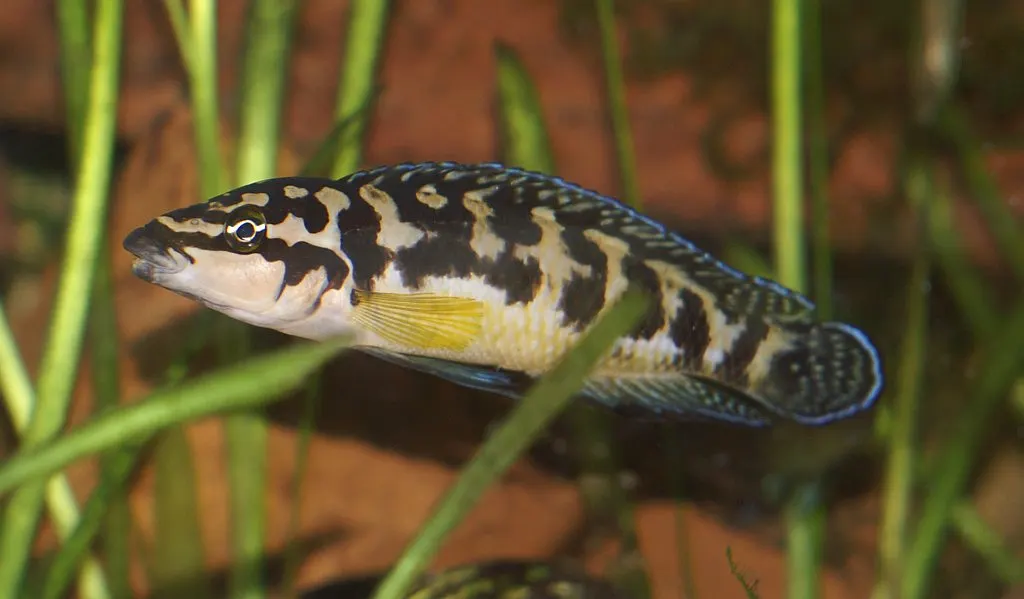
The masked julie (Julidochromis transcriptus) is a small, rock-dwelling cichlid found only along the northwestern shore of Lake Tanganyika, in the Democratic Republic of the Congo. The IUCN Red List rated it Critically Endangered in 2025, with large-scale harvest for the pet trade listed as the main threat.
How to recognise it
This is a small fish. Males reach about 7 centimetres in total length. It belongs to Julidochromis, a group of elongated, cave-using cichlids whose genus name refers to their resemblance to wrasses. The species was described by Hubert Matthes in 1959.
Names need care in the hobby. According to a Tanganyika specialist site, the trade name 'Gombe' or 'Gombi' julie comes from a misspelling of the village Kombe, and fish from different localities have been mixed under one name. Ad Konings treats the Kombe and Katoto populations as a separate form close to Julidochromis ornatus, so fish sold as masked julies are not necessarily typical ones.
Where it lives
The species is endemic to Lake Tanganyika, on the northwest shore between Luhanga and Makabola in the Democratic Republic of the Congo. The Red List counts it as known from a single location, with an area of occupancy of about 20 square kilometres and an extent of occurrence of about 37 square kilometres. Its habitat is rocky shoreline in a large permanent freshwater lake.
Pins are Wikidata “endemic to” fields. Orange dots, when present, are GBIF occurrence tiles — survey bias included.
How it lives
It lives among rocks and eats zooplankton and small invertebrates found in algae growth. FishBase describes it as usually solitary and territorial.
Fish from the closely related Kombe form, which are sold under the same name, spawn in caves every few weeks with clutches of roughly 10 to 80 eggs, and both parents guard the eggs and young. Aggression toward their own kind is high, and a pair holds its territory strongly. Whether the same holds for the Luhanga to Makabola fish is not documented.
Why it is in trouble
The 2025 assessment lists large-scale harvest as the main threat. It affects essentially the whole population, with very rapid declines, and the recorded use is pets and display animals, traded nationally and internationally. Soil erosion and sediment washing into the lake is a smaller threat, affecting a minority of the population. The population is recorded as decreasing.
An earlier assessment, in 2006, rated the species Least Concern.
What is being done
The assessment records a harvest management plan as in place, though the species is not known from any protected area. Recommended actions include site and area management and protection, policies and regulations, and alternative livelihoods linked to the fishery. Listed research needs include population, harvest and trade trends.
Sources
Written for this catalog in our own words from the sources below, checked against them on 12 November 2026. Population figures are estimates and carry the year they were made. Status and assessment year: IUCN. 2026. The IUCN Red List of Threatened Species. Version 2026-1. iucnredlist.org.




