Endangered
Maroon-fronted Parrot
Rhynchopsitta terrisi
The maroon-fronted parrot (Rhynchopsitta terrisi) is a large, macaw-like green parrot that lives only in the pine forests of the Sierra Madre Oriental in northeastern Mexico. The IUCN Red List rated it Endangered in 2020. It nests in colonies on tall limestone cliffs.
How to recognise it
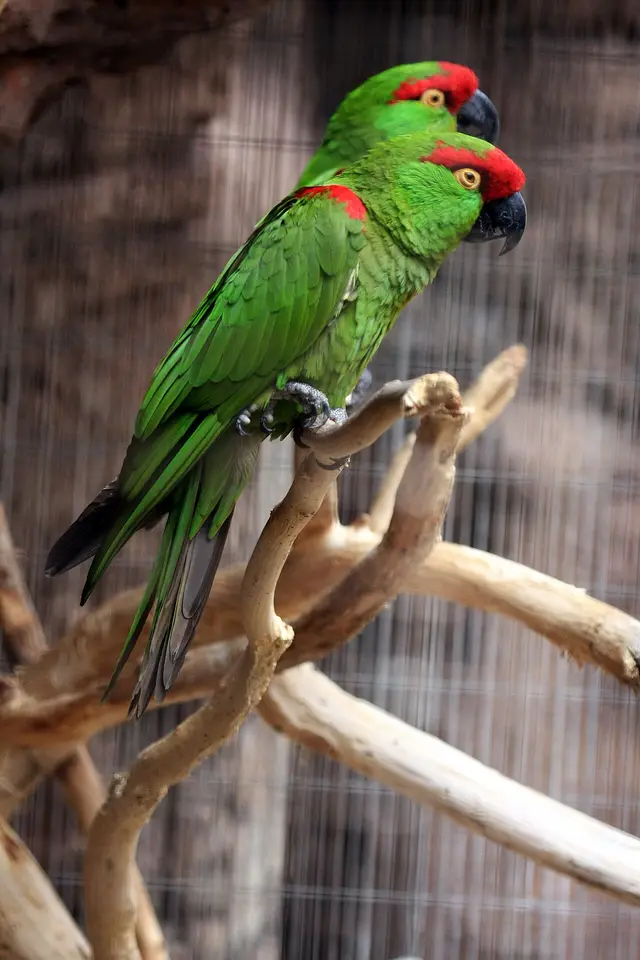
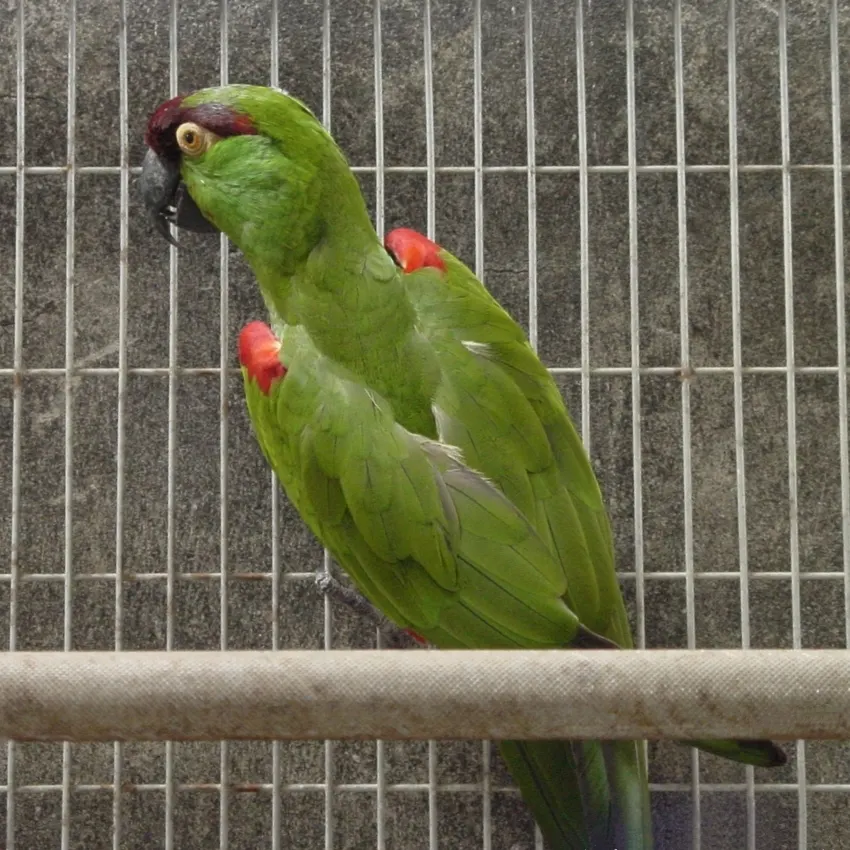
It is a heavy-billed, dark green parrot about 40 to 45 cm long and weighing roughly 390 to 470 g. Adults have a maroon forehead and eye stripe, dark red patches at the shoulders and thighs, and a yellow ring around the eye. The tail is long and pointed, and the underside of the wings and tail looks blackish in flight. Young birds have a pale bill and lack the maroon brow, red shoulder patch and yellow eye ring.
Two relatives look similar. The military macaw is larger, with a longer tail and blue in the wing and rump. The thick-billed parrot is smaller and shows yellow under the wing. The call is a high, rolling cr-a ak, and a distant flock can be mistaken for acorn woodpeckers.
Where it lives
The species is endemic to Mexico. It occupies a stretch of the northern Sierra Madre Oriental about 300 km long, across parts of Coahuila, Nuevo León and Tamaulipas. It favours mature pine, fir and oak forest in the high mountains. The IUCN gives an elevation band of 2,000 to 3,500 m, while another source gives 1,300 to 3,700 m. The Red List puts its extent of occurrence at about 1,900 square kilometres.
It is not a long-distance migrant, but flocks make long daily flights, reportedly up to 40 km, between roosts and feeding areas.
Pins are Wikidata “endemic to” fields. Orange dots, when present, are GBIF occurrence tiles — survey bias included.
How it lives
Pine seeds make up most of its diet, with some acorns, fir seeds, and the flowers and fruit of agave. Breeding follows the pine crop. Pairs arrive at the nesting cliffs around April and May, eggs are laid in early July, and the young leave the nest around October and November. Nests sit in cavities and crevices high in limestone cliffs, usually near running water, and many pairs share a cliff.
A pair raises two chicks on average, with a range of one to four. Studies by R. Valdés-Peña and colleagues in 2007 and 2010 suggested that fewer than 10 percent of the population breeds successfully in any one year.
Why it is in trouble
Numbers are small and falling. The 2020 assessment puts the population at 1,000 to 2,499 mature birds, all in a single subpopulation, while an older figure quoted for the species is 2,500 to 3,000 birds in total. The IUCN estimates a past population reduction of 30 to 49 percent, and the decline is continuing.
The main causes listed are loss of mature conifer forest to grazing, small-scale farming, logging and fire, and drought, which feeds the fires and dries up water. Some birds are taken for the pet trade, though the IUCN rates that as a smaller part of the problem.
What is being done
International trade is restricted under CITES Appendix I. The IUCN notes that a recovery plan exists, that important sites have been identified across the range, and that the species occurs in at least one protected area. Captive breeding, habitat restoration, site management, awareness work and livelihood alternatives are also listed.
A cliff-camera project backed by Loro Parque Fundacion and completed in 2016 recorded nest success at individual cliffs and ran school workshops across the breeding area. A university programme at the Monterrey campus of ITESM also runs education and research in the Cumbres de Monterrey National Park and the Sierra de Arteaga.
Sources
Written for this catalog in our own words from the sources below, checked against them on 12 November 2026. Population figures are estimates and carry the year they were made. Status and assessment year: IUCN. 2026. The IUCN Red List of Threatened Species. Version 2026-1. iucnredlist.org.