Endangered
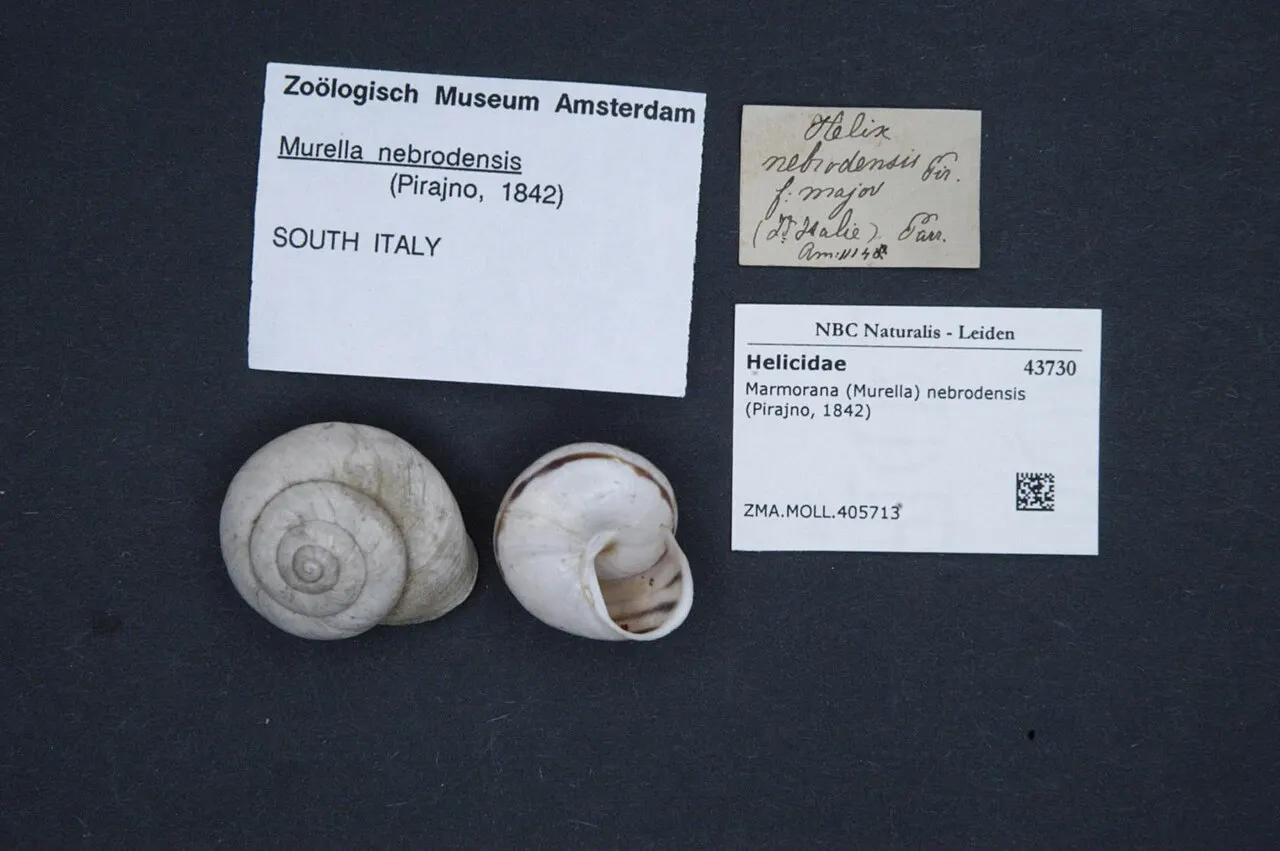
Marmorana nebrodensis
Marmorana nebrodensis
Marmorana nebrodensis is a land snail from the Italian island of Sicily. The IUCN Red List rated it Endangered in 2025 because it lives in a very small area, roughly 20 square kilometres across five locations, where its rocky habitat is under pressure from roads, quarrying and recreation.
What kind of snail it is
It belongs to the Helicidae, the family of familiar garden-type land snails, and to the genus Marmorana, named by Hartmann in 1844. The species was first described as Helix nebrodensis by Pirajno in 1842. A 2010 molecular study of Tyrrhenian land snails found that Marmorana is not a single natural group (it is paraphyletic), so the classification of Sicilian species is still being sorted out.
Species in the genus make and use love darts during mating. Almost nothing else has been published about this snail's own biology, so its habits are best treated as unknown.
Where it lives
The species is native to Sicily and is recorded nowhere else. The Red List gives its extent of occurrence as about 500 square kilometres, and the area it actually occupies as about 20 square kilometres. It is counted from five locations. The listed habitat is rocky ground, such as inland cliffs and mountain tops.
The global biodiversity database GBIF holds only about 70 occurrence records for it, which shows how thinly documented the species is.
Pins are Wikidata “endemic to” fields. Orange dots, when present, are GBIF occurrence tiles — survey bias included.
Why it is in trouble
The assessors list three ongoing pressures: roads and railways, recreational activities, and mining and quarrying. For all three, the size and severity of the effect are recorded as unknown. All three act on rocky ground, the only kind of habitat recorded for the species.
The area the snail occupies is judged to be shrinking. Whether the population is falling, or split into isolated pieces, is listed as unknown, and no population size has been recorded. The assessment also leaves open whether any of its sites sit inside a protected area.
What is being done
The assessment lists site protection and awareness work as the conservation actions that apply. It records that the species is not covered by international legislation or by any international trade controls. With so little known about numbers, surveys of the five sites would be the obvious next step.
Sources
Written for this catalog in our own words from the sources below, checked against them on 12 November 2026. Population figures are estimates and carry the year they were made. Status and assessment year: IUCN. 2026. The IUCN Red List of Threatened Species. Version 2026-1. iucnredlist.org.




