Endangered
Malagasy Harrier
Circus macrosceles
The Malagasy harrier (Circus macrosceles) is a long-winged marsh hawk that hunts low over wetlands and grassland in Madagascar and the Comoro Islands. The IUCN Red List rated it Endangered in 2025, with only 100 to 499 mature birds and a falling population. Loss of marshes and fire are the main pressures.
How to recognise it
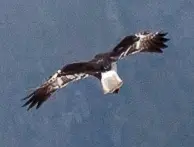
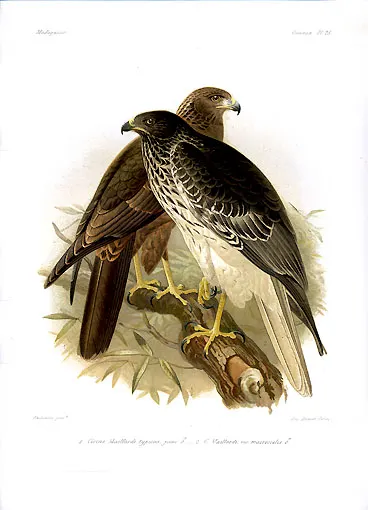
It is a big, slim harrier, 42 to 55 cm long and 600 to 910 g, with long narrow wings and bright yellow eyes. Females can be up to 13 percent larger than males. Males have a blackish back and forewings, a greyer head with dark streaks, grey bars on the tail and secondaries, and whitish underparts and rump. Females are browner overall.
It flies low and gracefully, with its wings held in a shallow V.
Where it lives
On Madagascar it occurs across most of the island except the south, in marshes, grassland and savanna, from sea level up to about 1,800 m (the IUCN gives 2,000 m). A 2005 to 2006 countrywide survey logged about 56 percent of birds in marshes and 42 percent in savannas and grasslands. About 1 percent were over rice fields.
It also lives on the Comoro Islands, where it is more often found in drier and forested habitats. The IUCN lists it as possibly extinct on Mayotte. The species was long treated as a subspecies of the Reunion harrier (Circus maillardi), but the IUCN assesses it as a species in its own right.
Pins are Wikidata “endemic to” fields. Orange dots, when present, are GBIF occurrence tiles — survey bias included.
How it lives
It takes small vertebrates, including birds such as the Madagascar partridge, rodents, frogs, reptiles and chameleons, along with many insects. It hunts by cruising low over the ground and dropping onto prey. Pairs perform spiralling courtship flights and pass food between them.
The nest is a platform of grass and stems on the ground, usually in a marsh, or low in a bush. The female lays 3 to 5 white eggs and incubates them for about 32 to 34 days. The young fledge at about 42 to 45 days.
Why it is in trouble
The 2025 assessment estimates 100 to 499 mature individuals and a decreasing population. A 2009 survey in Bird Conservation International covered 68 percent of Madagascar's districts, recorded only 80 harriers over 16 months and estimated roughly 200 to 500 birds worldwide, including 50 to 250 in the Comoros.
About 69 percent of the birds seen were in marshes and grasslands above 1,100 m, and the survey found that natural marshes at lower elevations had largely been turned into rice fields. Uncontrolled fires destroyed seven nests at Ambohitantely Special Reserve in 2005.
People also take a toll. Chicks are collected for food and adults are killed, partly because harriers are seen as a threat to poultry. The IUCN scores small-holder farming, intentional use of the species, and mining and quarrying as ongoing threats, and lists the bird as used for human food.
What is being done
The harrier occurs in at least one protected area, and key sites have been identified across its range. The Peregrine Fund says it helped create three National Protected Areas in 2015, which added 190,000 hectares of protected habitat. The IUCN records no species recovery plan and no systematic monitoring scheme.
The IUCN lists site and habitat protection, site management and awareness work as the actions needed, and calls for research on population size, distribution and trends and on life history. The 2009 survey described protecting the remaining natural marshes as critical to the survival of the species.
Sources
Written for this catalog in our own words from the sources below, checked against them on 12 November 2026. Population figures are estimates and carry the year they were made. Status and assessment year: IUCN. 2026. The IUCN Red List of Threatened Species. Version 2026-1. iucnredlist.org.