Endangered
Madagasikara madagascariensis
Madagasikara madagascarensis
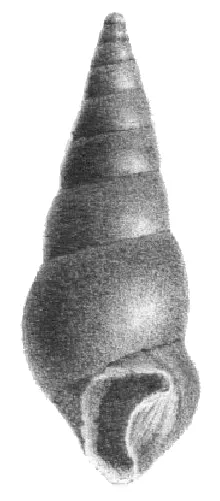
Madagasikara madagascariensis is a freshwater river snail found only in Madagascar. It breathes through a gill and closes its shell with an operculum, like other members of the family Pachychilidae. The IUCN Red List rated it Endangered in 2016, citing a small range of three to five locations, and its population trend is unknown.
What kind of snail it is
The species was described by Grateloup in 1840 under the name Melania madagascariensis. It was later placed in Melanatria. In 2010 Frank Köhler and Matthias Glaubrecht studied shells, radulae, stomach anatomy and a mitochondrial gene, and created a new genus for Madagascar's endemic river snails. They called it Madagasikara, the Malagasy word for Madagascar.
The 2010 study described three new species. Counts of the genus differ, with five species in the paper's abstract and six in later accounts. At least one species gives birth to live young, although the others in the group lay eggs. Spelling varies too: the IUCN and GBIF use madagascarensis, while other sources, following the 1840 original, use madagascariensis.
Where it lives
The snail is endemic to Madagascar. The IUCN assessment lists permanent rivers and streams as its habitat and counts three to five locations, with an estimated extent of occurrence of about 3,500 square kilometres. The wider genus is associated with fast-flowing streams.
Museum records help a little with place. GBIF holds seven preserved specimens, none with a collection date. Five name Nosy Be, an island off Madagascar, and two give no locality. Those are old shells and say little about where living populations are today.
Pins are Wikidata “endemic to” fields. Orange dots, when present, are GBIF occurrence tiles — survey bias included.
A short history of the group
Köhler and Glaubrecht's molecular clock suggests the family Pachychilidae is no more than 50 million years old, and that the Madagascan lineage arose between 15.6 and 31.5 million years ago. They concluded that the island's radiation of river snails is no older than 3 to 5 million years. Their results pointed to dispersal overseas rather than an ancient Gondwanan origin.
Why it is in trouble
The Endangered listing (criteria B1ab(iii)) rests on a small range, few locations and ongoing habitat degradation. The assessment records soil erosion and sedimentation, tourism and recreation areas, and two other threats of unrecorded type. Each affects a minority of the population or has an unknown extent, and none has a measured impact.
No population size is known, and the population trend is listed as unknown. The assessment recommends protecting the species' habitat. It could not say whether the snail lives in a protected area, and it names research on population size, distribution and trends as the main need.
Sources
Written for this catalog in our own words from the sources below, checked against them on 12 November 2026. Population figures are estimates and carry the year they were made. Status and assessment year: IUCN. 2026. The IUCN Red List of Threatened Species. Version 2026-1. iucnredlist.org.




