Endangered
Pulitzer's longbill
Macrosphenus pulitzeri
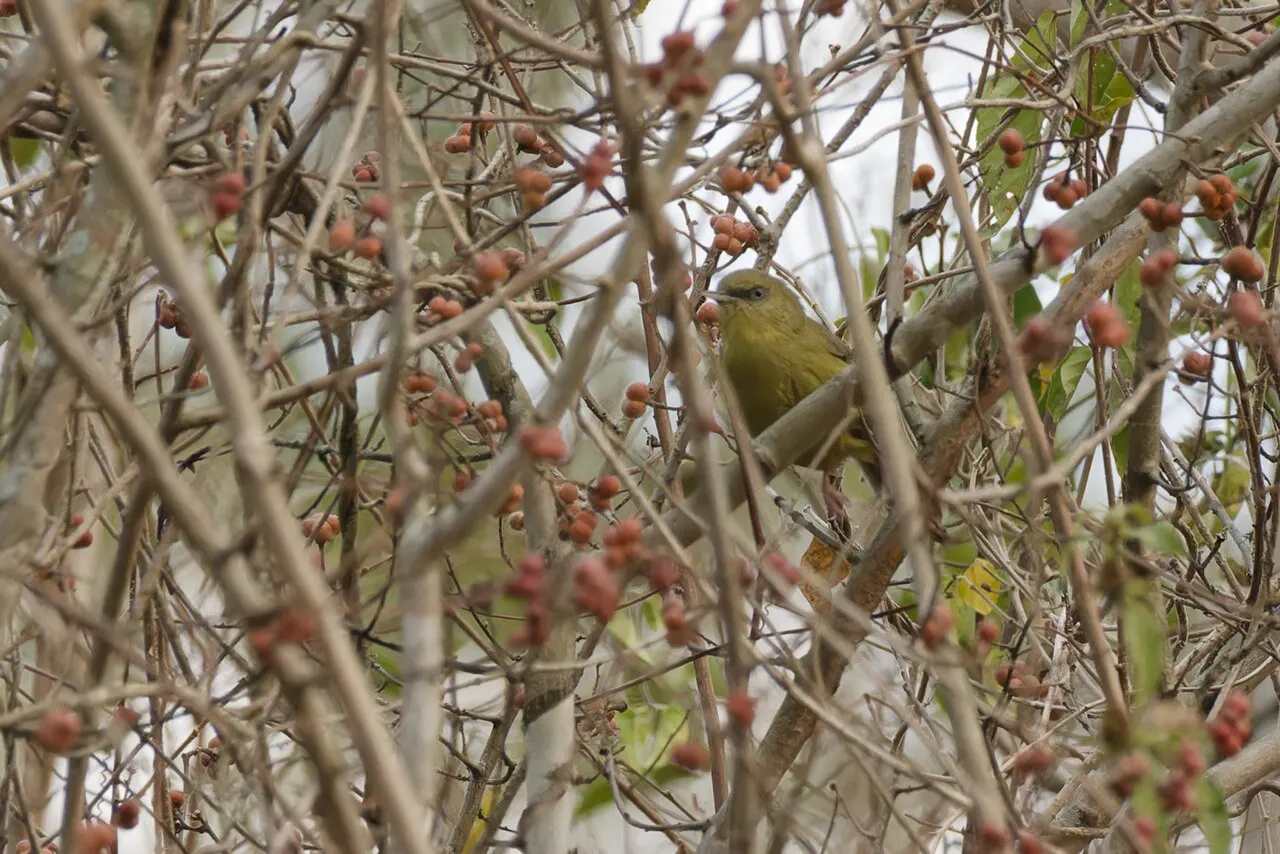
Pulitzer's longbill (Macrosphenus pulitzeri) is a small, secretive songbird found only in Angola, in dry forest along the western escarpment. The IUCN Red List rated it Endangered in 2022, with an estimated 1,000 to 2,499 mature birds and a population that is still shrinking.
What it is
Wolfrid Rudyerd Boulton described Pulitzer's longbill in 1931. It was once grouped with the Old World warblers, but is now placed in the Macrosphenidae, a small family of African warblers. It is a plain bird about 13 centimetres long, with a short tail and thin bill, dull olive-brown overall and paler on the belly. It keeps to dense foliage, which makes it very hard to see.
The voice is the easier clue: a slow run of thin, high notes with something of a sparrow's chirp in them.
Where it lives
The species is found nowhere outside Angola. It lives in dry forest on the Central Escarpment in the west, at roughly 800 to 1,030 metres above sea level. A 2014 paper in Oryx put the strip of escarpment holding this bird and Monteiro's bushshrike at about 370 to 400 kilometres long and only 10 to 20 kilometres wide. It described the longbill as common in drier forests and possibly rare in the more humid ones, though no analysis of habitat choice was run.
Kumbira Forest, a site the same paper calls the best representative area of the escarpment, was surveyed in 2010. The longbill was recorded at 11 of 203 survey points (5 percent), almost all in the upper reaches of the valley. It is not a migrant. The Red List assessment treats all the birds as one subpopulation of 1,000 to 2,499 mature individuals.
Pins are Wikidata “endemic to” fields. Orange dots, when present, are GBIF occurrence tiles — survey bias included.
Why it is in trouble
The main pressure is small-scale farming, which clears and degrades the dry forest the birds need. The assessment estimates a population reduction of 10 to 19 percent in the past, at present and projected, all driven by habitat decline.
At Kumbira, the Oryx paper found that overall forest cover was maintained between 1989 and 2010, but old-growth forest was replaced by younger secondary growth in many areas. It also describes slash-and-burn agriculture as a widespread threat to forest across the region.
What is being done
Conservation sites have been identified over the species' whole range, but it is not recorded from any protected area. The assessment reports no recovery plan, no systematic monitoring scheme and no captive population.
Sources
Written for this catalog in our own words from the sources below, checked against them on 12 November 2026. Population figures are estimates and carry the year they were made. Status and assessment year: IUCN. 2026. The IUCN Red List of Threatened Species. Version 2026-1. iucnredlist.org.




