Endangered
Maccoa Duck
Oxyura maccoa
The Maccoa duck (Oxyura maccoa) is a stiff-tailed diving duck of eastern and southern Africa. The IUCN raised it from Vulnerable to Endangered in 2021, after counts showed steep falls in all three of its populations. Breeding males have a bright blue bill, a black head and a chestnut body.
How to recognise it
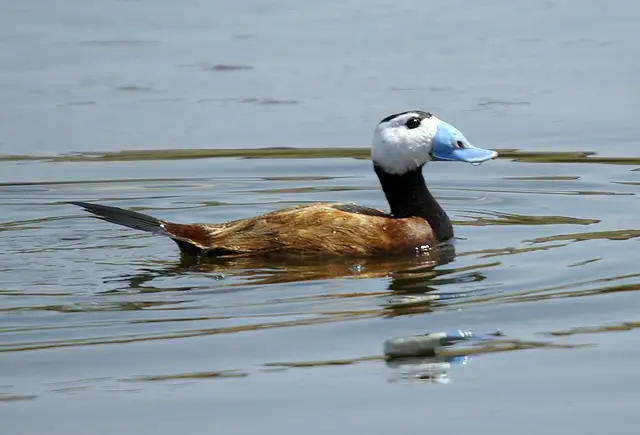
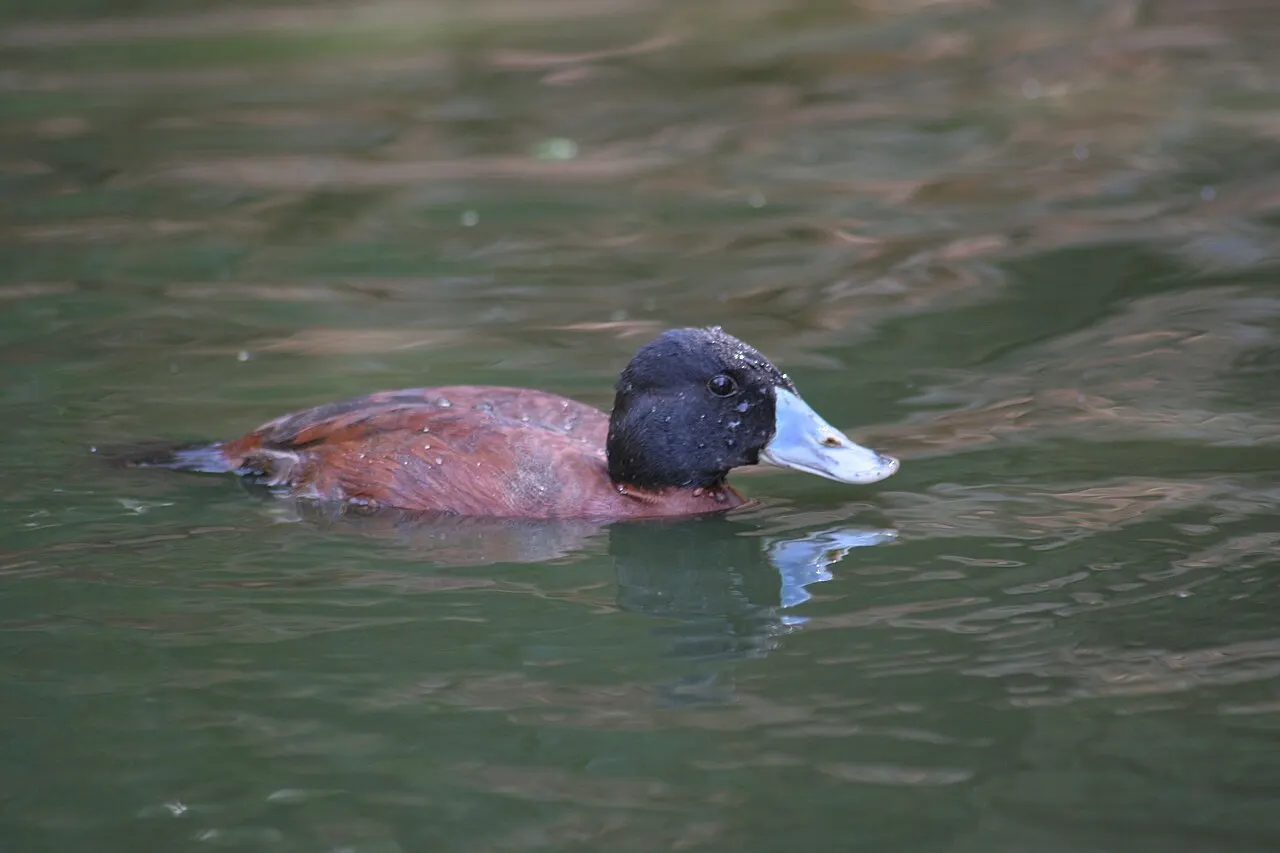
A breeding male is hard to mistake. It has a bright blue bill, a black head reaching the throat, a chestnut breast and back, and a short, stiff black tail that is often held cocked upward. The Red List gives its length as 46 to 51 centimetres.
Females and non-breeding males are plainer brown. Females have a pale throat and a pale stripe below the eye across the cheek. Like other diving ducks the Maccoa sits with its legs far back on the body, which makes it awkward walking out of the water.
Where it lives
The Red List counts the Maccoa duck as native in 13 countries: Kenya, Uganda, Tanzania, Ethiopia, Eritrea and Rwanda in the east, and Angola, the Democratic Republic of the Congo, Namibia, Botswana, Zimbabwe, South Africa and Lesotho further south. Vagrants have been recorded in Burundi, Malawi and Eswatini. It does not migrate, but groups gather and disperse between wetlands.
It uses freshwater lakes and pools, marshes, brackish and saline wetlands, farm dams and sewage works, from sea level up to about 3,000 metres. For breeding it needs open water with emergent reeds such as bulrush. The birds are patchily spread. A 2012 estimate put about half of the world's Maccoa ducks in South Africa, and large groups have been found on dams in Namibia.
Pins are Wikidata “endemic to” fields. Orange dots, when present, are GBIF occurrence tiles — survey bias included.
How it lives
It dives for 15 to 22 seconds at a time, taking mostly bottom-living invertebrates such as fly larvae, worms and snails, plus some seeds and roots. Males are polygynous, defend territories, and take no part in nesting.
The female builds a nest in emergent vegetation or takes over an old coot or grebe nest. Clutches are typically five or six eggs, though sources give ranges from 2 to 9, and where several females lay in one nest it can hold 12 or more. Incubation takes 25 to 27 days. Reports of the breeding season differ, from January to May in one account to August to January in another, and one says it can breed year-round.
Why it is in trouble
The Red List put the population at 4,800 to 5,700 mature birds in 2021 and records it as still falling. African-Eurasian Waterbird Census counts between 2002 and 2018 showed the southern African population down by 52 percent and the eastern African population down by 99 percent. A 2012 estimate of about 11,000 birds was made on a different basis and is not directly comparable.
Wetland drainage for farming, small-scale farming around wetlands and drowning in fishing gill nets are the main pressures listed. Because the duck feeds on bottom-living invertebrates, pollutants may build up in it more than in other ducks. Drying wetlands from climate change are projected to cost it habitat, most sharply in Namibia, Botswana and Zimbabwe.
What is being done
An international single species action plan was adopted under the African-Eurasian Waterbird Agreement around 2006 or 2007 (sources differ), but much of it, including stopping wetland loss at key sites and cutting gill net use, is still waiting to be carried out. The Red List records that the duck occurs in protected areas, that conservation sites have been identified across its range, and that it is monitored. It is not in captive breeding and has not been reintroduced anywhere.
Sources
Written for this catalog in our own words from the sources below, checked against them on 12 November 2026. Population figures are estimates and carry the year they were made. Status and assessment year: IUCN. 2026. The IUCN Red List of Threatened Species. Version 2026-1. iucnredlist.org.